A Complete Beginner's Guide to Playing Pokémon TCG Live
How to set up and play a game of Pokémon TCG Live

The Pokémon trading card game (TCG) has been around since the mid-90s, and though it's changed quite a bit over the years, the basic idea is the same: you and another player battle head-t0-head to see who's the stronger trainer. Nowadays, we've got access to a worldwide community of players thanks to Pokémon TCG Live, a free app run by The Pokémon Company that lets you build decks and battle digitally. It is, in my opinion, the best way to get into the TCG right now, so let me walk you through what a game looks like!
Setting Up the App
To begin, download the app onto either your phone, tablet, or PC. You're then going to need to make an account with Pokémon TCG Live. You'll use an email and password to create it, then select a username that will display in the game. You'll also be able to customize an avatar to represent you, including choosing an outfit, an intro phrase, and a victory phrase. Once you've done that, you'll complete a short tutorial. It's very in-depth, but if you need a reminder or a cheat sheet during your match, you can keep this article open on the side.
Setting Up the Game
Before you join a game, you need to select your deck. While I'll go over deck building in its entirety in another piece, right now, I'll suggest that for your first few times playing, you try out one of the pre-made decks the game provides. It's also a good idea to go through the extra tutorials in the "Learn" tab if you want to understand the game a bit better and learn how to navigate some of the more popular decks.
Once you're ready to play against real people, you can join a match by clicking "Play" in the main menu. The game will randomly match you with another player, and you'll get the intro splash screen where you can see each other's introduction phrases and avatars. I find this endearing - a bit like we've become the NPCs in a Pokémon game that challenge you to a battle!
Before anyone moves any cards at all, you have to decide who goes first. To do this, you have to flip a coin. The winner of the coin flip gets to decide whether they want to go first or second - and this can definitely matter depending on the deck you build. (Interesting note: for in-person games, players often use a 6-sided die for their "coin," calling even numbers heads and odds tails).
Once the first player is decided, you'll draw a hand of seven cards. From this hand, you'll place your basic Pokémon onto the board - one in the active spot, and any others on your bench if you'd like to put them there. Once you've placed your basics, you'll deal out your six prize cards to the left-hand side of your board.
If you don't have any basic Pokémon in your hand, you'll take a Mulligan; you reshuffle your hand into your deck and draw again, and your opponent gets to draw another card. You'll do this until both players have basics in their active spot.
Once both players have their active spot filled and prize cards placed, you'll flip your Pokémon over and start the game.
Taking a Turn
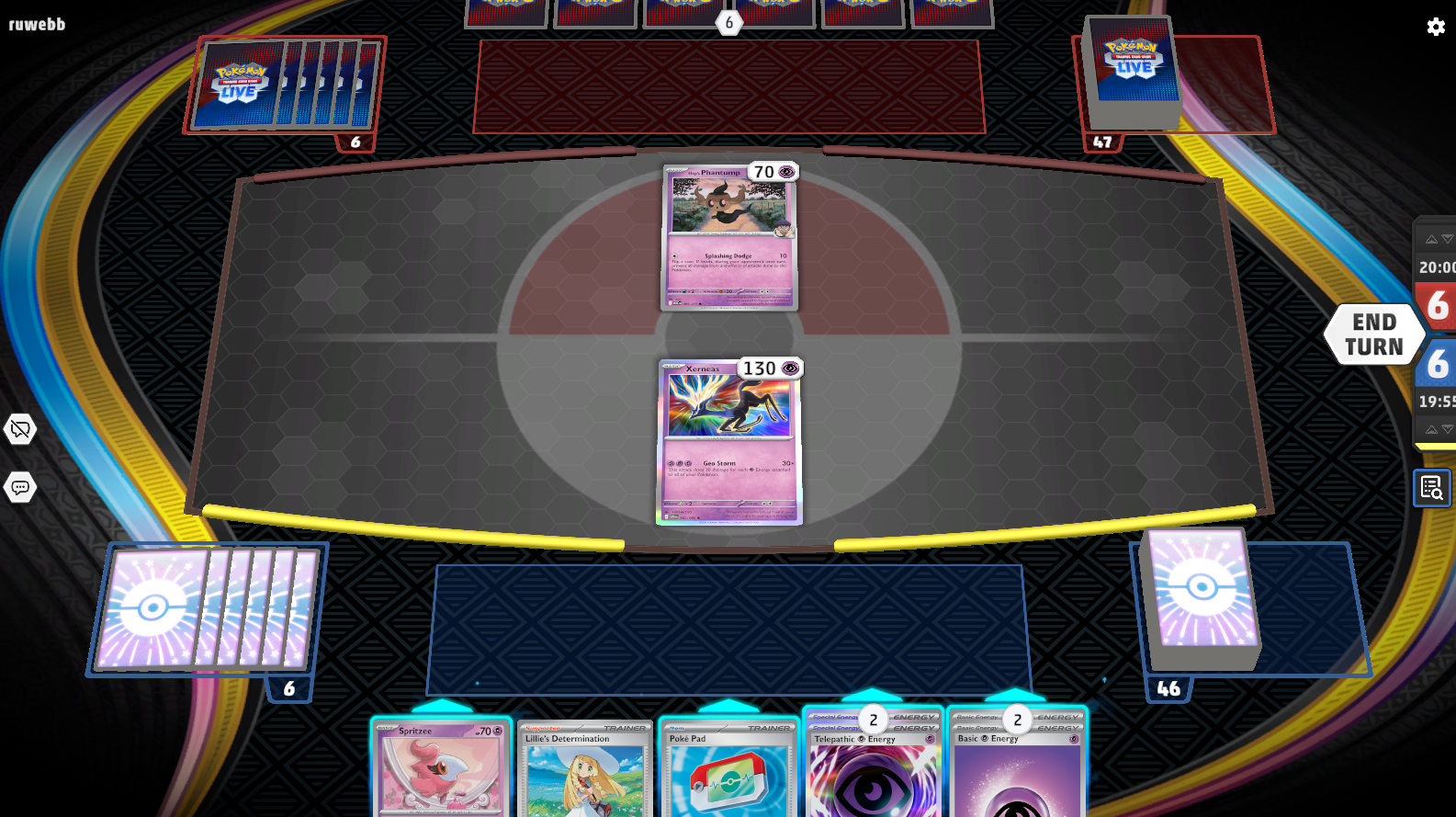
Your turn will always begin with drawing a card, and with the light indicator (the yellow band that goes across your active spot) lighting up on your side of the board. When this happens, your timer will start; each player has 20 minutes for the round.
Remember that if you take too long, the game will time you out, and your opponent will win. You'll get a warning before this happens, and you're fine to take your time as long as you're taking actions.
A Quick Overview of the Pokémon Play Board
In PTCGL, your board will look consistent each time you play, which is convenient.
On your side of the board, starting on the left, you've got your six prize cards lined up face down. Next, you've got your active Pokémon in the top center and your benched Pokémon in the box in the middle of the screen. Below that, you've got your hand of cards, which is only visible to you - your opponent can only see the number of cards you have. Finally, on the right side of the screen, you've got your deck and your discard pile. Your opponent's board will look exactly the same.
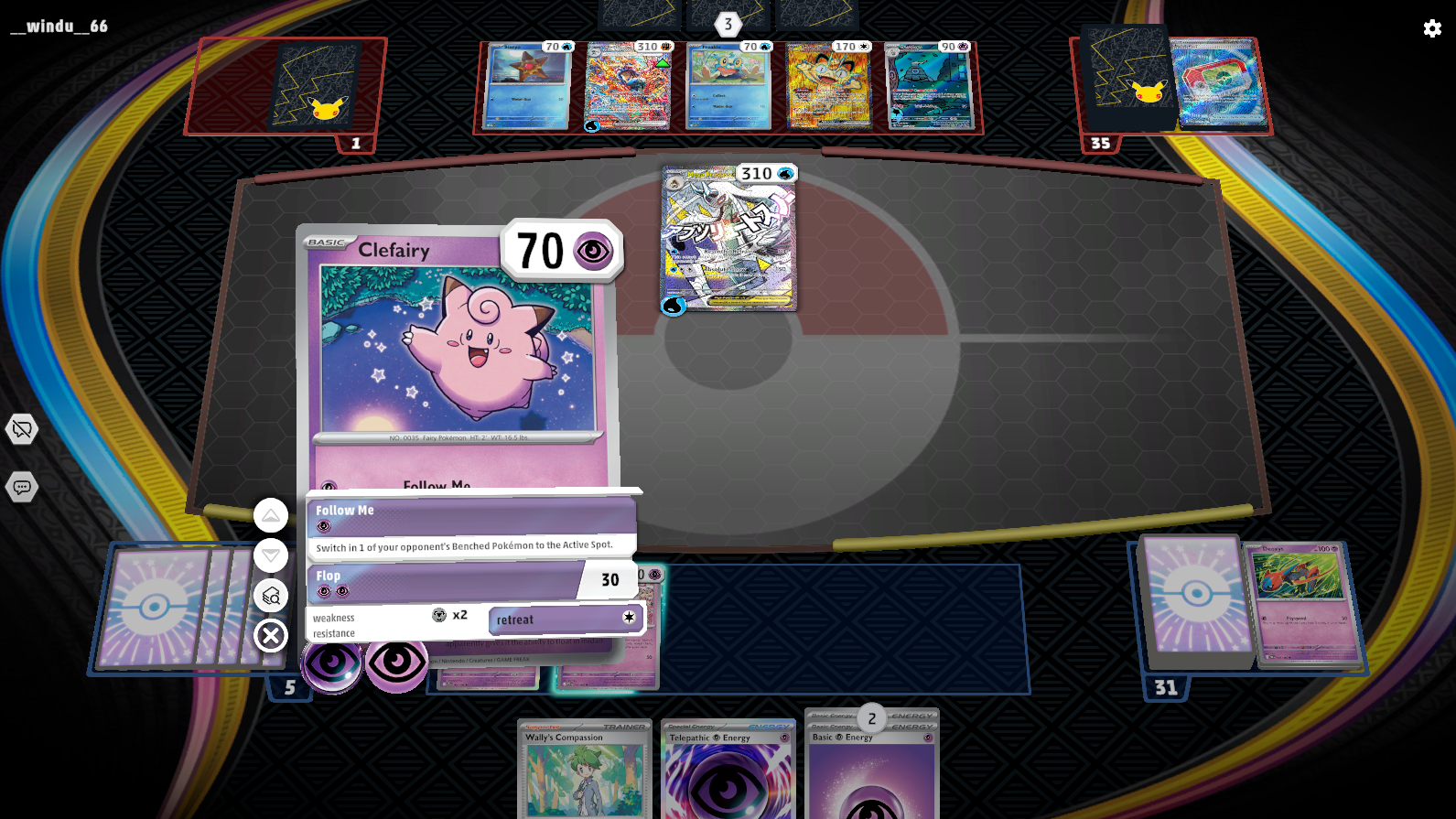
You can click on or hover over your and your opponent's cards to read them during the game. You can also click on either discard pile to see what's in it. When you're playing, the cards that you can play will be highlighted in your hand; any Pokémon in play that can take any action (retreat, attack, use an ability, etc.) will also be highlighted, as will the stadium if it's applicable.
To play a card from your hand:
- On mobile, drag and drop the card to its appropriate position on the board (Pokémon to the bench or the active spot, energy to the Pokémon you want to attach to, trainer cards to the blank space between active Pokémon)
- On PC, click to select the card and then click its appropriate position. You can also drag and drop your cards if you want to.
Actions You Can Take
There is a range of actions you can take during your turn. Some of these actions have restrictions on how many times you can use them; typically, you can do each action one time, with some minor exceptions.
The actions you can take are:
- Playing a Pokémon to your bench (as many as you like, up to 5 total benched Pokémon)
- Evolving your Pokémon (you can evolve each Pokémon once per turn, and not on the turn they were played onto the board)
- Retreating your Pokémon and promoting a benched Pokémon to the active spot
- Attaching an energy card to your Pokémon (once per turn)
- Playing a trainer card (you can play as many items, stadiums, and Pokémon tools as you like, but only one supporter per turn)
- Using the stadium in play (once per turn)
- Using Pokémon abilities (once per Pokémon per turn)
- Attacking your opponent's Pokémon
Keep in mind that occasionally, a card will affect these actions and make them either impossible or more frequent. For example, Budew has an attack called Itchy Pollen, which makes it so your opponent can't use any item cards on their turn. There's also a stadium that allows you to have more Pokémon on your bench if you have a Tera Pokémon (a specialized form of EX Pokémon) in play. These cards must be countered to remove their effects, such as knocking out Budew or replacing the stadium with your own.
Your First Turn
Your first turn will look a little bit different from the rest of your turns. To start with, if you go first, you can't play a supporter card. Whether you go first or second, you can't attack on your first turn, nor can you evolve your Pokémon. There are some cards with specific text that negate or change these rules, so be sure to read your cards carefully.
Action Order
There are a couple of rules to remember when you're playing your cards.
Firstly, triggering an attack from your active Pokémon will end your turn automatically, so make sure you've done everything you wanted to before you attack. You can also end your turn without attacking by clicking the "End Turn" button on the right side of the screen - this will open a pop-up for confirmation if there are other actions you can still take, so don't worry about hitting that accidentally.
Secondly, the sequencing of your cards can matter quite a lot. For example, you might have a card that shuffles your hand into your deck and lets you draw new cards - if you've got anything else you want to play from your hand, this needs to be the last card you put into play! Keep in mind which actions are once-per-turn and make sure you're committed to the idea before you take action.
Finally, lots of cards and Pokémon work well together if you play them in the right order. You might be able to stack energy attachments, save a damaged Pokémon from a knockout, do tons of damage, or disrupt your opponent's plans if you play your hand well. Be sure to read your cards to go in the best possible sequence for your turn.
Winning or Losing the Game
There are three win conditions for PTCGL.
- You knock out all of your opponent's Pokémon, leaving them with nothing on the board.
- You take all six of your prize cards.
- Your opponent cannot draw a card to start their turn (called "decking out").
Meet any one or multiple of these conditions, and you win! You'll earn XP for your character, which can level you up and unlock more rewards. You can also earn toward the reward ladder that's currently in play, letting you collect cards from the most recent expansion to add to your deck or simply fill out your card dex. In ranked mode, you also earn points to move up the ranking ladder and match with other players at a similar experience level.
Don't worry too much if you lose. Since this is designed as a game for children and does rely on elements of chance, there's no real punishment for losing a round. You never lose XP; you simply earn less. While you might lose points on the upper tiers of the ranked ladder, you don't have to worry about that early on; losses in anything under the Ultra Ball tier (the second-highest category) don't count against you.
If you're interested, you can find your stats by clicking on your character profile picture. You'll be able to see your wins, losses, and total games played, as well as your current win streak, which is pretty cool.

A Note on Conceding and Timing Out
You may also win the game if your opponent chooses to concede; this can be done by selecting "Concede" from the settings menu in the game. Concessions are typically for games that you or your opponent know for a fact that you won't win for whatever reason - you realize a key card is in your prizes and you can't get to it; you've been drawing terribly while your opponent is 100% set up; both of you have been drawing terribly and can't actually do anything on your turn, etc. Conceding doesn't make you bad at the game - it happens a lot! It just means you know when you're beaten, and you don't want to waste your or your opponent's time with a drawn-out game that isn't fun. It's a good way to avoid frustration and boredom, and let both players modify their decks so the next game is better.
It is, however, considered fairly rude to concede on the very first or very last turn; this takes away from the XP earned by the winner, limiting in-game rewards and leveling. It's also just bad manners to take away the satisfaction of a legitimate win just to be petty. Please don't do this.
You can also win if your opponent times out, meaning they took too long to play their turn. This may happen due to a bad connection, a real-life issue taking precedence, or simply getting stuck in decision paralysis. It doesn't happen very often, but when it does, try to have grace for your opponent. That being said, it's once again considered very rude to intentionally walk away on your last turn and refuse to let the turn switch over so your opponent can win in a standard way. Once again, please don't do this.
Play On
Once you get the basics of the game down, the Pokémon TCG becomes a really fun puzzle to solve in every match. Like most deck-building games, it's great fun to try and find new ways to use the same 60 cards against a range of opponents, and with a global network of trainers logging in every day, PTCGL is perfect for learning and exploring the joys that come with this game.
So, feel free to explore and experiment. Put unusual cards in your deck, make unusual moves, climb the Ranked ladder or hang out in Casual or Build & Battle for extra challenge. However you do it, enjoy your time in the arena!
Join the conversation
What do you think? Reply below to share your perspective.