And There Is No New Thing Under the Sun
The greatest enemy is time

The villainess of Final Fantasy VIII wants to destroy time because the villain of Final Fantasy VIII is time itself.
The thing that hath been, it is that which shall be; and that which is done is that which shall be done; and there is no new thing under the sun.
Is there any thing whereof it may be said, See, this is new? it hath been already of old time, which was before us.
There is no remembrance of former things; neither shall there be any remembrance of things that are to come with those that shall come after. Ecclesiastes 1:9–11
What I mean by that is: Ultimecia, through some possessions during the past, is trying to transform Time, which is a line (or a lot of lines, a rhizome) into a dot, a point, because then all of the world’s suffering will end. The heroes of Final Fantasy VIII are controlled by destiny to stop her because destiny is nothing more than Time’s Holy Ghost. Its purpose is to make sure that everything will always fall into the right place.
By her instrumentalized Logos, Ultimecia understands that time is what makes people suffer, because all idiosyncrasies are scrutinized through contrast and comparisons, and all pain is little more than immediate. Her people were persecuted, and at the same time, fate itself led her to become a villainess who would try to destroy time and would be stopped by a military group that only exists to stop her.
This military group finds out that they have already known each other forever. Being just pawns of fate, playthings, metaphysical jokes, they were destined to strengthen lines that were previously decided as places from which they would hang, hold, but never let go. Transforming this line into a point, where everyone has access to every point in time simultaneously, each person can choose whichever moments they would live, in the order they want, passing through everything that was pre-established, but not in a linear fashion. Ultimecia doesn’t want to destroy destiny; she wants to destroy time to control destiny, a very congruent objective, because her own existence is not denied, just unfairly treated.
To deny the denial of existence, you need to deny existence itself — and only then can true freedom be reached again.
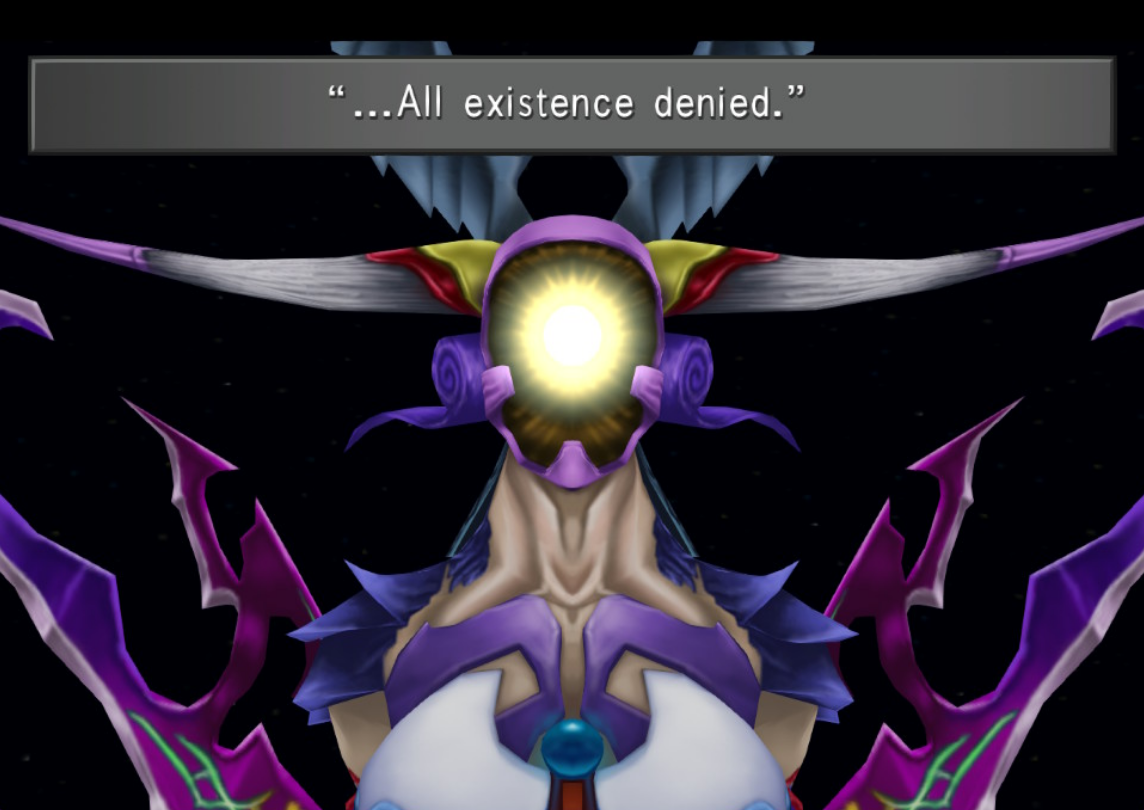
The issue is that a ball of yarn is still composed of lines. Things had to happen until time compression existed. Something needs to occur within time so time can be destroyed (or affirmed). Determinism is kind of like a cuck, but it’s also conformed and comfortable in all of its victories, accepting things good and bad as only Real. It wants us, the inhabitants of its thread, to reach the same “clarity”: accept that things exist instead of lamenting decisions taken, mistakes made, or even celebrating when things work. Time is stoic in a teenager's way. It also doesn’t have a choice; therefore, nobody should have one.
Time marches on regardless of us. We, however, are too creative to avoid suffering. We imagine other times, where yeses are nos, and nos are yeses, maybes are yeses or nos. We imagine that the mistakes we made apart from our words wouldn’t have happened, and we wish the mistakes others made had bigger consequences. We imagine that endings would have continued, that new beginnings would be derivative from old ones, that wills would be denied, wishes would be controlled, and censurings would be indulged.
The point of all that imagining is that we don’t, won’t, didn’t have any answers. We know that for every question asked, we don’t just choose an answer — we choose to not choose every other answer. Time, in a way, allows infinity in its restriction: if it were freely accessible, it would be only reducible in the most varied ways. It is what it is, and what it was, and possibly what it will be too.
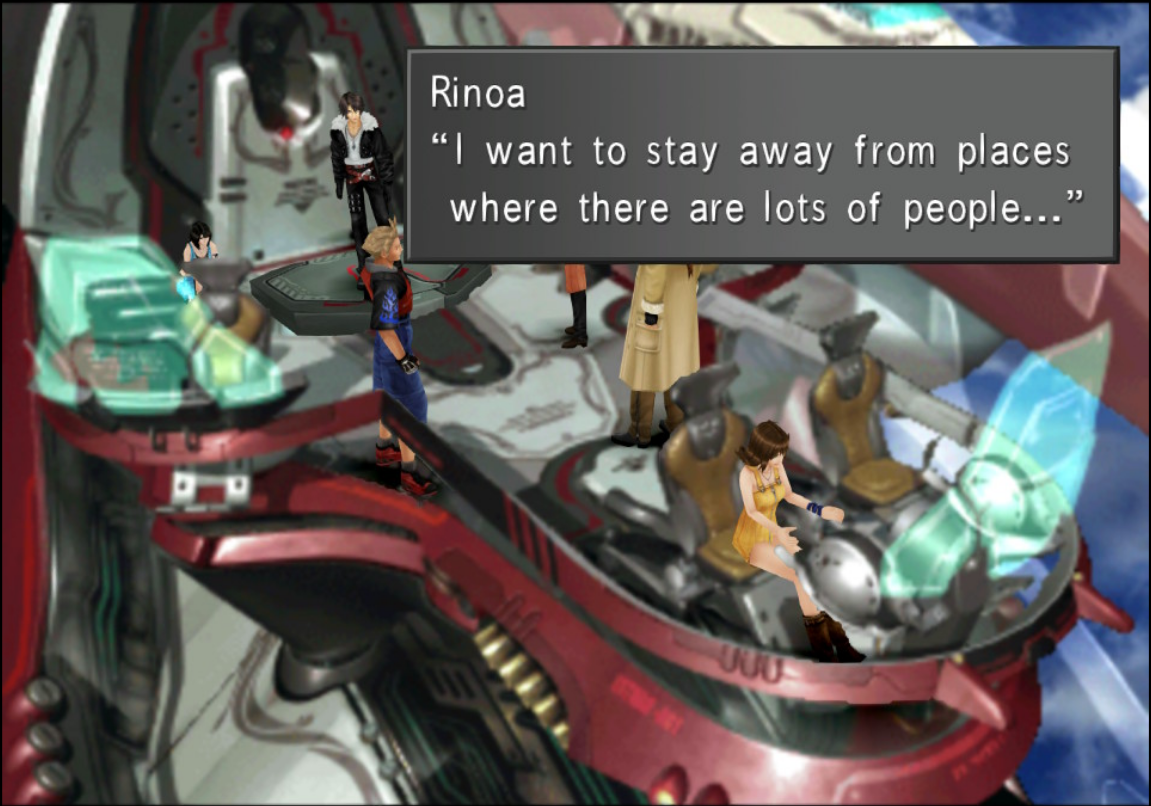
To play a video game is to time-travel. We go back in time when we mess things up. We talk to time travelers from the future, people who have already gone through our ordeals, whenever we search for things on the internet. We relive times we liked whenever we replay something, and we deny times we dislike, banishing them to the void whenever we abandon a game. All characters from all games are victims of our control; we are Time to them, and their programming is their fate. Final Fantasy VIII is a game that wants to Exist, and therefore uses its own determinism to destroy what makes it a game.
Beating Ultimecia frees her from the shackles of fate. Now she can be whatever she wants; she has fulfilled her destiny, and her reward is liberty. She’s not a being chained to an attack cycle that can be easily negated by 99 Meltdowns in our menu. She can become something. Her destined cycle will be repeated every time someone plays the game until the end, and every time she will be freed to turn into whatever she wants. Meanwhile, all of the other characters will remain there in a perpetual interaction cycle amongst themselves, going to the same party while the credits roll, eating the same hot-dog, repeating the same dance, and looking out of the same window.
Death gives Ultimecia her victory, and her liberation from fate by people who are just following theirs. It's the ultimate objective that she designed, beating time, controlling destiny, and controlling us, as well, since we are the beings who instrumentalize the characters to complete their tasks. Final Fantasy VIII was not the first to explore the idea of a Digital Nirvana (it’s something explored through the minds of any person who left their legacy digitally) but Ultimecia is maybe the first character to beat the suffering of being a prisoner to the cycle of lies that we call a narrative.