How to Play Emploeon EX in Modern Pokemon TCG Standard
Life of a penguin

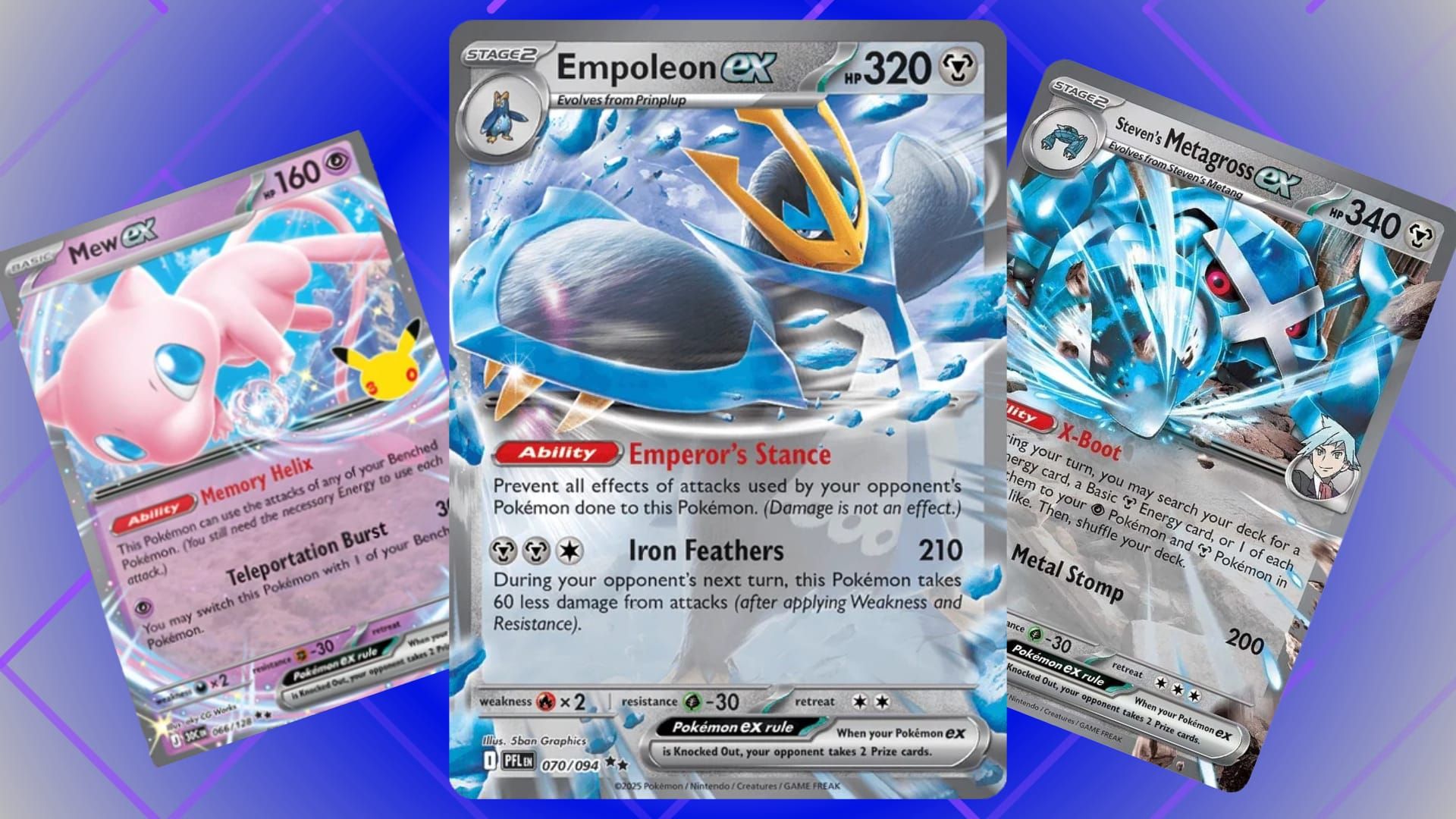
My favorite Pokémon of all time is Piplup, the adorable penguin water starter from Sinnoh in Pokémon Diamond and Pearl. When I first played Diamond as a kid (well, a teen), I had a great time watching my little Piplup evolve into the impressive Empoleon (whom I promptly named Stormfront, which I thought was so cool).
After getting into the TCG, I wanted to know if it was possible to build a viable deck around my favorite penguin, so I set out to see what Empoleon could do and how it'd been used before. I discovered that Empoleon EX, released in the Phantasmal Flames set in 2025, had some pretty great moves, but it wasn't being used in competitive play all that often. I decided to fiddle around with some existing deck lists that I found and see what I could come up with.
What I came up with was a deck that currently has a roughly 65% win rate on Pokémon TCG Live despite its somewhat inept player! Here's how I revamped the Empoleon EX deck for the modern standard scene.
General Strategy — Iron Defenses and Sharp Attacks
To start, let's look at Empoleon EX itself.
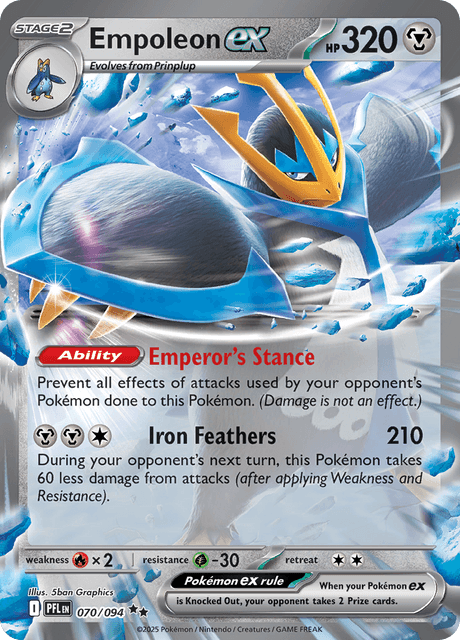
This is a Stage 2 Pokémon, meaning it has to evolve twice to get here — from Piplup into Prinplup, then Prinplup into Empoleon. It's a Metal type (as opposed to specifically a Steel type in the video games) and, as such, is weak to Fire types and resistant to Grass types. To me, this doesn't make a lot of sense, as Empoleon is a Steel and Water type in the games, but I don't make the rules.
Empoleon is pretty tanky at 320 HP, putting it on par with Dragapult and other Stage 2 Pokemon. What makes it great, though, is its ability and attack.
Emperor's Stance is Empoleon's ability, which lets it prevent all effects of attacks used by opposing Pokémon on it. This means Empoleon can't be put to sleep, confused, burned, poisoned, or paralyzed as a direct attack effect; opposing players have to use some kind of Trainer card to do that, which is much harder to accomplish. Importantly, this also means attacking opponents can't place damage counters on Empoleon; this is considered an effect rather than direct damage. With the popularity of Dragapult (and similar decks), whose strategy relies pretty heavily on the 6 damage counters its attack places on the bench, this is an insanely powerful ability.
Empoleon's attack, Iron Feathers, is nothing to sneeze at either. This attack is pretty costly at 1 metal and 2 colorless energy (more about that in a minute), but it does a whopping 210 damage. It also has an interesting effect: if Empoleon uses Iron Feathers, then on your opponent's next turn, it takes 60 less damage from attacks. This can be a major advantage, sometimes even being enough damage reduction to prevent a knockout, buying you time to build up an alternative attacker.
So we've got a strong attacker with great health and defenses that make it hard to knock out — this is already a really solid base for a deck! To flesh out the deck, though, we need to solve some problems:
- How do we buy ourselves enough time to evolve up to Empoleon?
- How do we attach 3 energy to Empoleon quickly?
- Do we try and save one Empoleon the entire game, or bring in alternate attackers?
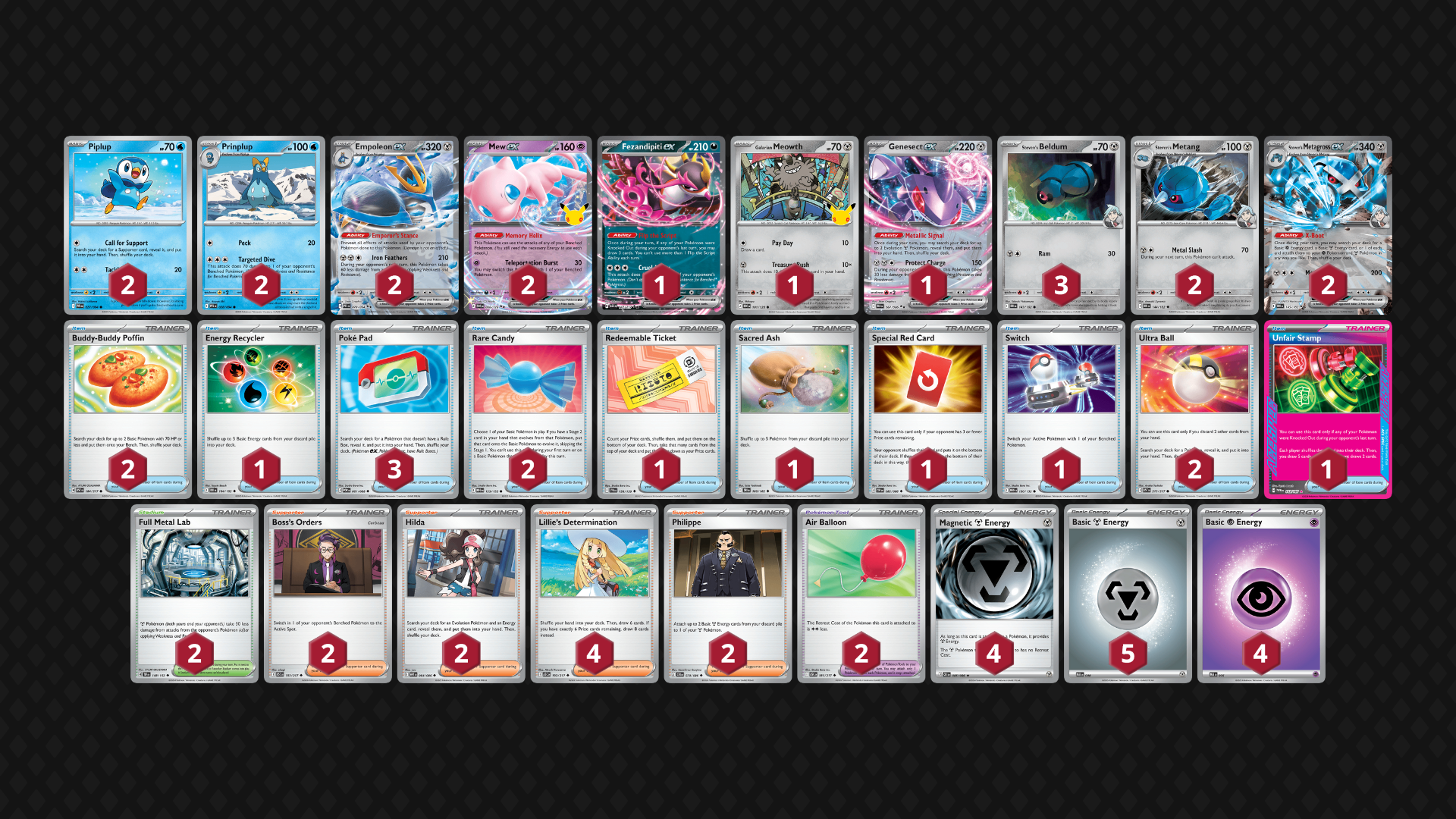
After mulling these questions, I put together a deck list based loosely on some of the other popular Metal decks in format.
Key Pokémon
Weirdly enough, one of the first Pokémon I added to the roster here outside of the main mechanics was Galarian Meowth from the 30th-anniversary collection. This simple card had a couple of features I really liked. For one, it's 70 HP, meaning you can find it with Buddy-Buddy Poffin, which is always great for early-game setup.
It has the Pay Day attack for one energy of any type, letting you draw a card, which can be good for early-game searching. Its other attack, Treasure Rush, costs one Metal energy and does 10 damage for each card in your hand; this can easily take out low-level Pokemon like Budew or even other 70 HP basics if you have enough cards, which can be great for early prizes. I love this card as my early-game stall.
The real driving force behind the deck, though, is the Steven's Metagross EX line. This is a monster of a Metal Stage 2 that was introduced in Destined Rivals, and it's a reasonably popular deck leader in its own right. Metagross has 340 HP, which is frankly ridiculous for a 2-prize Pokémon; it's weak to Fire and resistant to Grass. Unfortunately, it's got a three-energy retreat cost; fortunately, because it's Metal, we can negate that with Magnetic Metal Energy.
In this deck, I'm using it as both the energy engine thanks to X-Boot (its ability, which lets you grab and attach one Psychic and one Metal energy to your Psychic or Metal Pokémon each turn) and as an alternate attacker (its Metal Stomp costs one Metal and 2 colorless energy and does 200 damage).
To make evolving Metagross and Empoleon easier, I've included a copy of Genesect EX, whose Metallic Signal ability lets you search for two evolution Metal Pokémon and put them into your hand each turn.

The other stand-out Pokémon in this deck is Mew EX from the 30th anniversary collection. I really love this card and will happily take as many copies as I can get my hands on to play in as many decks as I can. Mew's Memory Helix ability lets it use any attack from any of your Pokémon in play as long as it has the right energy attached. Pretty much every major attack in this deck can be performed with two Metal and one Psychic energy attached; thus, Mew can be extremely useful for quick, versatile attacking. And, because Mew is a Psychic type, we can attach the energy with Metagross, which makes setup ridiculously easy.
Mew makes this deck an extremely easy win against things like Mega Lucario. I've also found that having Mew up with Fezandipiti EX out lets me knock things off the bench with Cruel Arrow much more often. This is super convenient to slow down or even completely upset your opponent in the early game while they're setting up their major attackers. My only gripe with Mew is that it has such low HP at only 160, which makes it a vulnerable knockout target.
Key Trainers
One of the absolute key Trainer cards in this deck is Full Metal Lab, a stadium that makes Metal Pokémon take 30 less damage from attacks. Paired with Empoleon's Iron Feathers attack effect, it takes 90 less damage per hit when this stadium is in play, which makes it incredibly hard to knock out. Full Metal Lab also keeps bench attackers like Mega Starmie EX from wiping out your basics before they can evolve.
As with any deck, Pokémon search is important, but in this one, the key is finding your basics and Genesect EX, so I've included two Buddy-Buddy Poffins and two Ultra Balls. You can't get Prinplup with Genesect, though, so I've also included a couple of Poke Pads. Hilda also makes finding that initial energy significantly easier while giving you another out to Prinplup if you need it or an alternate way to build up to Metagross if Genesect is prized.
Because we have on-board search for both evolutions and energy, we don't need them to go directly into our hand if we're recovering them in the late game, so I included a copy of Sacred Ash and Energy Recycler, which shuffle back into the deck. I also included a copy of Redeemable Ticket, as prizing any of our Stage 2 Pokémon or our Genesect could be dangerous.
I chose Unfair Stamp as my ACE SPEC card for this deck because I wanted a little more hand disruption; it's the same reason I included Special Red Card (though I currently have that one in every deck I play, much like Lillie's Determination and Boss's Orders). Because we have on-board ways to find our evolutions and energy, we can afford to shuffle our hand occasionally, especially later in the game where this could be a major problem for opponents like Alakazam or Slowking that rely on high hand counts or drawing into what they need.
As finishing touches, I included Rare Candy to speed up Metagross evolution, Switch to move our heavy hitters around, and Philippe as an alternative energy recovery.
How to Play Empoleon EX
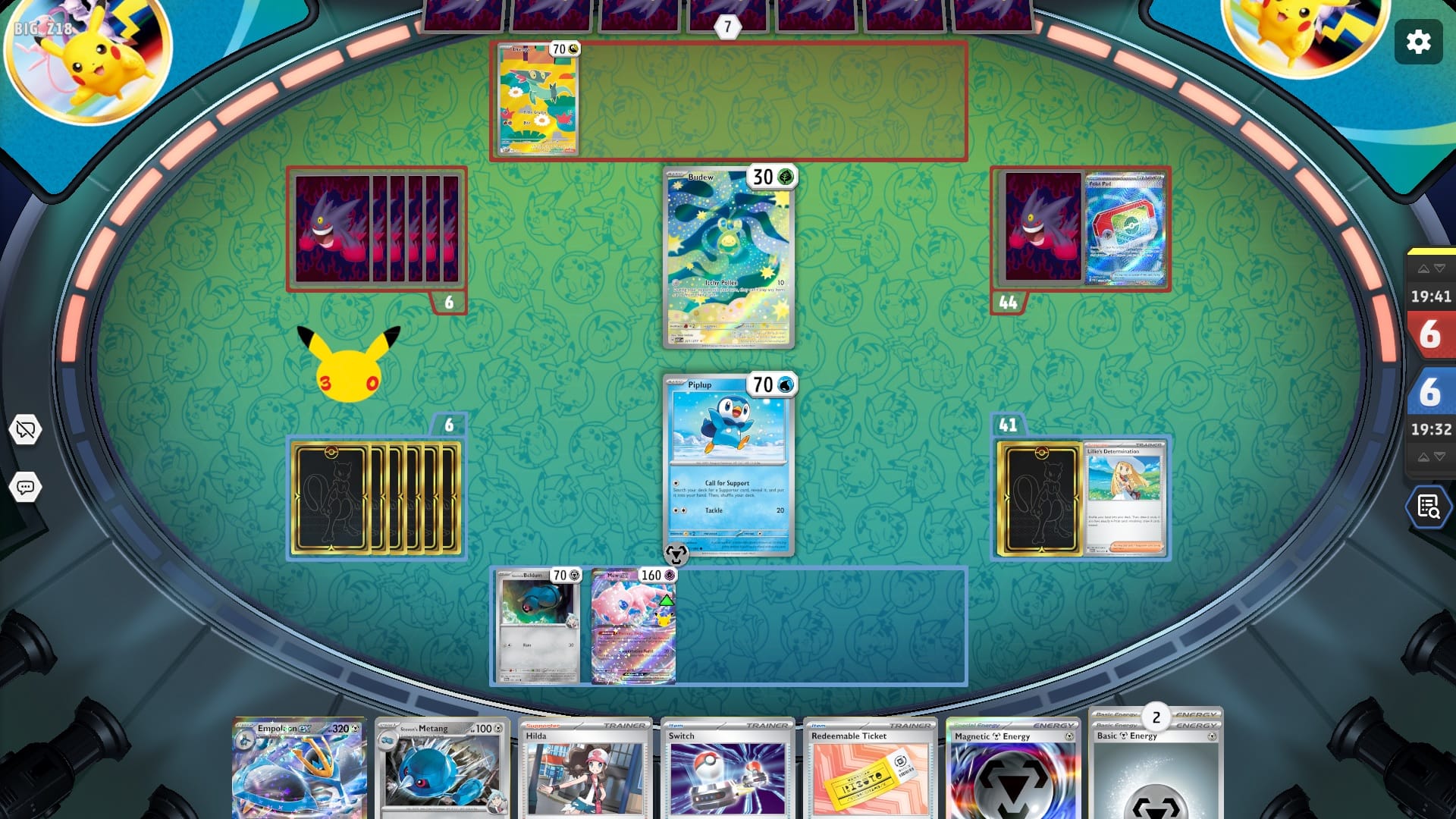
This deck is pretty simple to set up, but it can slow down significantly if you go in the wrong order, so sequencing is important.
Start by choosing to go first if you can; you want as much time as possible to establish your board and get evolving. On turn one, you're looking to establish your board as follows:
- Galarian Meowth in the active with one Metal energy attached.
- Ideally, two Steven's Beldums on the bench.
- At least one Piplup on the bench.
- Genesect EX on the bench.
Leave a bench spot open until you know what you're up against; it can either go to Fez or Mew, depending on your opponent's setup.
On your second turn, use Genesect to evolve into Steven's Metang or, if you're lucky enough to draw into Rare Candy, straight into Steven's Metagross. We're prioritizing this evolution line so we can get energy attached as efficiently as possible. We can use Metagross as an attacker early while setting up Empoleon or Mew, which is convenient, but you generally want to keep it out of the active to protect your use of X Boot.
From there, evolve into Empoleon EX, add the three necessary energies, pull it into the active, and start swinging. Ideally, you'll put down Full Metal Lab when you bring Empoleon up to give it the best chance of taking minimal damage while dealing 210 damage per turn.
You can use Mew as your main attacker for fighting matchups like Mega Lucario EX, or if you're looking to hit the bench with Cruel Arrow; this can knock out attackers as they're setting up, such as in the Beedrill EX deck, which makes your life much easier later on. Keep an eye on where your Magnetic Energies and Air Balloons are attached, and you should always have a backup attacker powered up on the bench so you can switch if Empoleon's health gets too low.
This deck is great against most Grass decks and most other Stage 2-dependent decks; it sets up really quickly, though not quite as quickly as something like Mega Starmie EX. It's not great against Fire decks, obviously, and I've struggled a bit against Alakazam for some reason, but overall, it's a decent competitive deck that's fun to play. And hey, more love for Piplup is always good!
Join the conversation
What do you think? Reply below to share your perspective.