The Basics of Building a Competitive Deck in Pokemon TCG Live
New to competitive Pokémon TCG Live? A Master League player walks you through deck building from the ground up


The Pokémon trading card game is one of the simpler deck building games available to play — it's a straightforward turn-based game designed to be easy enough for children six and up to learn, but with enough complexity that adults can enjoy the game as well. Building a Pokémon deck itself is relatively easy on the surface, but there's a lot that goes into making a deck competitive within the modern gaming scene.
With Pokémon TCG Live (PTCGL), you can have access to the entire card dex from the Sun and Moon era of cards onward with relative ease, giving you thousands of cards to pick from and play across a range of formats. So how do you pick what you want to play? How do you build a deck that will hold up to ranked gameplay? What goes into card selection?
While I haven't been playing for a long time, I've built decks that have gotten me into the Master League a few times. It's not as hard as it looks! Let me walk you through it.
The basic rules of Pokémon deck building
On a very basic level, building a deck for Pokémon follows a set of simple rules:
- Your deck will have a set number of cards, usually 60 (more on the "usually" in a moment).
- You may only have up to 4 copies of any one card in your deck. (Note: there are Pokémon with the same name that have different attacks and abilities listed underneath them. You can still only have 4 cards with that same exact card name in your deck.)
- Your deck must be able to meet at least 1 of the 3 possible win conditions for the game — you need to be able to knock out enough Pokémon to take all of your prize cards, knock out all of your opponent's Pokémon in play leaving them without backup, or cause your opponent to run out of cards to draw to start their turn (called "decking out").
From there, we can get a bit more detailed about what goes into deck building.
Card types
There are three basic categories of Pokémon cards, with some subcategories. Most cards will have an edition marker in the bottom left that will tell you whether the card is legal in the current Standard format. Keep that in mind for later on.
The pocket monsters you call on to attack. They come in types (Grass, Fire, Water…) with strengths and weaknesses, and may carry Abilities.
- BasicPlayed directly onto the board.
- Stage 1Played onto its corresponding Basic.
- Stage 2Played onto its corresponding Stage 1.
- Special — Mega Evolution & EXCan be any stage; more powerful, but worth more than one prize card when knocked out.
Cards you play to take actions on your turn and shape the game state for you and your opponent.
- ItemUsually one-time-use: search your deck, add or remove conditions, affect damage.
- SupporterStronger effects, but only one per turn.
- Pokémon ToolAttached to a Pokémon (one each); can't be removed without a card effect.
- ACE SPECIncredibly powerful — only one ACE SPEC card allowed per deck.
Powers your Pokémon's attacks and abilities, and fuels certain Trainer card actions.
- Basic energyTyped (Grass, Fire, Water…). Unlimited copies, and legal in every format.
- Special energyColorless or typed, with a secondary effect — these have editions to track.
PTCGL formats
The format you're playing will determine the exact rules of your deck's construction.
The format used in official Pokémon events — League cups, regionals, and championships. Only cards from edition marker H forward are currently legal. It's what the ranked ladder runs on, though you can also play it casually.
The newest format, used at pre-release events. You get one of four 40-card starter decks plus 4 packs to customise before playing. Currently built around the Chaos Rising expansion (Delphox, Goodra, Ampharos, or Crobat).
Meta decks
Because this is a competitive game with a limited pool of cards, there's always going to be a few sets of decks that become popular quickly because they work particularly well. These are called the Most Effective Tactics Available, or meta decks.
While you absolutely do not need to one-for-one copy a meta deck to be successful in PTCGL, it's a good place to start to see how deck construction works. Meta decks let you see how different Pokémon work together ("synergize" is a word you'll hear thrown around a lot) and how different Trainers can support those Pokémon effectively. You can find meta deck lists from various competitive tournament events on a range of websites like Limitless TCG.
Building a deck together
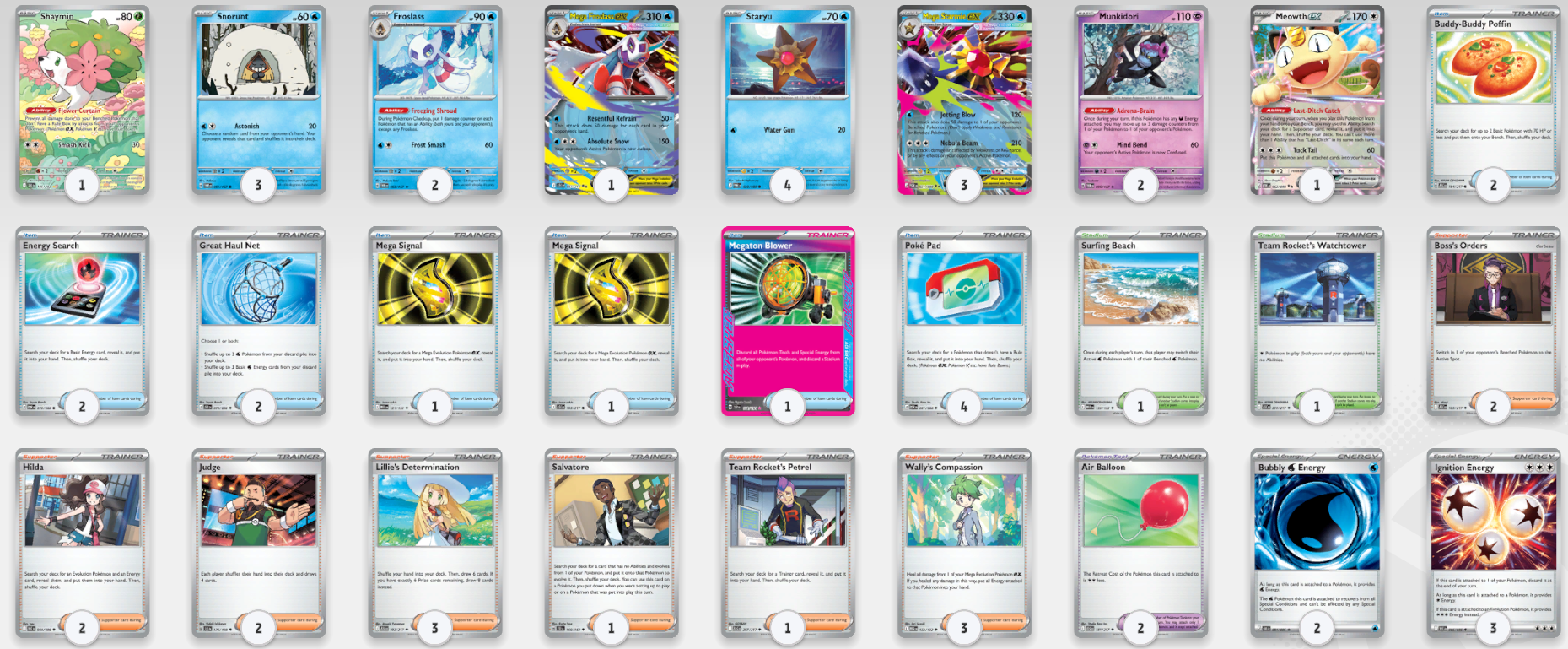
To really make this make sense, let's build a deck together. We're going to build a deck that I use a lot, crafted around Mega Starmie EX.
Choosing your Pokémon
When you're building a deck, you'll typically want to base it around one or two powerful Pokémon who will be your main attackers. There are some exceptions to this rule — things like "box" decks that rely on a specific mechanic or gimmick — but it's a good way to start if you're brand new to deck building. After you've decided on your main attacker, you'll want to think about which Pokémon would work well with it or make it more effective with either their abilities or attacks.
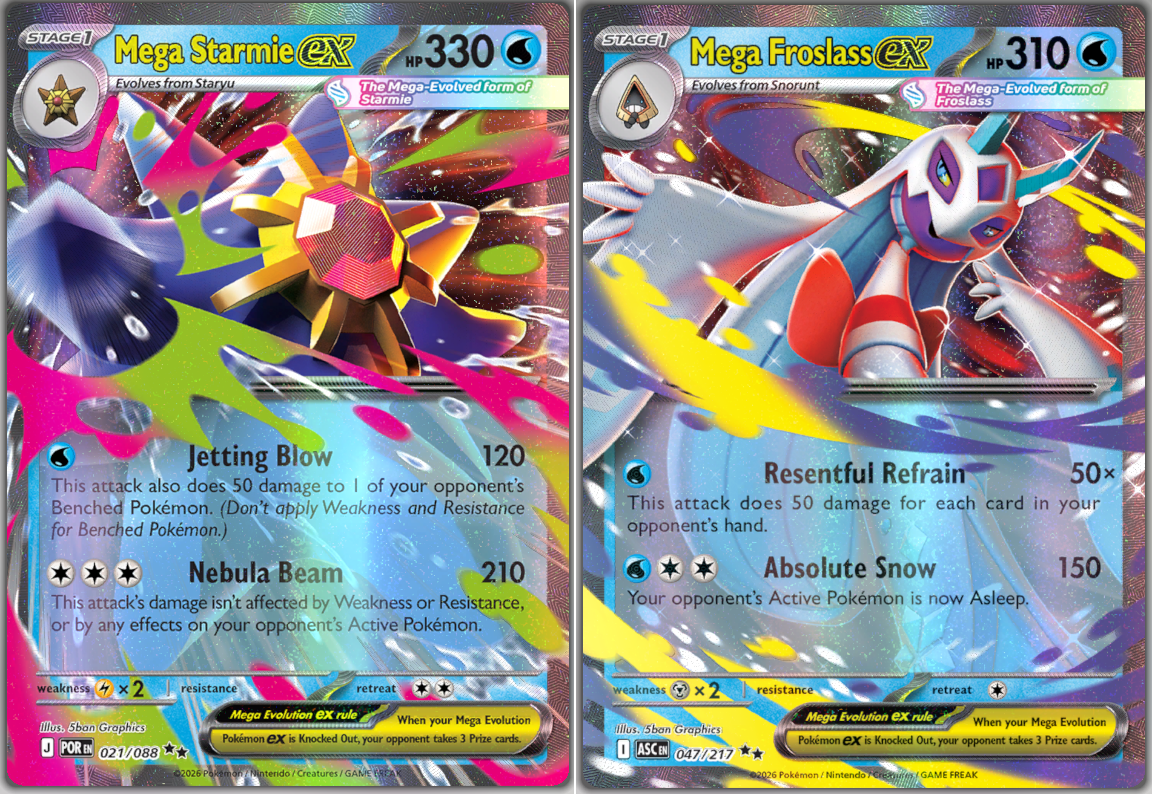
For this deck, our main attacker is Mega Starmie EX, a Mega Evolution of Staryu. This Pokémon's strategy is hitting hard and fast across multiple targets. Because they're a Stage 1, it only takes two turns to get up to speed (sometimes faster with certain trainer cards). Their main attack is Jetting Blow, which requires only one Water energy and does 120 damage to the active Pokémon and 50 damage to a benched Pokémon of your choice. They also have Nebula Beam for three colorless energy (meaning this attack can use any basic energy for power regardless of type) which does 210 damage — more than enough to knock out (KO) most regular EX Pokémon.
Because this is our main attacker, we're going to put four Staryus into the deck. Because Mega Starmie is worth 3 prize cards, we're only going to put in 3 copies of it — 2 to put into play and one more just in case some of them end up in the prize cards.
It's always a good idea to have a backup attacker in case you need more power or a different strategy, so for this deck, we're going to choose another powerful Mega Evolution EX Pokémon with a one Water energy attack: Mega Froslass EX. This Froslass's Resentful Refrain does 50 damage per card in your opponent's hand to their active Pokémon — not bad! Their secondary attack, Absolute Snow, takes one Water and two colorless energy, and does 150 damage while also putting your opponent's active Pokémon to sleep, which can be helpful in slowing down the game if you need time to find cards or establish your bench. It's also a Stage 1, so it's just as quick to set up. As this is our backup, we're only going to include one Snorunt for our one Mega Froslass EX.
(As an aside, you can totally swap these two attackers and have an equally powerful deck. The build for the rest of it would be totally different, so that's a conversation for another day.)
Starmie is all about bench damage, so we need supporting Pokémon who can damage the bench to increase our chances of getting double KOs with Jetting Blow. A great card for this is regular Froslass, which has the ability Freezing Shroud: any Pokémon with an ability gets 1 damage counter between each turn. So we add in two more Snorunts and two Froslass. We can also use Munkidori's Adrena-Brain ability: if there's a Dark energy attached to Munkidori, you can move 3 damage counters from one of your Pokémon to one of your opponent's. This makes adding just enough damage to your opponent's bench to take the KO really easy, and when paired with Froslass (who damages your own Pokémon with abilities too), gives you free damage to move around every turn regardless of what your opponent does.
Now that we've got our attackers and support set up, we're going to add a little bit of board control to our deck. We're adding in Shaymin, whose Flower Curtain ability protects our own bench from damage, and a Meowth EX, whose Last-Ditch Catch ability lets us grab any supporter card we need from our deck when we play Meowth to the bench. Neither of these are wholly necessary, so feel free to replace them if you like, but they're nice to have.
Tackling trainer cards
Trainer cards are the section of the deck that can change the most from player to player; everyone has their own idea of what makes the perfect mix of tools to support your Pokémon in play. Ideally, you'll want a good mix of all trainer types, focusing on a mechanic or set of mechanics that will make powering up and using your main attackers as easy as possible.
For Starmie, we're going to need to be able to:
- Find Staryu and get it on the board.
- Evolve Staryu into Starmie.
- Attach a Water energy.
- Keep Starmie from getting knocked out, and/or have a plan for if it does.
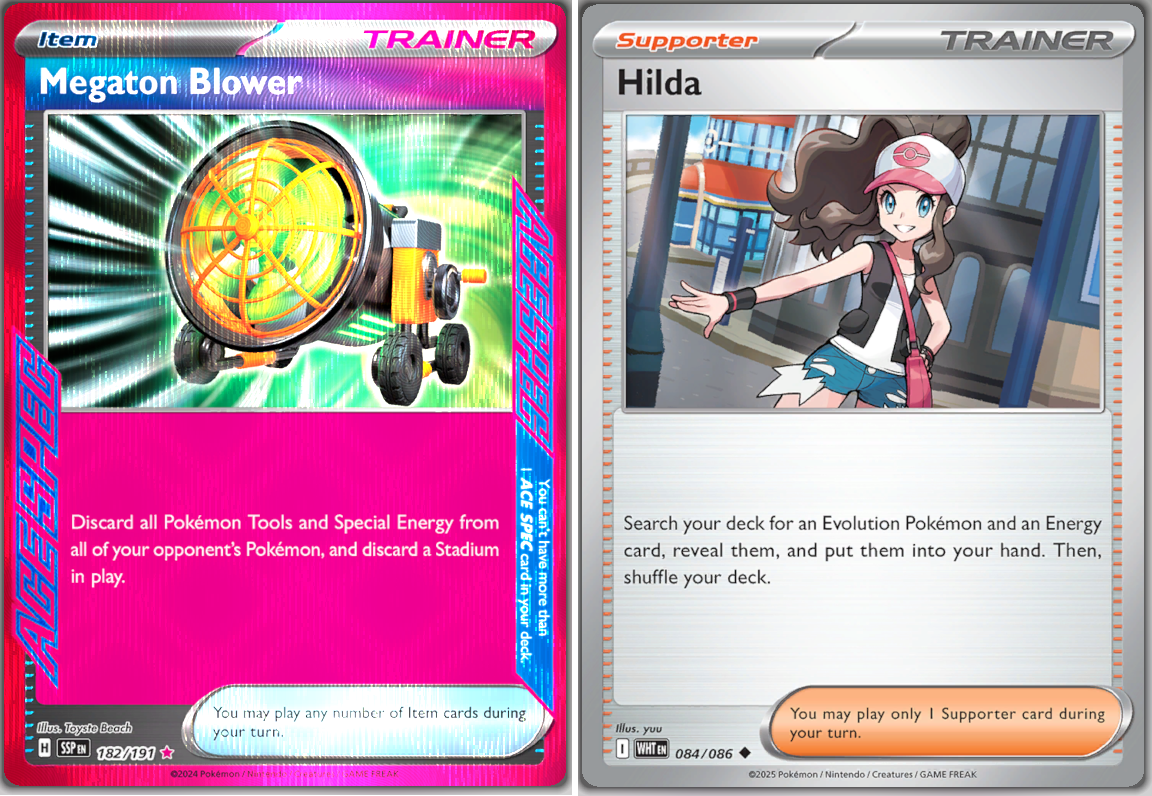
To accomplish this, we're going to focus on some basic trainer tactics: finding Pokémon quickly, evolution and energy attachment combos, healing, and recovery. Here's the list of trainers I work with to accomplish this. Note that other Starmie builds may have different counts or different picks entirely — it's up to personal preference and trial and error while playing.
The one ACE SPEC card I play is one of the less common options: Megaton Blower. This card discards the stadium in play as well as all of your opponent's attached special energies and Pokémon tools. I love this as a mid-game advantage; clearing your opponent's board when they may be relying on these things to attack effectively can not only buy you time to get back on your feet if you're falling behind, but can also lead to totally "bricking" your opponent for the win if you time it well.
Exploring energy
Now that we have our Pokémon and our trainers, all we need to do is add energy! For every deck, you'll need to assess what kinds of energy your Pokémon need, and how much you're likely to need to get through the game successfully. You don't necessarily need enough energy to power all of your Pokémon at once to full power — remember you can only have up to six Pokémon on the board at a time, and some of them are only there for their abilities and won't need to attack. I tend to keep enough energy in my decks to power up my main attackers plus a little extra for longer games.
You'll also want to consider whether you want to include special energies. These cards, as explained above, have unique effects that can sway the game in your favor if played at the right time or against the right opponents. There are some special energies that are colorless, meaning they can be used by any Pokémon, and some that are type-specific, so you'll have to take that into consideration.
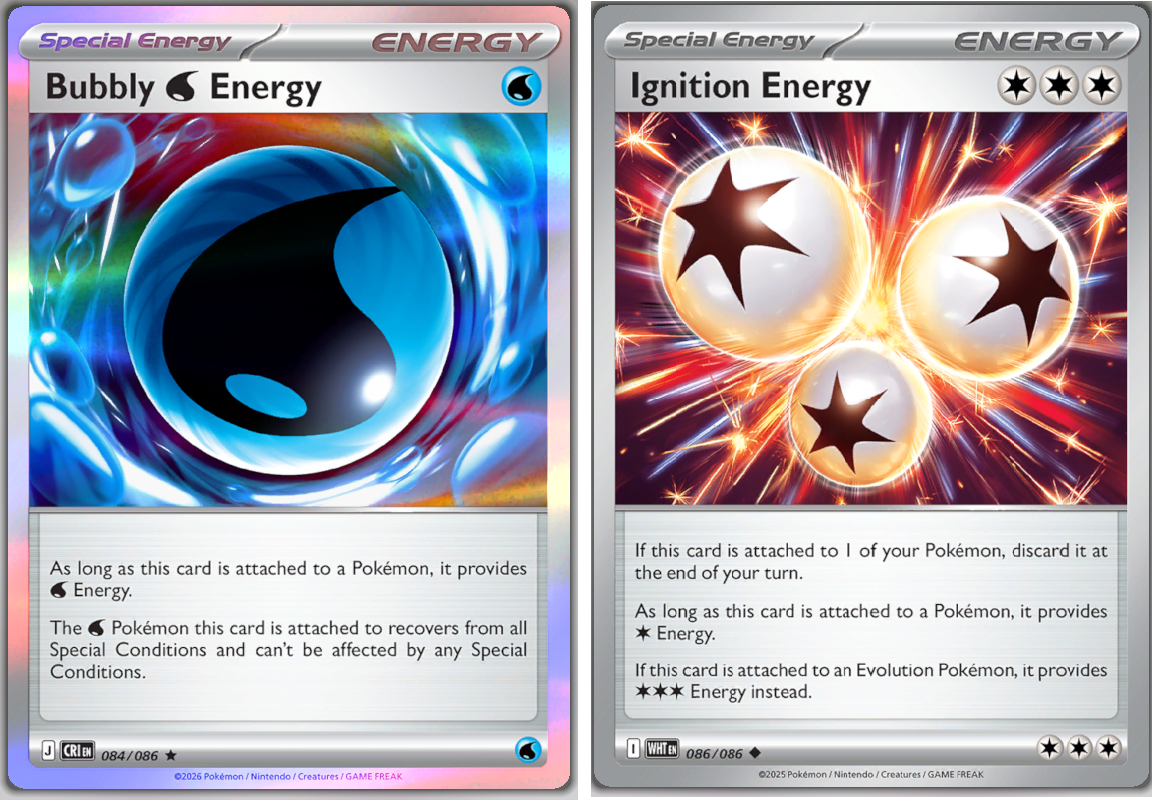
For this deck, we're going to include basic Water energy because both of our attackers are Water types. We're also going to include 2 Dark energies to power up Munkidori's ability. For special energies, we're going to include the brand-new Bubbly Energy, which prevents the Water Pokémon it's attached to from being affected by conditions like Sleep, Paralysis, and Poison. This is pretty convenient for any deck that relies on those conditions to progress the game. We're also going to include a few Ignition Energies; this colorless special energy provides 3 energy instead of the usual 1 when it's attached to an evolved Pokémon, but only for one turn. This is useful for Starmie, whose Nebula Beam attack requires 3 colorless energy and does 210 damage; Ignition Energy can let us use this attack quickly in a tough spot.
Testing and using your deck
PTCGL has a lovely feature in their deck builder that lets you test a deck you've just built to see if it draws and runs the way you want it to. While I like this feature, I do find that it can be a bit buggy (some abilities and card effects don't stack the way they're supposed to or won't activate even if all conditions are met) and that the AI opponent often uses a deck that is no longer Standard format legal. Still, it's a good way to see if you're drawing the way you want to and if your combos work as expected.
The best way I've found to test your deck is to just play! Jump into Casual mode and play a few rounds. If you don't like something or think something could work better, you can go into the editor between matches and make those changes — as I mentioned earlier, there's nothing wrong with trial and error.
Once you're happy with your deck, keep playing with it. Get comfortable with how it draws, what your opening hand looks like most often, and how you can get around your opponent's strategies. When you're confident with it, I look forward to seeing what you've got in Ranked mode!
See you in the Master League.
Join the conversation
What do you think? Reply below to share your perspective.