Growing Young With Pragmata
The synaptic shooter sub-genre is born

Time definitely moves faster as we age. I just turned 43 recently and can sadly vouch for this. When I was a young child, a single hour could feel like an eternity. Now, entire months can slip through my fingers like sand. Why? I'm sure there are many theories, but here's mine: when we are young, almost every experience is new. I'm willing to bet that this constant barrage of the novel means our brains are furiously working overtime to lay down new neural pathways, where each new concept must be established and embedded in previous context. This means that even the most mundane things can be exciting, sparking endless curiosity and slowing down time as we take in each fine detail, sensation, and emotion.
Now, though, at 43 years old, it's the very opposite: time moves faster because I experience relatively few novel experiences day-to-day. It's easy to move through each day on some degree of autopilot, simply because my experiential context is now that much larger. Remember the first few times you drove a car as a teenager? You were probably paying attention to every single sign, every single flash of light, every creak or rumble. Whereas now, I'm sure you can take a 30-minute drive and almost completely forget the journey between origin and destination. That's a good analogy for how it feels to grow older, at least in terms of first-person perceptual experience.
You can now view this story as a video essay at the SUPERJUMP YouTube channel.
若返り美容液 YOUTH SERUM
What's the answer to this dilemma? Surely there's a way to slow down the entropy rollercoaster as it pulls us ever faster toward the grave each year. Well, friend, I have good news! The answer is obvious, too: as one grows older, one must deliberately seek out novel experiences. Yes, I know, nostalgia and the comfort of the familiar are seductive (and shouldn't be easily dismissed, as our fond memories are one of the great delights of being human). But growing young is, I think, less about superficially looking young; it's actually about seeking out the unfamiliar and experiencing the joy and wonder of the unknown. It's about throwing your mind into spaces where your brain can't gravitate to autopilot mode and is forced to discover, learn, and establish new connections.
This is the key reason why I'm so thoroughly enjoying Pragmata, Capcom's latest new IP. It's been a long time coming, too, having first been revealed way back in 2020 at the birth of a console generation now firmly in its winter.
...as one grows older, one must deliberately seek out novel experiences.
I haven't yet completed Pragmata. I can't say that it's an especially lengthy game, but to tell you the truth, I'm doing my best to savour it. Here is a big-budget experience that is not only brilliantly polished but that also leans heavily into a range of ideas that may seem disparate at first glance, but which, when combined with elegant lateral thinking and thoughtful restraint, become remarkably impactful. Experienced from a third-person perspective, Pragmata's gunplay initially reminded me vaguely of a faster/sleeker iteration of the model established in Resident Evil 4. The camera pulls in over your shoulder as you aim and fire at enemies. It feels controlled and deliberate rather than chaotic or frenzied. And yet, the smooth movement and relative athleticism of Hugh - the game's protagonist - felt more akin to Sega's Burning Rangers, strangely enough. Okay, I'll stop reaching for analogies here: Pragmata deserves more credit than that.
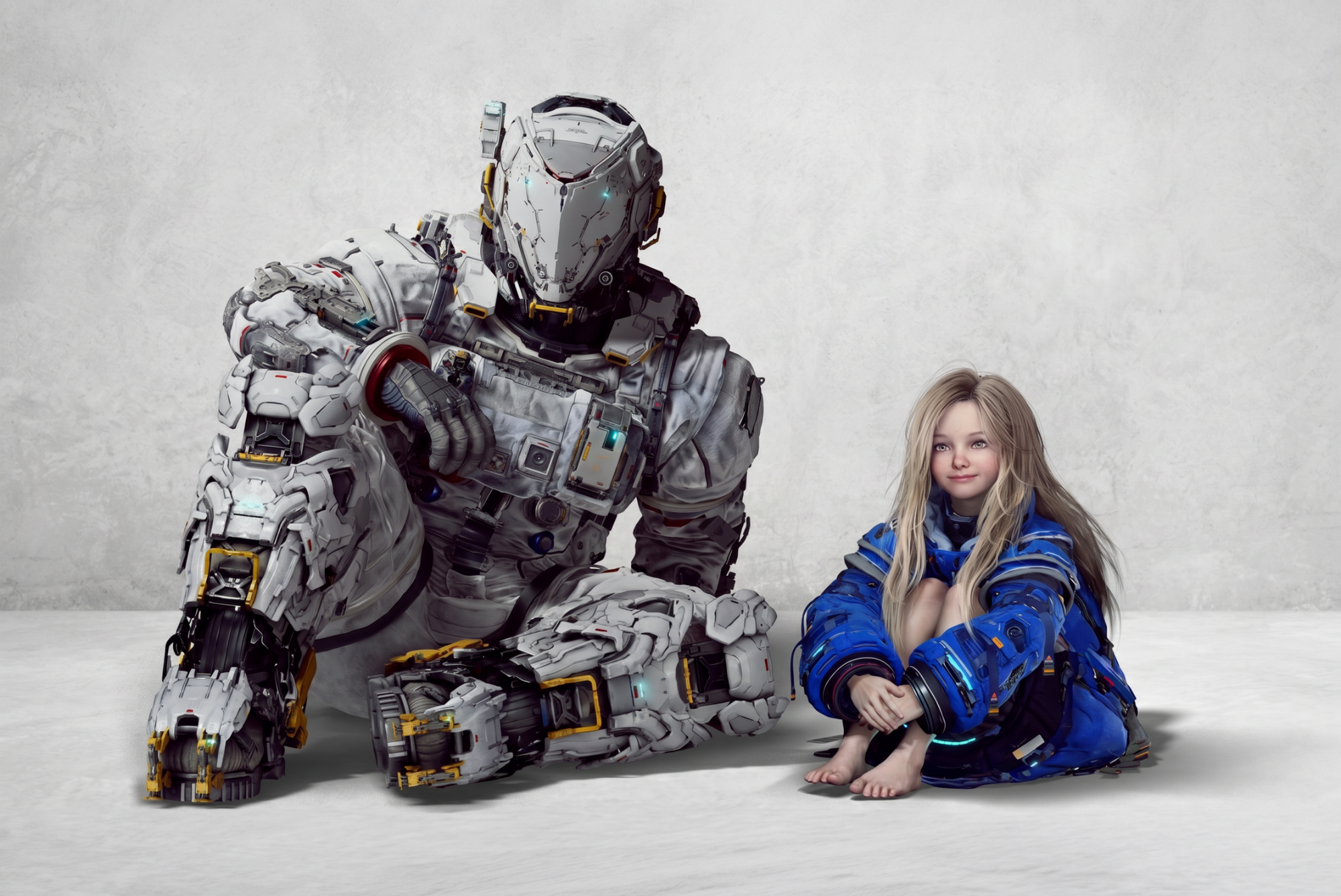
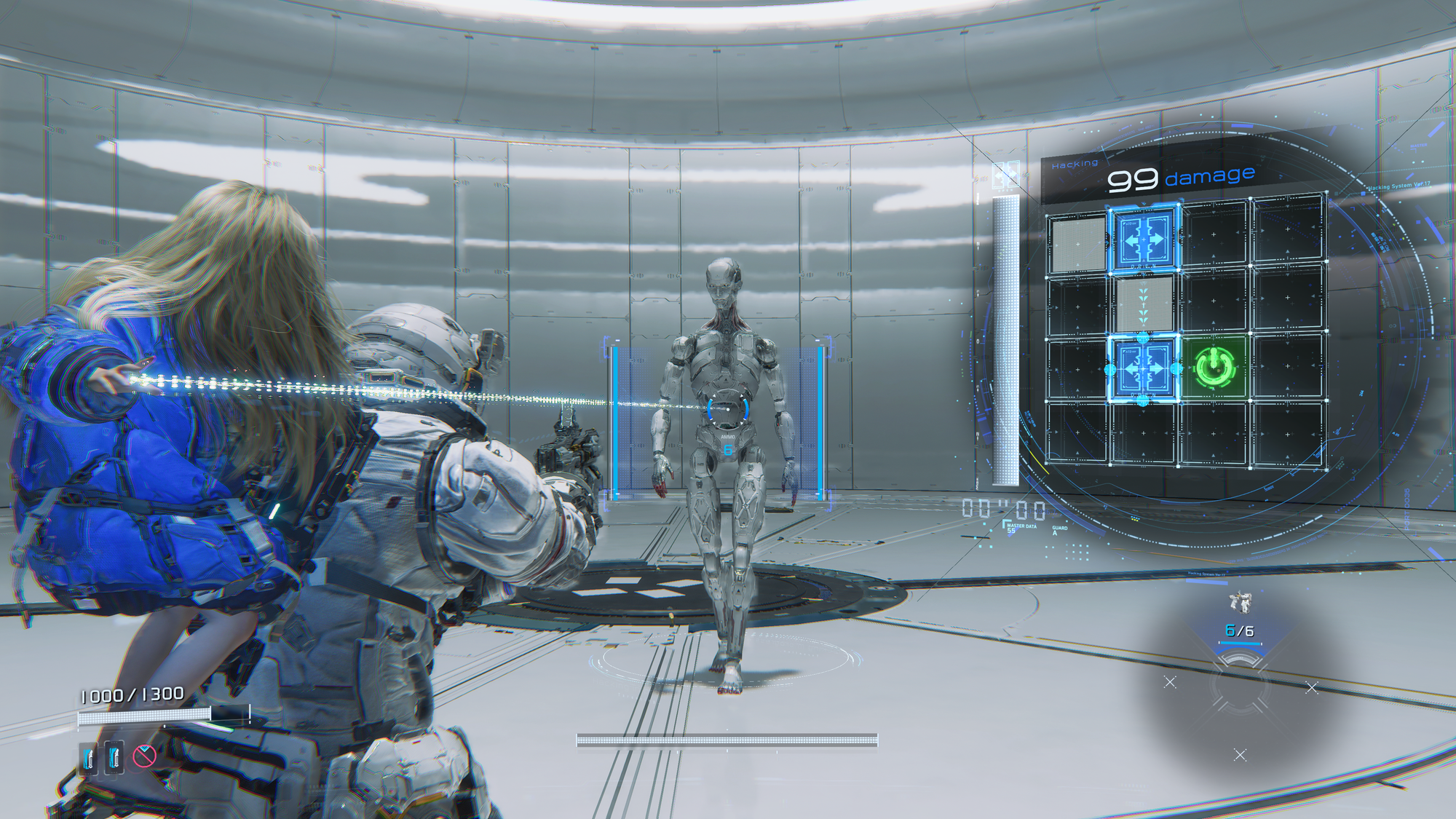
Pragmata is the first entry and originator of the new synaptic shooter sub-genre. New players will immediately discover that simply firing at enemies is almost pointless; while they can be damaged, they are highly resistant to Hugh's weapons. Raw-dogging it won't work here. Thankfully, our trusty assistant Diana (the little android girl with the flowing hair attached to Hugh's back) can hack enemies, which has the primary effect of opening up their body panels to reveal weak spots that Hugh can target to radically increase damage. And yeah, that's cool in and of itself (the opening/closing animations have a lovely kinetic tactility to them), but it's only a very brief taste of what's to come. When you target an enemy to hack them, a hacking interface appears in real-time. This interface works like a pathfinding or node-connection puzzle of the kind you might typically see in an immersive sim. Fundamentally, you're trying to hit the green power indicator; if successful, the hacking interface closes, the enemy's body panels open up, and you can blast away with greater damage. Importantly, though, the game doesn't pause when this interface is visible; enemies will continue moving towards you, and you can also move/jump/dodge around while hacking.
It may sound unintuitive, and at first, it feels a little weird (you know, in the same way that driving your first car feels clunky and alien). But as with driving, it's possible to smoothly move through a gradient of mastery over time. This is where Capcom took a cool idea and elevated it into the stratosphere: both the hacking and the gunplay continuously and evenly progress through a glorious series of elaborations throughout the game. In the later game, you'll be fighting multiple enemies (each with their own speed, aggression, and combat tactics), performing sophisticated multi-modal hacking routines, and artfully dashing, dodging, and jumping all over the place all at once.
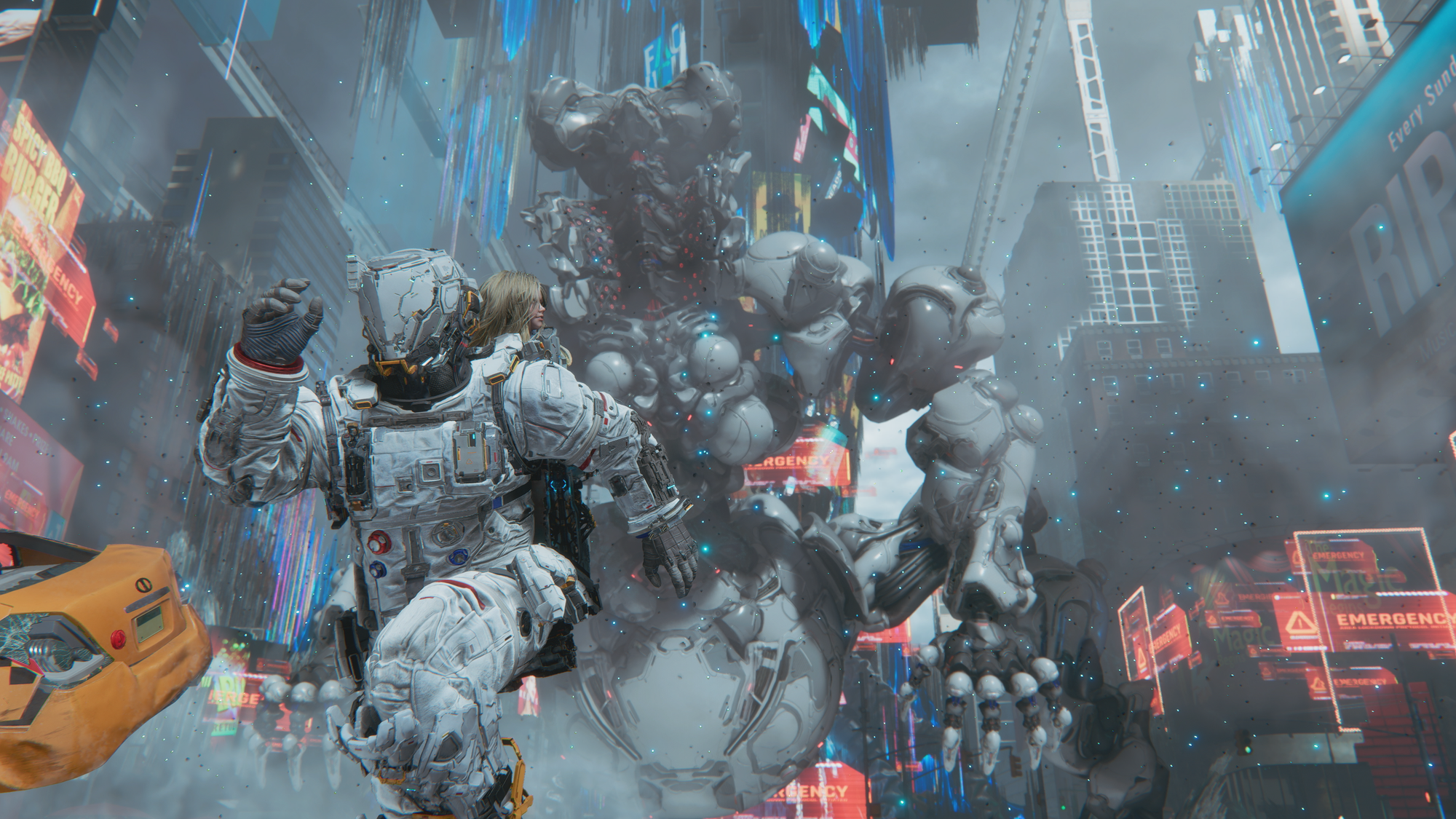
It may sound unintuitive, and at first, it feels a little weird (you know, in the same way that driving your first car feels clunky and alien). But as with driving, it's possible to smoothly move through a gradient of mastery over time.
シナプスシューター SYNAPTIC SHOOTER
Innovation in video games is rarely a question of inventing something entirely new from whole cloth. I'd say that, in most cases, the greatest innovations are more about taking a set of ingredients and combining them - often in unexpected ways - to build something that feels qualitatively different. If you dissect Pragmata and reduce it to its constituent parts, then yes, it's all been done before: Binary Domain and Vanquish lean into fast third-person combat against humanoid robots, NieR: Automata enabled players to switch between third-person combat and hacking modes, and multiple immersive sim games like Deus Ex featured grid/path-based hacking. But Pragmata is the first game to weave all of these threads together into an experience that feels like an elegantly coordinated dance. Here, players must simultaneously:
- Engage in third-person shooter combat
- Run/dodge/jump to navigate the environment and evade enemies
- Solve spatial hacking puzzles
It's easy to see how this kind of design could quickly devolve into nonsensical, overwhelming chaos. But Capcom's design brilliance is on full display here, both in how they've finely balanced each encounter to carefully weight and buttress each of these elements, and in delivering an incredibly smooth difficulty curve that gracefully unfolds throughout the entire game. This latter point cannot be understated; many games will teach you all the key ropes in an early tutorial, then subsequently implement a difficulty curve by simply making enemies stronger and more numerous (and perhaps giving players the ability to upgrade their own stats to keep up). While Pragmata does enable players to kick up defence and damage numbers over time, the real focus here is on concept layering. Once you grasp the basic idea of moving/shooting/hacking all at once, you'll gradually progress through encounters that add new concepts to each of these three pillars. This means that the overall palette of enemy and player interactions widens and deepens over time, with each new concept requiring full understanding of its precursors. So, as you are seamlessly onboarded to each new concept, layer by layer, you'll soon find that you are carrying out truly remarkable feats of parallel cognition.
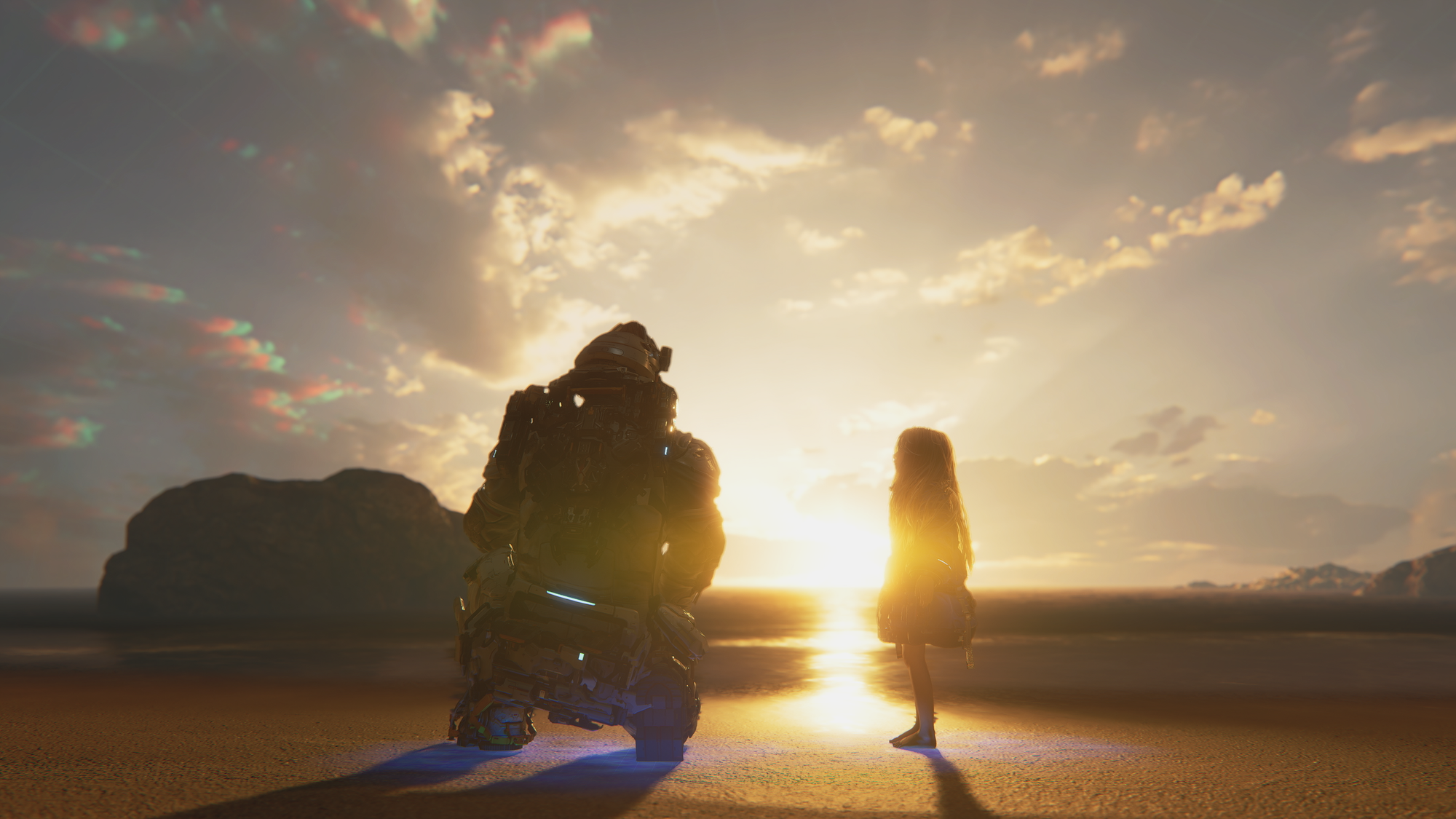
Capcom's design brilliance is on full display here, both in terms of how they've finely balanced each encounter to carefully weight and buttress each of these elements, while also delivering an incredibly smooth difficulty curve that gracefully unfolds throughout the entire game.
若さを保つ STAY YOUNG, PLAY PRAGMATA
The key to youth isn't Botox or wrinkle cream. No, it's all about confronting your mind and body with the unfamiliar. Stepping into uncharted worlds forces you to adapt in ways that generally don't come naturally in day-to-day life. This is one of the many reasons I love video games in general, and why I adore Pragmata in particular. That this experience is overflowing with heart, innocence, wonder, style, and even some biting and highly relevant commentary on modern technology is a most welcome bonus.
So, friends, if the days are starting to blur together — if you can feel the river of time picking up speed around you — go play Pragmata. If you’re young, it’ll keep you young. And if you're older? Well, it's never too late to grow younger.
Join the conversation
What do you think? Reply below to share your perspective.