How Accurate Is Dressmaker to Real-Life Garment Making?
Is Dressmaker an accurate sewing simulation? Does it need to be?

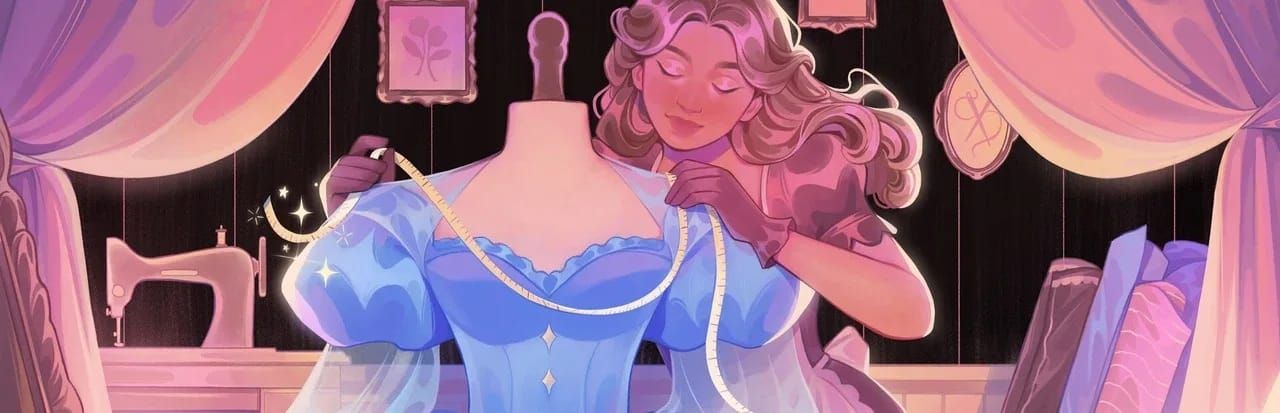
Like much of the internet in late September and early October, my friends and I became deeply obsessed with the indie gem Dressmaker from Cozy Lives.
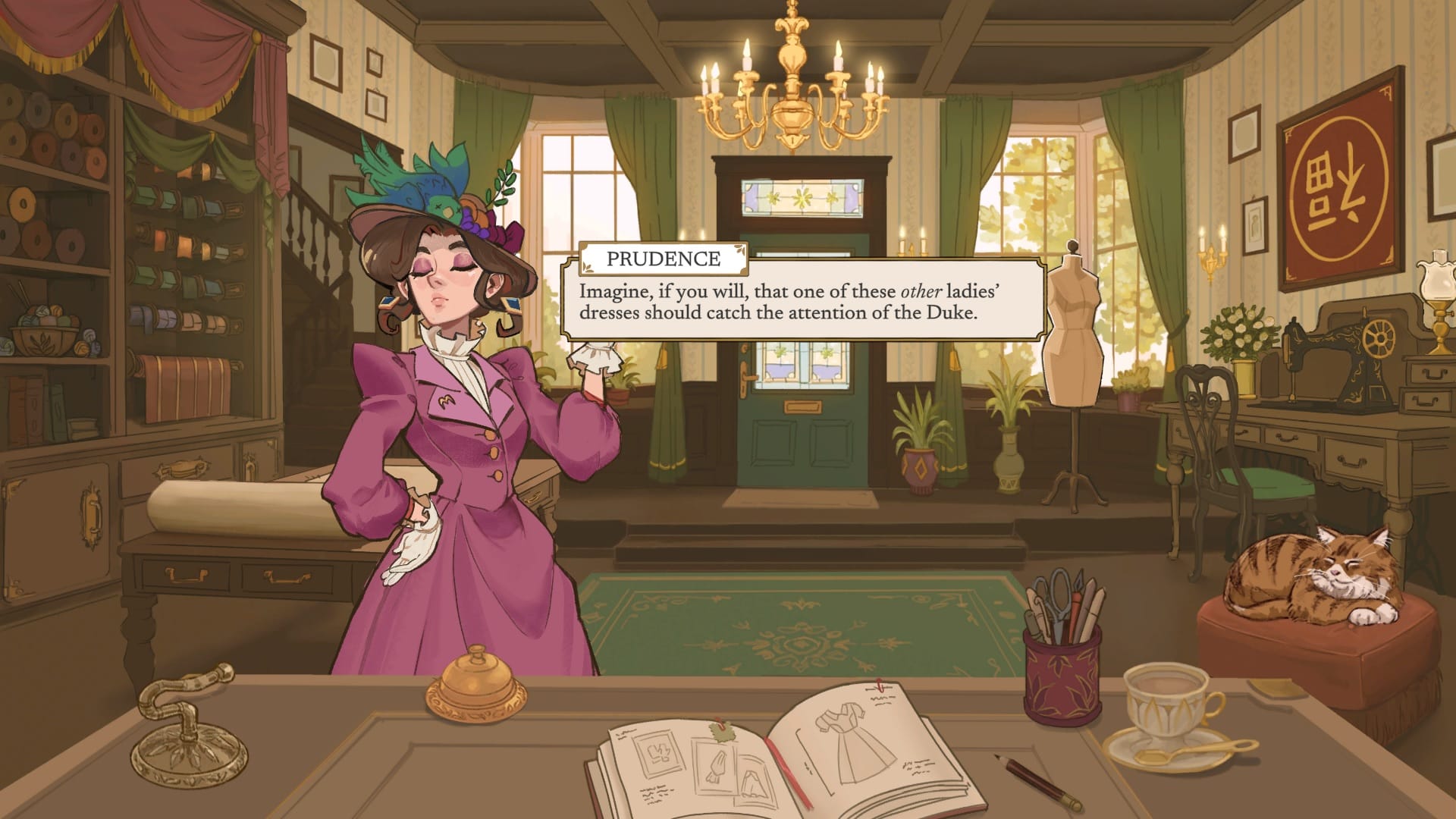
In this absolutely adorable sim game, you run your very own dress shop in a fictional semi-Victorian, semi-English town, crafting beautiful pieces for the locals to wear while learning all about their fascinating, fairytale-esque lives. You befriend local celebrities and nobility, get adopted by a pigeon, and occasionally experience the supernatural (all perfectly normal things for a seamstress, right?)
While the game is incredibly fun (I mean, sink-hours-in-only-to-realize-at-2-AM fun), as a fairly crafty and fabric-inclined person myself, I have to wonder how accurate this simulation is to real-world dressmaking.
What Dressmaker Gets Right
This sim is far more detailed than many people realize; opening up the game for the first time felt immersive enough that I was concerned about how the dresses would fit my clients and a bit sad I couldn't actually see them wearing the finished pieces.
Dressmaker goes into quite a decent amount of detail when it comes to the actual design portion of dressmaking, as well as the fabric orientation.
Pattern and fabric selection
In Dressmaker, the commission process starts with drafting a pattern: you pick pieces from your pattern collection you think best match the theme and attributes your client wants, then choose potential fabrics, colors, and accessories to finish the look. You set your dress form to your client's measurements, then pattern pieces adjusted to those measurements go into your inventory.
This is pretty close to the real world; when you're selecting a project to work on, whether it's for yourself or other people, you typically want to make sure you've got a pattern at least in mind before you start grabbing for the fabric racks. Real-world patterns may be designed for a whole garment such as a dress, but it's perfectly possible to mix and match pieces from your favorite patterns to get the look you want in the end. And it's definitely true that you need to adjust pattern sizing to match your or your client's measurements, though this is less accurate in the game (more on that later).
What Dressmaker really nails is fabric selection! The game has such a wide variety of fabrics to choose from, with everything from burlap to patterned silks and so many in between. The game categorizes these fabrics not only on the vibe that they give off — gothic, eclectic, cute, etc. — but also, crucially, on the weight of the fabric, though they only go so far as to say warm or cool. Choosing an appropriate fabric weight is incredibly important in real-world garment making, as it can change how comfortable and realistically wearable the finished product is. For example, you wouldn't want to wear a heavy wool dress in the summertime, or a light linen dress in the winter.
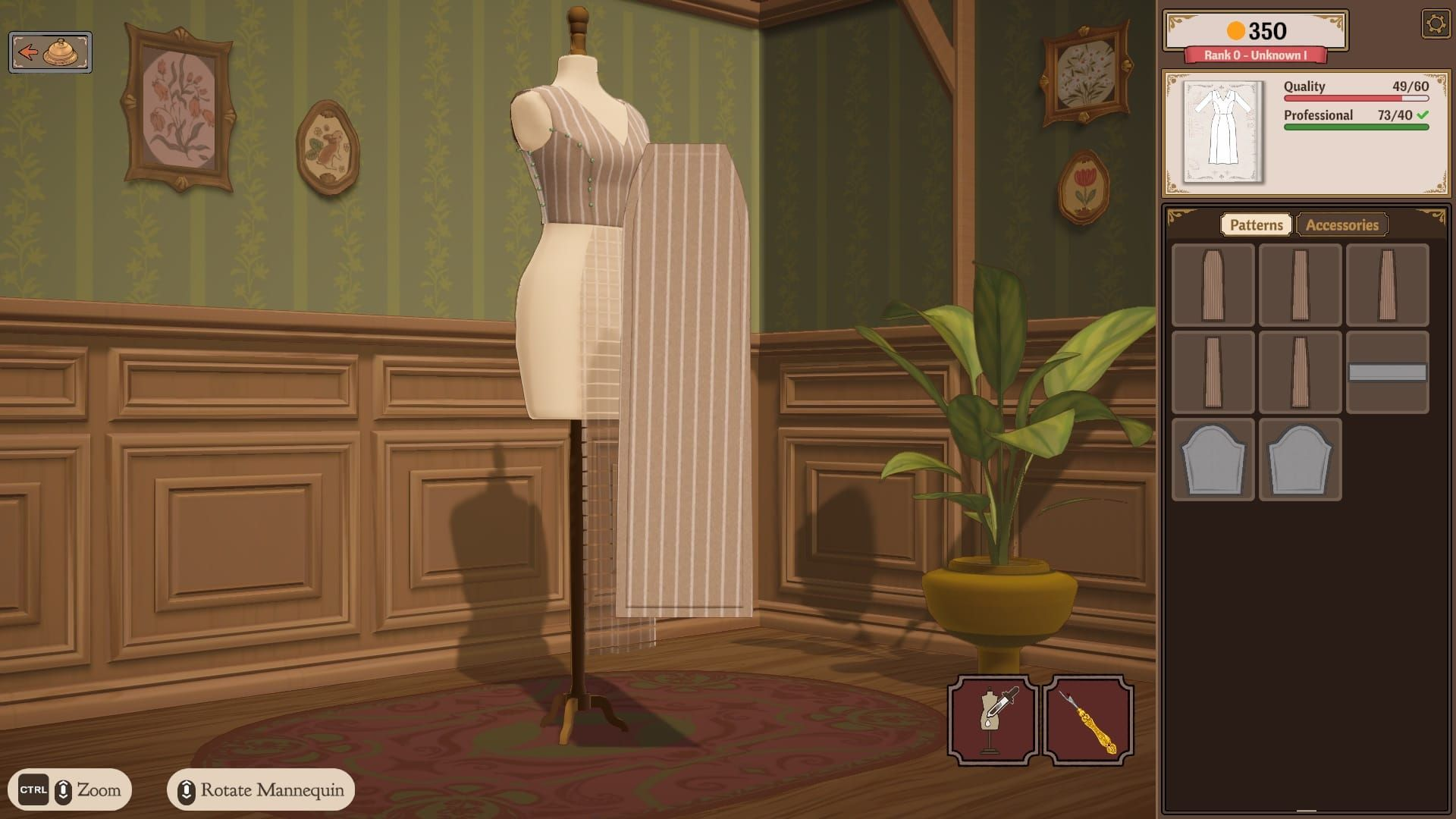
Dressmaker also fairly accurately reflects the relative pricing of the fabrics it presents. Cottons and linens are relatively inexpensive in the game, which is true to life, while silks and complex dye jobs and patterns are more expensive. I appreciate this detail; it makes me more conscious of preserving the fabric I have and using it up before I buy more materials. As every crafty or fiber-arts-obsessed person I know can tell you, this is a skill that takes serious discipline to develop in the real world.
There is no free burlap in the real world, sadly...well, unless you're taking apart massive rice bags, I suppose. Still have to buy the rice, though.
Cutting and grain direction
Another fascinating inclusion in the Dressmaker dressmaking process (as redundant as that sounds) is cutting out the fabric. While this might seem simple at first, I was impressed by the level of detail in the game for this part of the process.
To begin with, you are generally trying to save as much fabric as you can. Because you have to pay for materials, you're encouraged to use up the fabric as much as possible before cutting off scraps or buying more. You're also given a low-cost (well, no-cost) fabric in Burlap to make mockups out of to decide if you like how something fits together, which is an important part of the process in real life.
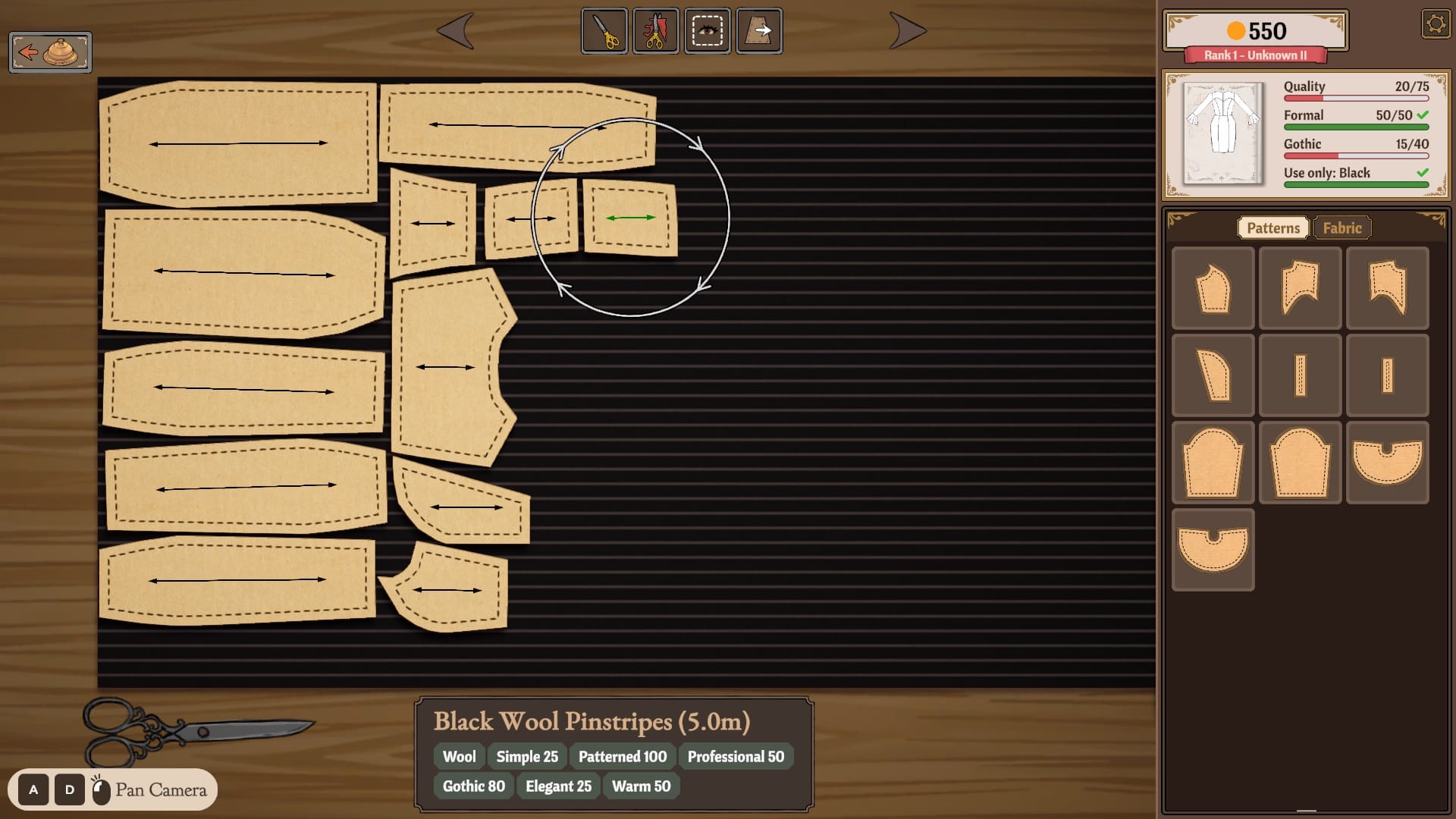
Beyond this, there's a mechanic for how the pieces are cut in relation to the grain of the fabric. Fabric grain refers to the direction in which the threads of the fabric are woven on a loom. Typically, a bolt (or length) of fabric is created in a large rectangle; it'll have threads running vertically (called warp threads) and horizontally (weft threads) throughout. The warp threads, because they are the original foundation the weft was moved through, are stronger. The weft threads (because they were doing the weaving) are more flexible and elastic. Thus, how you lay down a pattern piece on the fabric changes how it fits; a piece cut straight on the grain will be stronger, while a piece cut on the bias (diagonally) or across the grain will be more flexible.
Dressmaker incorporates this with a percentage you can match to grain lines on the pattern pieces to improve the quality of each piece and the final dress, which brings your score up. You typically need the skirts and front and back bodice pieces to be straight on the grain, while you might have sleeves or side pieces of the bodice cut on the bias, which is true to life. I find this adds to the challenge of fabric conservation; yes, you might be able to get more pieces out of your fabric if you ignore the grain, but the pieces will be lower quality, affecting your score.
What Dressmaker leaves out
Even with all of this brilliant detail, Dressmaker doesn't get the process 100% right. This is intentional; the developers have said themselves that they wanted to focus more on the fun design and creativity aspects of dressmaking than the nitty-gritty details.
Measuring and sizing
As I mentioned earlier, you have to measure your client and size your pattern pieces in Dressmaker, but the way it's done in the game is far more simplistic than in the real world. Real dressmakers need upwards of 20 unique measurements, including the bust and underbust size, waist, hips, upper arms and wrists depending on sleeve length, torso length, and skirt length (from your hip to your ankle or wherever you want the dress to sit on your leg). If you tried to make a dress with only the three measurements from Dressmaker, you'd run into quite a few problems very quickly.
I'll also note that the sizing range is limited. Just for fun, I tried to input my own measurements to make an off-the-rack dress for myself, and I couldn't adjust the mannequin out far enough. For reference, though I'd rather not give out my specific numbers, I am generally an XXL in dresses. Smaller sizes can definitely do this, but there's no way for larger plus-sized people to input their measurements. I don't really find this to be a flaw in the game, however. I'm well aware that the developers couldn't include infinite sizing; I'm sure the optimization on that would be a nightmare. I just thought it was worth mentioning because it means the game couldn't be used to accurately ideate projects for larger bodies even if the rest of the process were spot-on.
Fabric alignment
Though the grain alignment mechanic is interesting and fairly realistic, Dressmaker ignores many other important parts of fabric alignment. For example, if you cut from a patterned fabric, you really don't have to think too hard about how the pattern will line up on the seams; the game automatically adjusts for that so it always looks good. Personally, I like that they left this out — less headache for me!
Sewing details
There are also a bunch of little sewing details the game completely ignores:
- You never have to gather your fabric for things like the Milkmaid Bodice, and you don't have to hem anything at all.
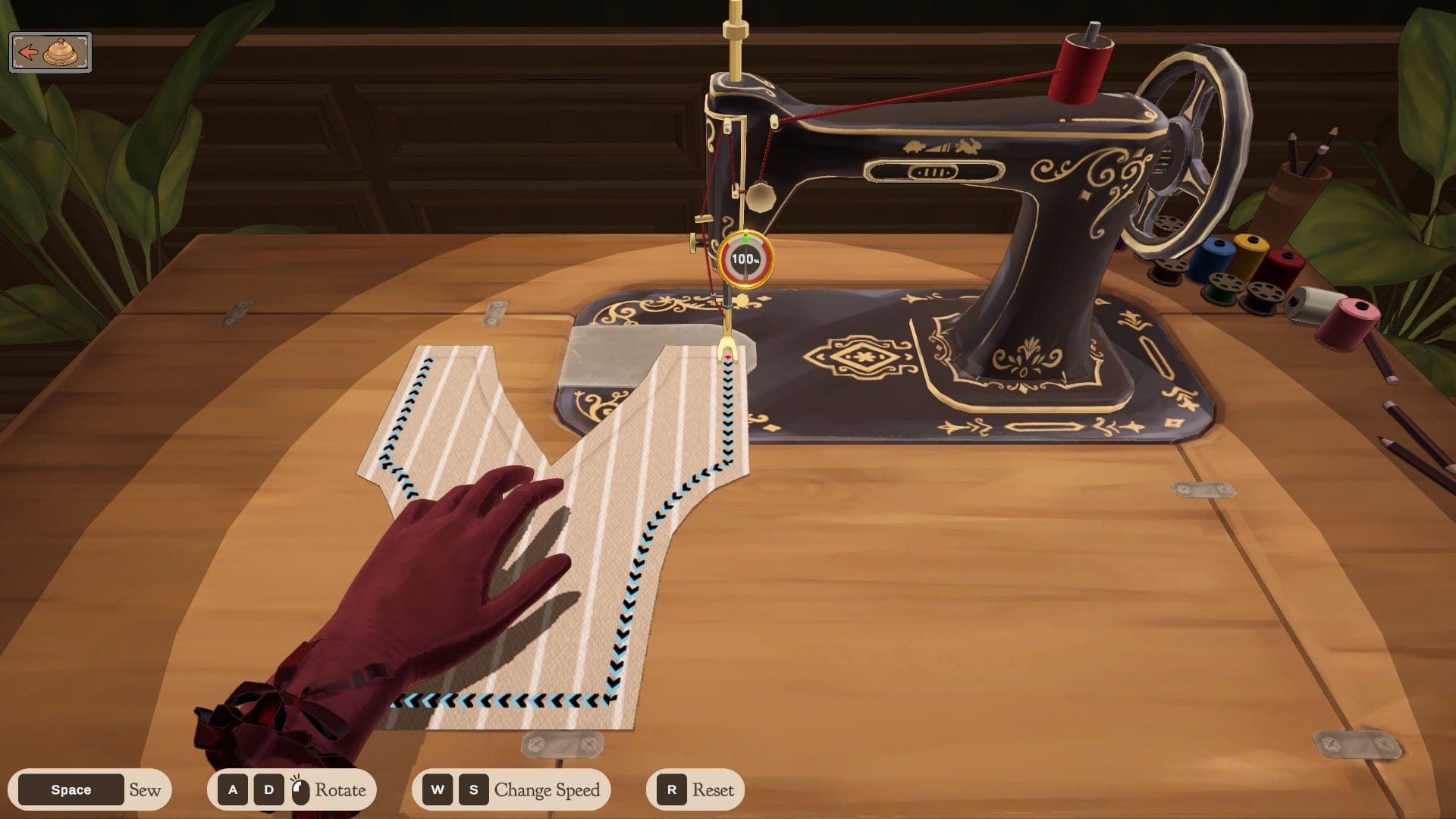
- You never deal with your sewing machine snagging or jamming, and you don't have to replace the needle or even match the thread color to the fabric (though I believe that's coming in an update shortly).
- You don't have to measure your seam allowance (that's done for you), and you don't have to sew on the accessories at all.
- Your scissors stay sharp and never snag or tear the fabric - nothing does.
- You don't have to pink your edges (cut them in a zig-zag pattern) to prevent fraying, nor do you have to clip any corners.
- You don't have to turn your fabric after sewing it right sides together.
You also don't have to deal with the awkward positions necessary to cut pieces, pin fabric, drape, or sew long pieces together, which I'm sure everyone is thankful for, but I imagine my little Dressmaker character doing it anyway.
Is Dressmaker an accurate dressmaking sim?
The short answer is no: Dressmaker is not an accurate dress construction simulation, but it was never designed to be. This game was, according to the developers, never meant to be a 100% faithful recreation of the garment-making process. It is, at its core, a fun little cozy game that you're supposed to be able to pick up and enjoy, with just the right balance of immersive detail and easy access for non-sewing players.
I don't think Dressmaker would be a better game if it included all the nitty-gritty details that come with creating a dress in real life. I like the level of control I have over the process already; anything deeper might cause me to lose enjoyment and play less. It might stifle the creativity that this community already shows, and that would be a shame.
I love Dressmaker for what it is: a sweet, fun, and often funny game about designing pretty dresses for interesting characters. And hey, maybe one day, I'll take that inspiration into the real world on my own terms.
Join the conversation
What do you think? Reply below to share your perspective.