How Bloodlines Change the World
Recounting my experience with Old World

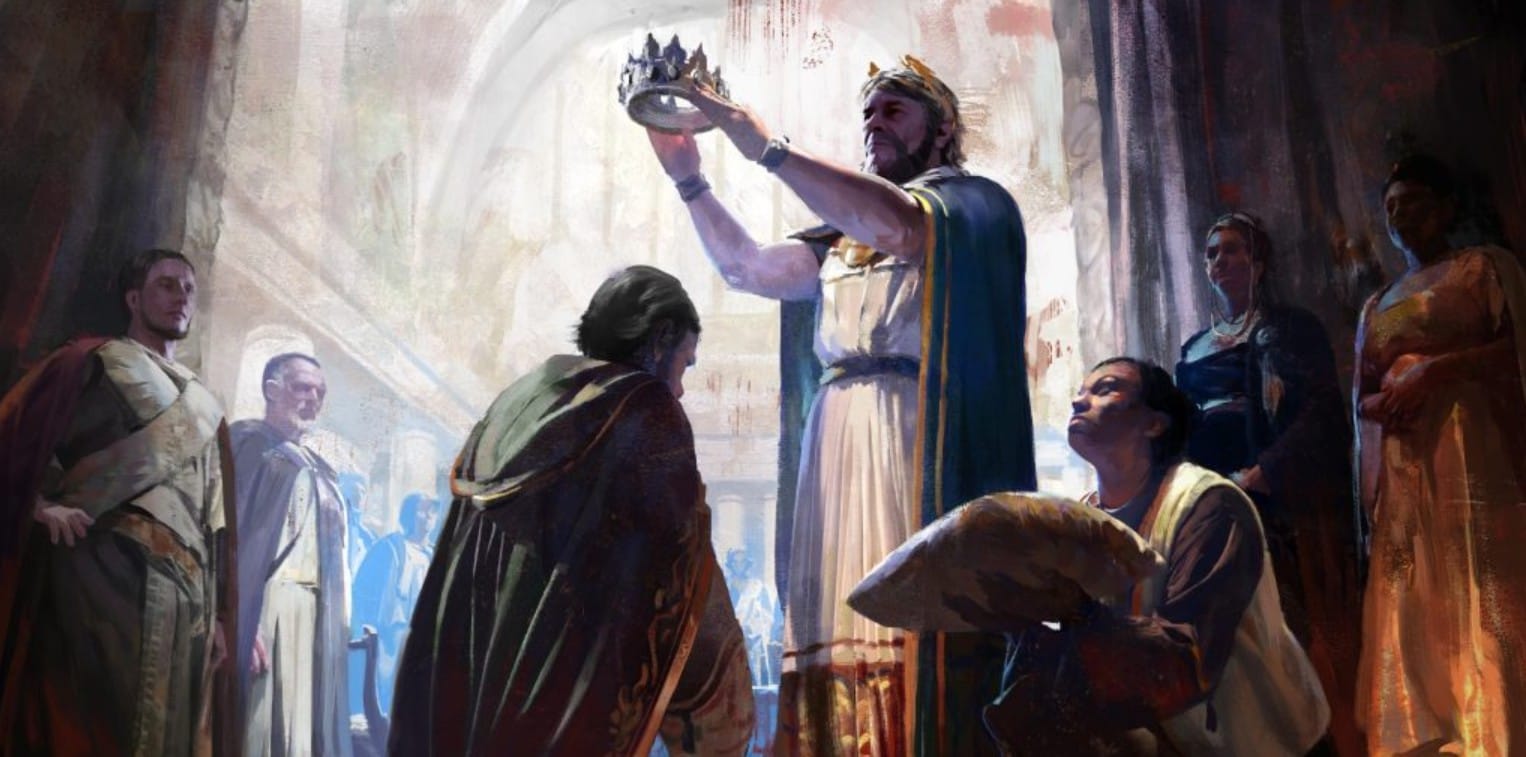
One of the most important parts of history is the rise and fall of the various dynasties littered across cultures. As empires come and go, the families atop these governments become staples, immortalized in culture through the arts, coming in the form of sculptures, books, and of course, video games.
Old World, the 2022 grand strategy game from developer Mohawk Games, features interesting innovations on the nation-building game formula. Rather than offering a selection of global nations, it focuses its sights on the diverse cultures that made up the Ancient Mediterranean. From here, each of these civilizations has multiple leaders to choose from, influential in the culture's development, and with a family to follow them throughout history. Each of these leaders is different, offering players a variety within each different nation to begin their dynasty. While each culture has its own hallmark research topics and structures, the starting characters and decisions that follow propel the events of this narrative-driven strategy game.
In my playthrough, I began my journey as “Pericles the Founder," a versatile statesman and founder of Greece, married to Queen Consort Aspasia, who, for some reason, was already upset with me. I focused on trapping as my initial research to take advantage of the resources around Athenai, the capital of what would be Greece, and set off into this new world. It only took a year for me to realize why Aspasia was disgruntled with me – pregnancy will make anyone irritable. In an effort to please my unhappy wife, I chose to name our newborn daughter after her, born in the second year of our nation's founding.
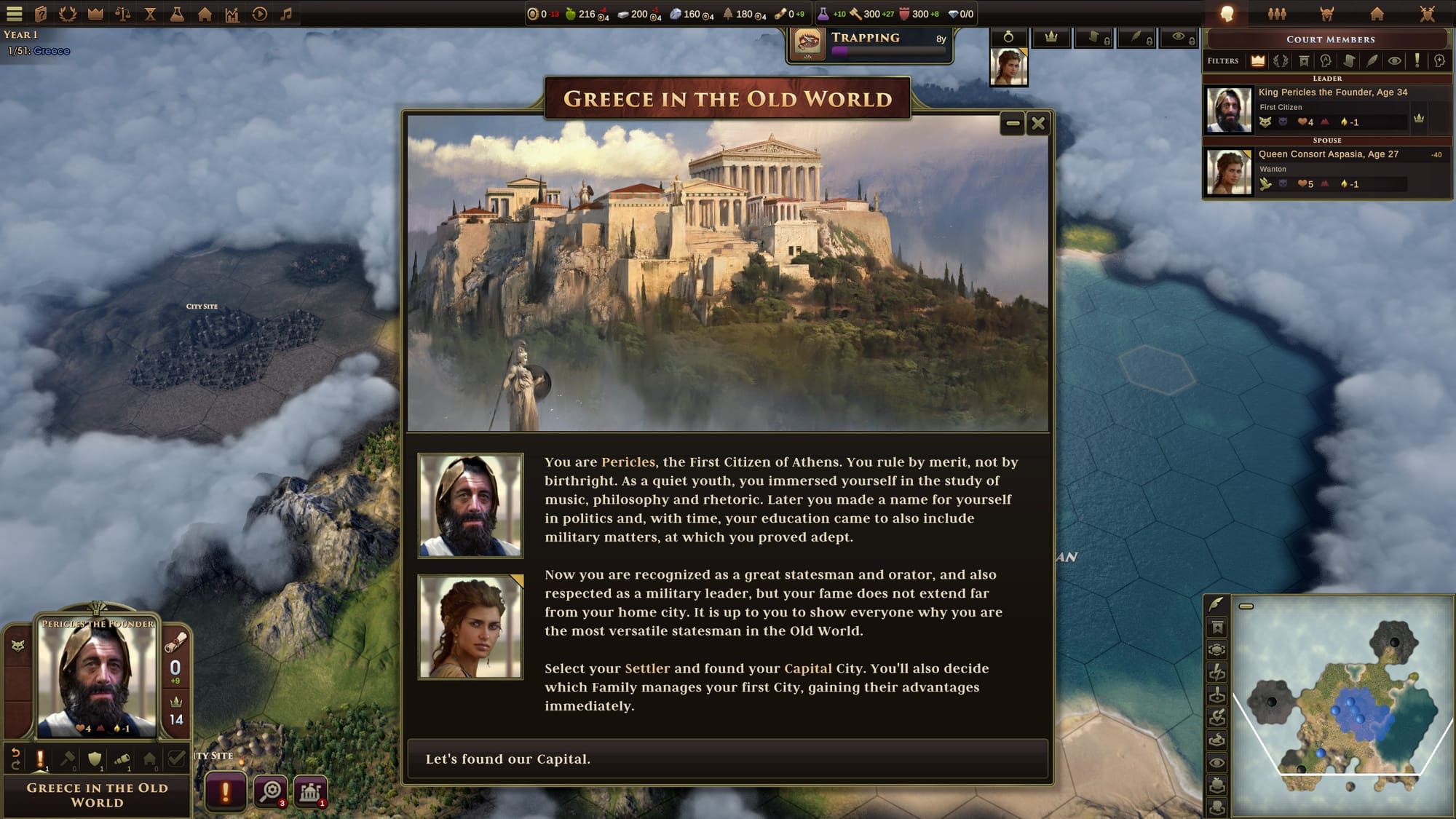
Old World has some familiar trappings of the strategy simulation genre. I can eventually become governor of my capital or offer the role up to somebody else in my court, the former bolstering my city's development. As I take the job with honor, it's only two years later that I become “Pericles the Settler,” with the foundation of Trapezus, the second settlement under my control. It's also worth noting that the years of Old World are depicted as "Year One" and so on, rather than having an assigned year or date.
The key actors of this game always seem to bring something with them, turning the pages of your nation's history with their own stories. Leonidas enters Greece with his knowledge of civil government to help propel us forward to a modern civilization. Sappho is exiled after a political scandal, allowed to roam freely in other lands, and eventually joins a rival family. Cultists are found living in ruins on a hill near a mountain range, and I allow them to continue their worship and even put up a shrine in what is now my land.
The daughter who soured my wife's mood towards me in the early years has finally turned 10, meaning it's time I formally teach her about the world. It's here that I must confess that my knowledge of world history is limited – it's been quite some time since I've been graded on my ability to remember dates and why they matter, and I was only ever so good at that anyway. I took the time outside the game to glance at who Pericles was when he was alive, and thus decided to teach Aspasia about commerce so she could go down a similar path as an Orator.
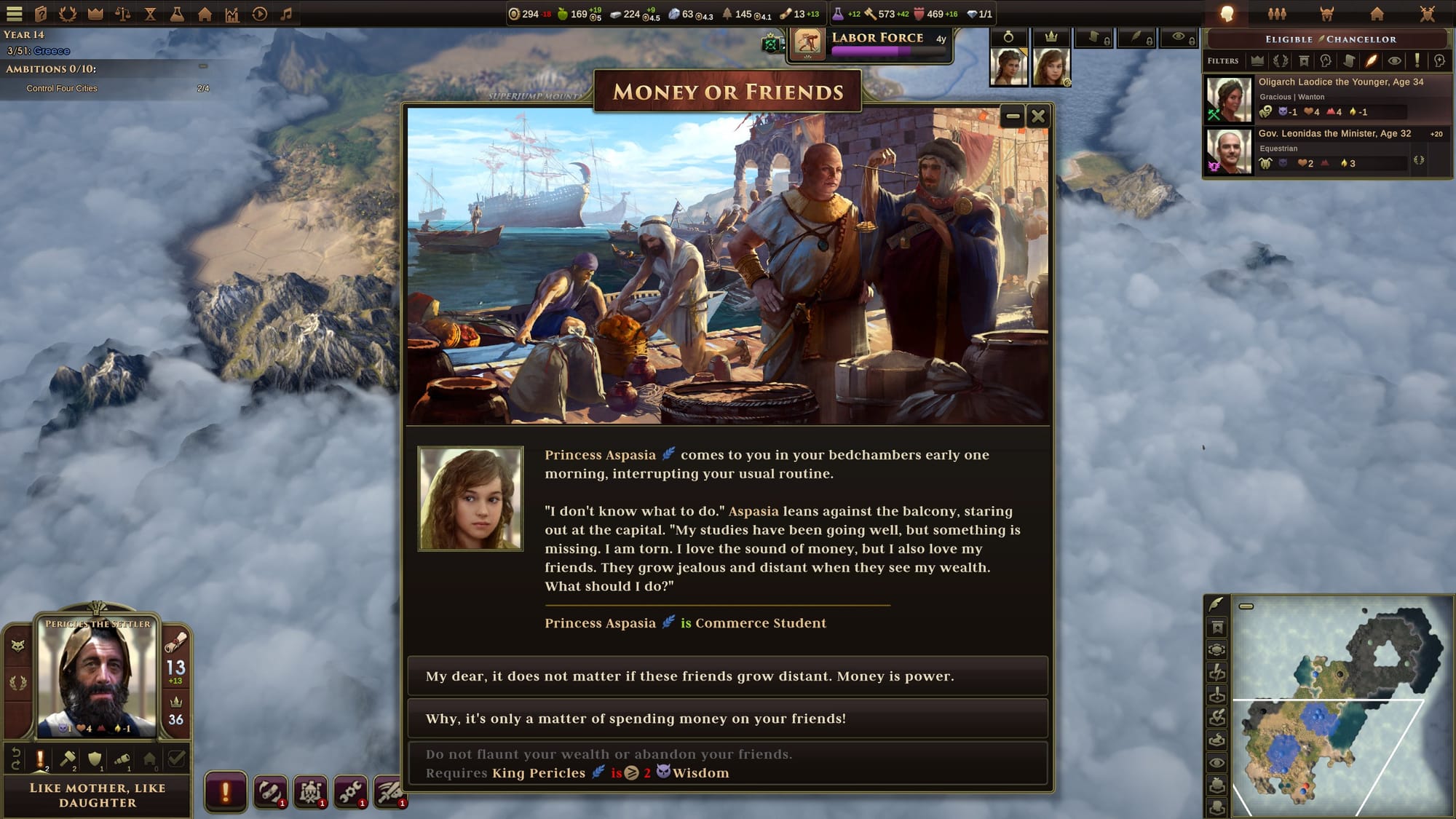
My time as a Grecian statesman comprised my first playthrough, and while I've managed a handful of other nations since then, I found that this first endeavor into Old World was more narratively fruitful. My first mistake would ring out through the rest of my playthrough – not knowing how to manage my money. Where Greece had been making some small profits for Years 1-12, it hadn't been enough to hire a philosopher to the court that my wife wished for. Her opinion of me soured more, yet I would not give up any of our resources. In a sort of irony, my daughter would ask me about a situation with money. Since Pericles isn't wise enough to tell her that money isn't everything, I tell her that she can spend money with her friends however she pleases, and this decision would set her on a path from which I could not save her.
Old World is made of ebbs and flows, bouncing gameplay developments with characters and stories that will throw a wrench into things. By Year 24, King Pericles the Pioneer turns ill. Rather than ride out my golden years sick and on the throne, I abdicate the throne to my daughter. Remember how earlier I told her she could spend her money with her friends as she pleases? That lesson alone formed her into a lackadaisical sort of person, and as an adult, she's become an alcoholic. The first thing she does is remove the cult of Aphrodite, those who have been dwelling in the mountains since before our arrival; their religion is gaining too much influence over the city. To make matters worse, we've been at war with foreign invaders for a few years now. I, as Pericles, lived a taxing life, and I can't help but feel guilty for my ignorance. Maybe my wife was right about that philosopher after all.
By the 33rd year, Aspasia had brought many positive developments to the throne. The neighboring Danes offered their leader, Rorik, to be her husband in an effort to unify the countries, and he sits on the throne as King Consort. Through this, it's discovered that the people of Carthage have been spying on Aspasia, and their agent is dispatched expeditiously. Where Pericles' time was focused on building a nation, Aspasia's era is to make the people of Greece happy and safe as we advance towards the future. Only a year later, Rorik and Aspasia give birth to Arisonoe, and in a similar fashion, the throne still can't afford to hire a philosopher to the court.
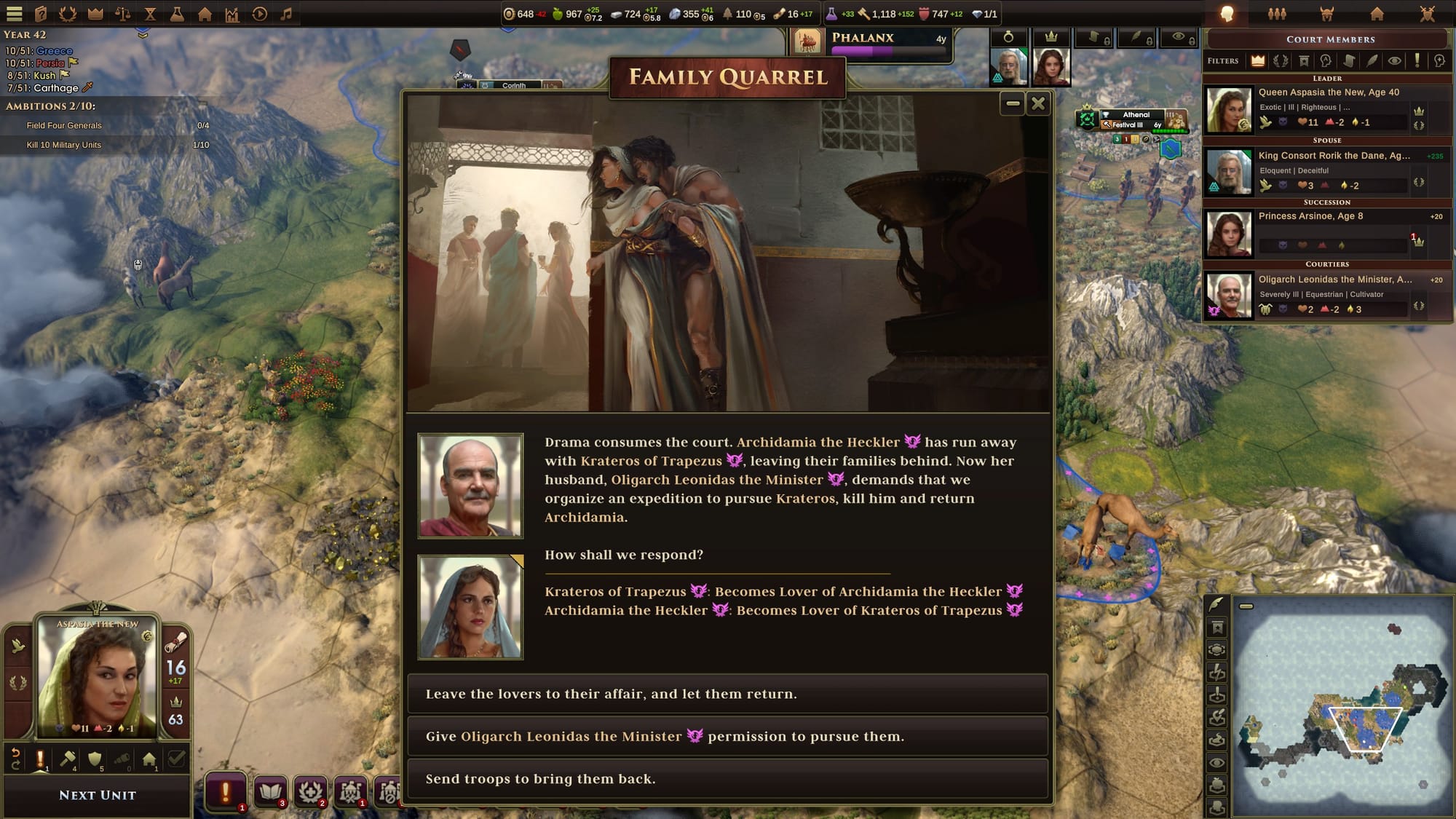
Some of the narrative events of Old World can feel more random than others, harder to pinpoint their causes. From a narrative standpoint, combining self-prescribed ideas with flavorful text that drives the concepts home, Pericles' sickness comes and goes while his daughter is on the throne. He's healthy again the year she takes over and only gets sick again towards the end of his lifespan while he's back in the political seat as governor of Athenai.
In the early 40s, things continue to take a turn for the worse. War erupts across the country from both the people of Carthage and Persia. Our lack of military might holds us back as we scrounge up soldiers, but governors in the cities fall ill and perish as well or simply make poor decisions. In Year 44, only a year after the passing of Pericles, Aspasia is doomed, sick, and close to death, and Arisnoe is only 10 years old.
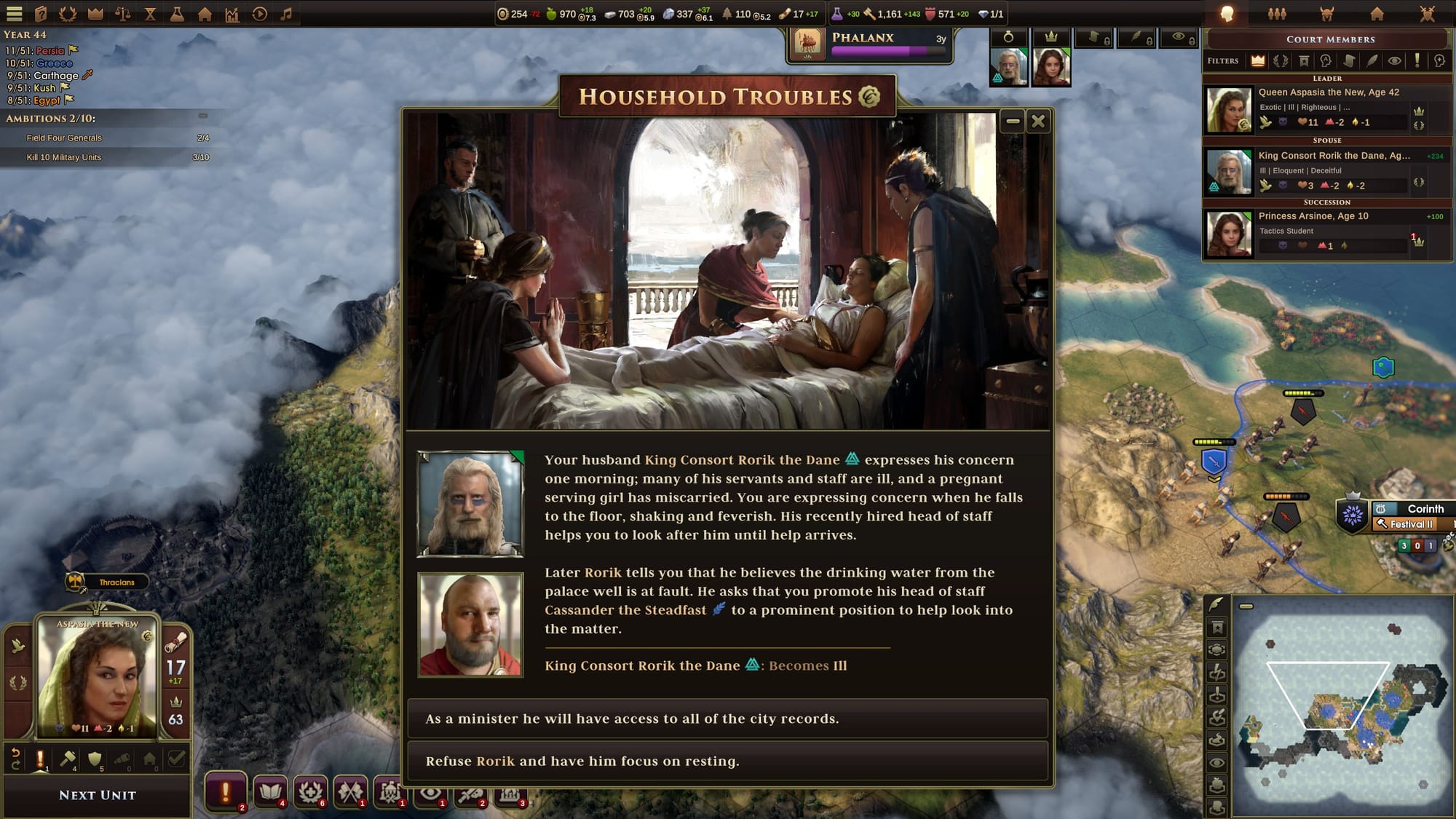
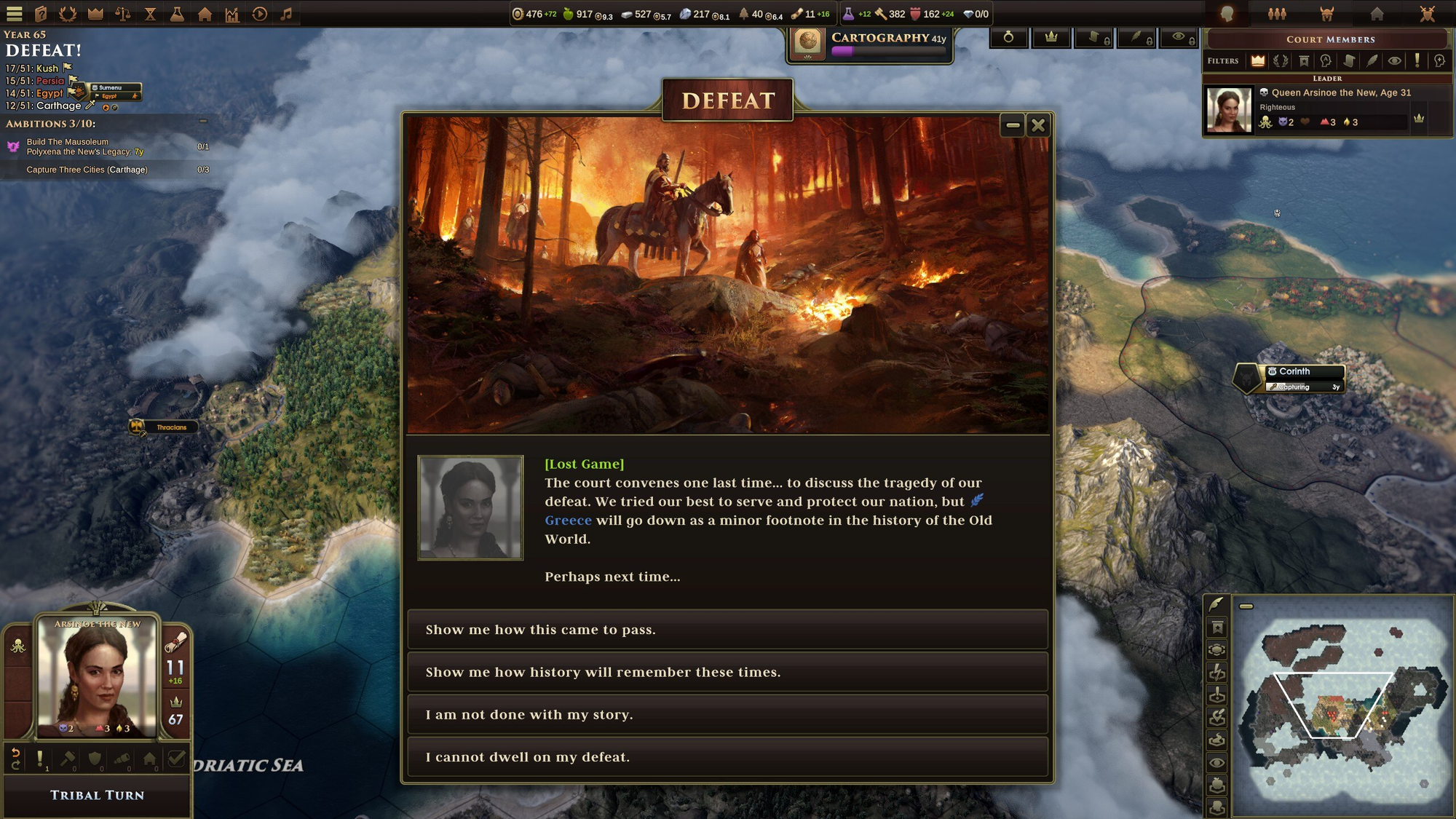
In Year 45, disaster falls. Both the King and Queen die from their illnesses as war ensues on Greece's borders. Arisnoe is still just a child, so a court member arrives to take the throne until she turns 18. By year 52, Arisnoe has been raised as an orphan during nearly a decade-long war with Carthage. Rather than pursuing commerce like her mother, she learns military training, the last chance to stop the nation from collapsing. As she turns 18, Polyxena, the regent queen dies of a sudden illness, making way for Arisnoe. As the 50s arrive, city after city falls to barbarians from the south and Carthaginian soldiers from the north. First, Trapezus. Then Thebes. Then Argos. At 25-years-old, Arisnoe takes to the battlefield in Corinth, and in an insane twist of fate, she's spared from death after being rescued by one of her soldiers and returns to the capital. It doesn't take long before Athenai falls to constant attacks.
In my story, Greece is a nation that couldn't make it to a century, with three rulers to take the throne, each bearing the sins of the last. An unwise settler, a listless queen, a daughter forged in war. When I play strategy games like this, or games in the Civilization series, I tend to go with the flow, making decisions on the fly and doing whatever feels natural. While this isn't optimal, Old World rewarded that behavior with a developing story.
I've started new playthroughs in Old World a handful of times since this initial story, and each of them has been different. No two rulers have been the same, nor have their developing moments and national impacts. Each war has demanded something different, each bloodline resonates with different ideals, and each story branch has led to something new.
For a long time now, I’ve thought about ways to transcribe my playthroughs in nation-building games, opting to recount the events as if they were going into a history textbook. The issue I’ve found with this, after multiple attempts, is that the focal point of a nation isn’t gripping when a face isn’t attached to it. Where other games draw on distinct historical figures that work as gameplay mechanics rather than characters, Old World bridges the gap through story developments that act as motivators for gameplay. I applaud Old World for its ability to weave story and gameplay in a way that the historical strategy genre has very much inspired its players, and very clearly benefits from.