Shadow Labyrinth Won't Be Consumed
Everything has always been there

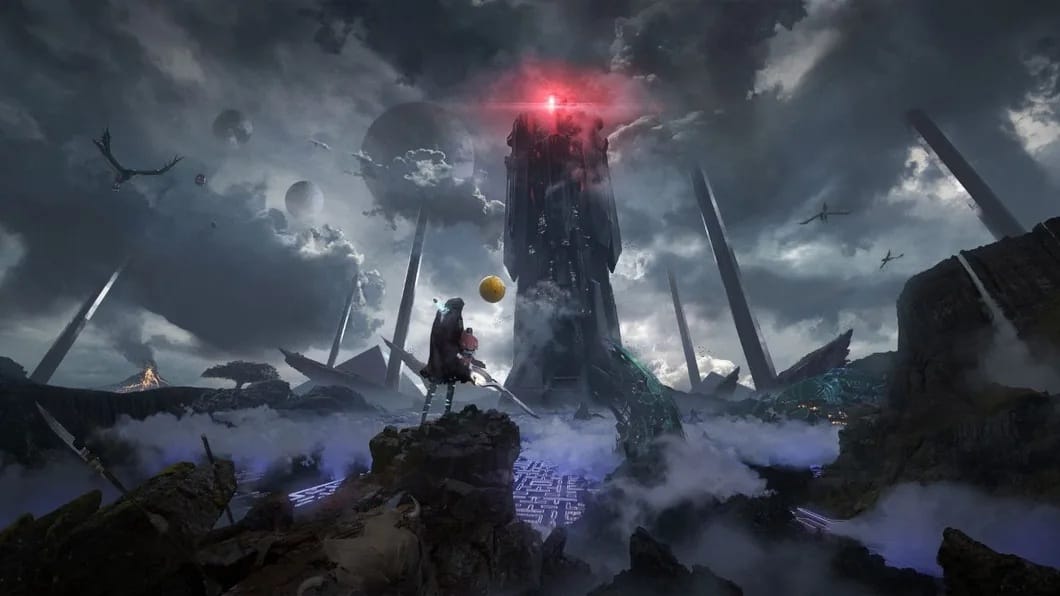
I don’t think there’s any new kind of recontextualization going on, to be honest.
The thing is, every piece of art is recontextualized through every person engaging with it. When you actively influence its outcome, as is usually the case with those things we call video games, that context is even less rigid. Of course, watching a movie when you have a cold will change your perception of it, but the movie will remain the same. Playing a game when you have a cold is a different beast entirely. It will resist your advances, and as your spatial awareness suffers and the brain fog makes it harder to gauge timing, you may not even be able to advance. It’s also arguable how much intellectual prowess and literacy are needed to be able to “advance” on movies and books, but they are, mostly, uncaring. The pages will be there, the scenes will advance. Your presence is irrelevant. For games, though, solipsism is kind of the key. There are even games that only move when you do! How odd is that? Why is your presence so important?
It is because your context as a player matters. Your mood, your skill set, your time, your culture. Every game is recontextualized by the player inhabiting it. In that sense, it was never stable enough to possess a single context to begin with. Therefore, rebranding is not recontextualization: playing is.
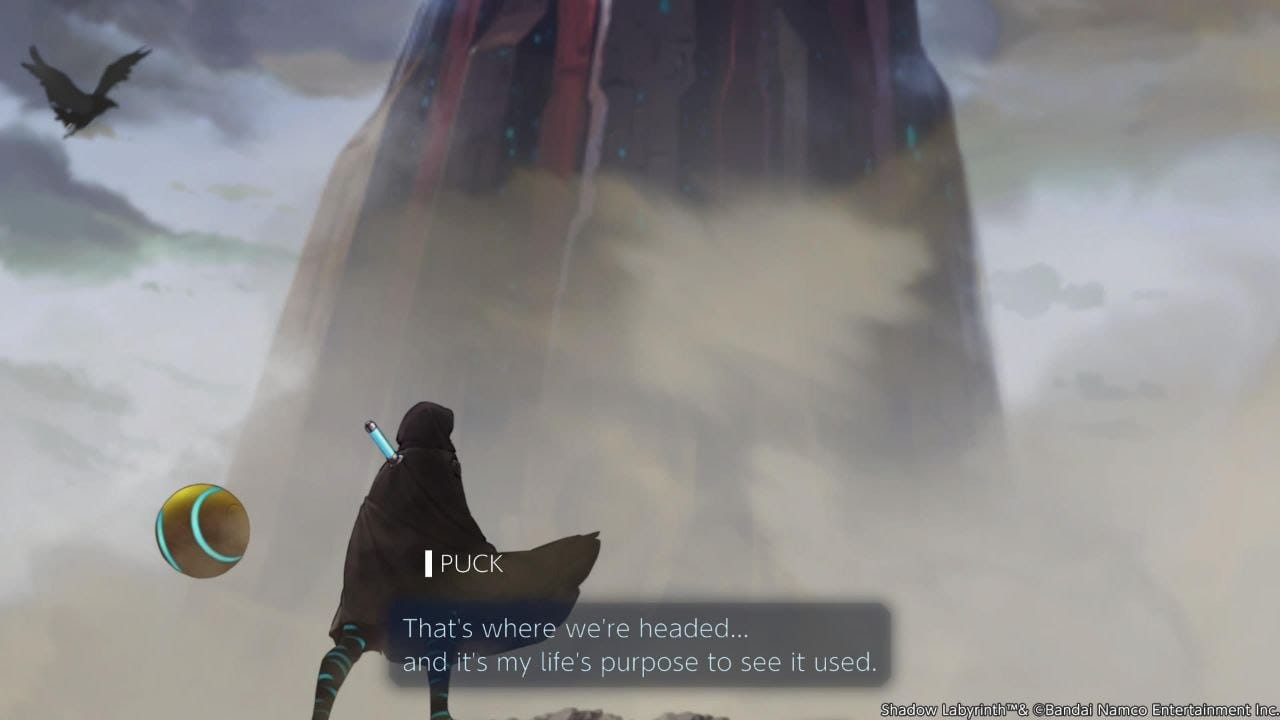
When Shadow Labyrinth was announced, as a kind of recontextualization of Pac-Man, and people spoke, and spoke deeply, and had less-than-graceful opinions about the concept, I was kind of confused. Is that really far from the original? I always thought the original Pac-Man’s ethos was something so abstract that it was very possible to apply any aesthetics to it successfully. Pac-Man 2 was already a corporate recontextualization; Hell, even Pixels was one. Were people just thinking that Pac-Man has always been Pac-Man World-adjacent? Why was Shadow Labyrinth treated differently?
Is it because it takes itself seriously?
What I’m getting at is: what do you mean you have never thought about geopolitical tensions when playing Pac-Man?
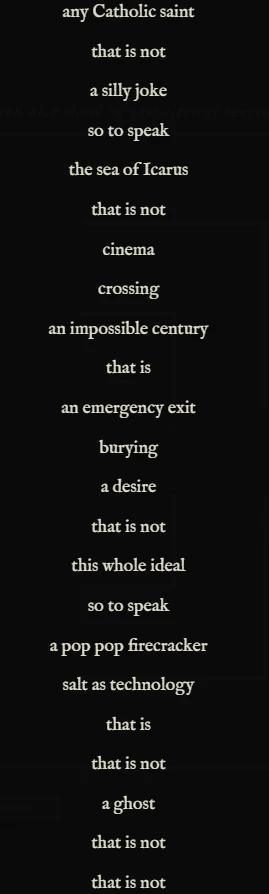
This project, by poet Stephanie Fernandes and coder/knitter (very similar crafts, really) Mayara Stelmaschuk Melo, plays with the idea of Pac-Man navigating a maze while thinking (speaking? consuming? creating through consumption?) a poem that (can be) about eurocentrism, and colonialism, and love, and excuses to invade other countries, and excuses to never believe in anything. There are no ghosts - of course, the idea of geopolitics is haunting enough - and there are no walls - of course, there are enough walls in geopolitics - there are only words, and Pac-Man, and your will to eat all of the excerpts and derive meaning from them.
Stephanie told me the idea evolved from another project she had, one about using train tracks as the synthetic construction of poetry. The need was to use a pre-existing technology to sublimate the poem - something that can be observed from things as simple as writing with a pencil (a piece of technology as well) - because humans also created that existing technology, "An obvious concept that is being distorted by extractivist A.I." she noted.
Mayara, then, told her that she thinks the dynamics of Pac-Man were similar to immigration, and so things evolved through an Excel sheet, and then, finally, to Touch Designer; more intertwining tools, shaping the piece.
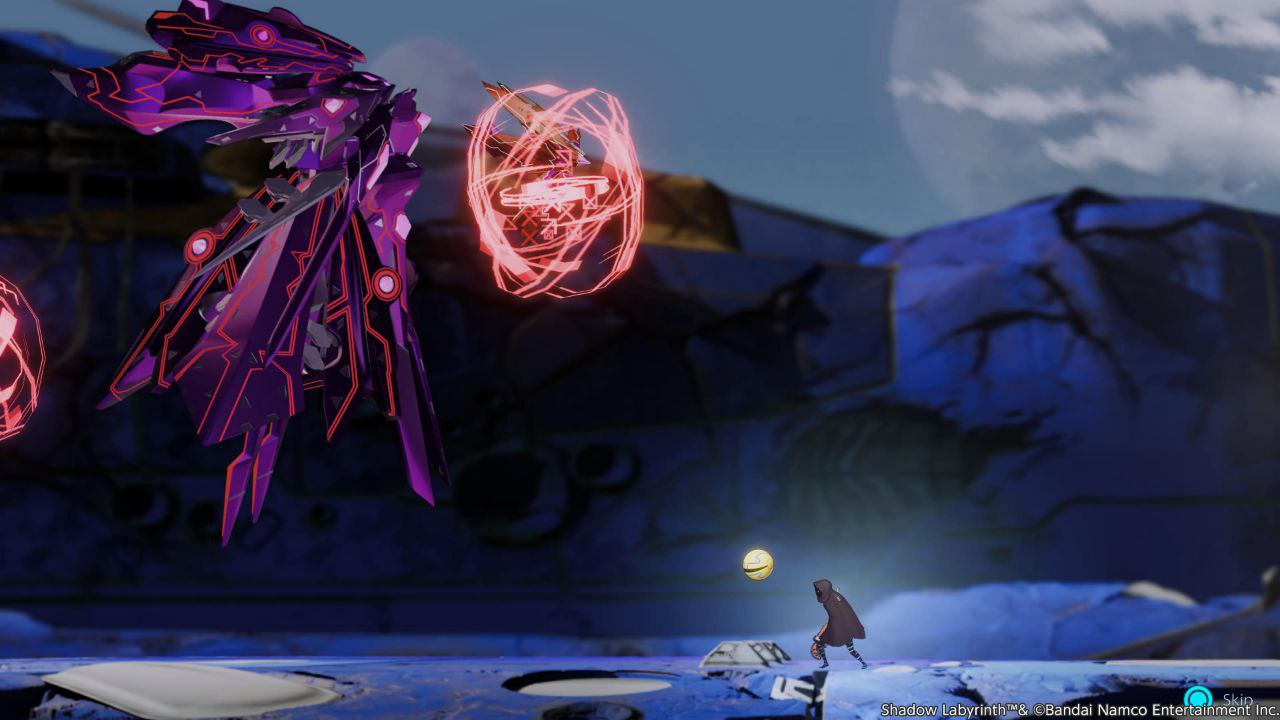
Shadow Labyrinth is a game about people who had their whole planet brushed off as collateral in geopolitical warfare, of the "galaxian" kind, not the "continental" kind. It explores a lot of lore regarding Bandai Namco's decade-spanning UGSF history, and it does that by using one of their most recognizable brands - Pac-Man. The idea of Pac-Man being part of a universal "canon" is fun enough, but apart from references to the history of Namco (and, by extension, videogames themselves) as idols to be rewritten, it is very much a free-form narrative tackle that aims very high on its aspirations.
Its opaqueness (somewhat alleviated by post-release patches that tone down its difficulty a bit) was much to its commercial detriment (a good sign for art, a bad sign for art that wants to keep existing), but its aesthetics were its main detractor. Not even in its "graphics" or "visual" side, although on that too, but mainly its pure conceptualization.
The "edgy reboot" is scrutinized as the usual procedure. I think that the problem runs a little deeper, here, however - what a piece of art means is not usually what it is. Pac-Man may as well have meaning about immigration, of course, but it isn't necessarily about immigration. What Sontag argues in Against Interpretation holds true:
Real art has the capacity to make us nervous. By reducing the work of art to its content and then interpreting that, one tames the work of art. Interpretation makes art manageable, comformable.
Against Interpretation - Susan Sontag (1964)
The great beauty of art lies in the clashing of possibilities and in the way our baggage interacts with it. The True Meaning is something that will never be achieved (even with the author's intentions clearly stated), so interpretation can never be factual. Decoding is something akin to playing as well - even outside of videogames - and play is a tool of learning, something that will be reinterpreted by the subject's own synapses. It is, therefore, very contextual! And so, every different interpretation is a recontextualization.
Where I believe the issue with the (un)popular reception of Shadow Labyrinth lies is in implication. The possibility that something suggests a different grandeur than its previous iterations is seen as an interpretation that became Fact, a victory of presumptuousness, and, therefore, an iconoclastization of the simplicity that people fell in love with.
It takes - or creates - one of the many interpretations of the original Pac-Man and builds a different set of ideas on top of them. Games usually don't afford that kind of distance, but Shadow Labyrinth is very honest about it. Pac-Man - PUCK, in this version - needs you. They need your body to travel, and they follow you, and it assigns meaning through you. It's not by mere chance that it is a kind of Isekai story - someone was playing Pac-Man, and now there is only their portable gaming device lying on the floor. At the same time, a body awakens within the fiction, and a yellow ball gives them enough power to swing a sword.
Following Sontag's postulation - the fear that interpretation replaces art instead of showing it - it is understandable that there would be some trepidation around the idea of Pac-Man "becoming" its Shadow Labyrinth version, as if every previous version, every recreation, every pizza with 7 slices left, would be forever tainted by those same big aspirations, in retrospect. The fact that it is an Official Product® makes it seem as if there's no other way around it, as if this particular interpretation had been sanctioned as a correction, a fear that the simplicity of Pac-Man was now allowed to be read as naive or lacking meaning. Therefore, the rejection is, actually, preservation: keeping the object of Pac-Man intact.
The object was never intact.
To keep something intact alludes to a physicality that is not its full existence axis. It, contrary to Sontag's argument (although feeling as if it's actually in favor of it), is what replaces art. It funnels meaning into what is supposed to be a true reading of the object - maintaining its integrity - instead of allowing it to flourish through other people's eyes. The approximation of an object's true essence is not necessarily the simpler one, nor are the more complex ones. The object's essence is elusive, which leaves the player in an impossible position: the engagement with the original Pac-Man, whatever Pac-Man it was, was already intervention. It already creates the instability that Shadow Labyrinth brings to the forefront. The fantasy of untouched play is false. Everyone already recontextualized Pac-Man whenever they played it.
The fear of tainting reveals itself as a desire to believe that one has never already done so. As time passes and memory crystallizes, we start forgetting that we also moved Pac-Man through our own strategies before, as we keep believing that we were powerless in the face of a piece.
Using play as interpretation, it becomes clear that a fear of imagination plagues nostalgia. Shadow Labyrinth is also not immune to interpretation. It contains multitudes, much like the original, and, of course, it can direct players through specific means of reading. As previously mentioned, there are hints of colonialism, hard sci-fi, it has tons of fun with its references and names, it talks about family, it critiques and embraces technology, etc. You will definitely come out of it with different texts that you will acquire through play.
And at the end of the argument, using play as the means of teaching and allowing interpretation, we get an embarrassingly simple question: how does Shadow Labyrinth play?
You navigate a maze, back and forth, collecting power-ups that allow you to defeat enemies.
Everything has always been there.