State of Indie 2026 Part 4: Going International
The world beyond


Welcome back to the final installment of State of Indie for 2026! In Part 1, we looked at the year's winners and losers; we examined the scene's economic underpinnings in Part 2, and how indie games get financed and published in Part 3. To wrap it all up, we'll dive deep into the international side of indie gaming.
Video games are a global hobby, and everybody knows it. What people don't think about as much is the extent to which development is also a global phenomenon. What was once restricted to Japan and the US has now spread to all corners of the Earth, with upstart studios in small countries making big impacts.
These upstarts still need to find an audience somewhere, and particularly for those in small countries, that means reaching abroad. The Anglophonic markets of North America and the British Isles are still key for most, but other regions are rapidly growing in importance, forcing developers to adapt.
Naturally, I have to start with mainland China.
Source: YouTube.
China's Mighty Gaming Culture
I've been writing about China's gaming scene for years, before many others had taken any serious notice. No matter how much I say, it never seems like enough.
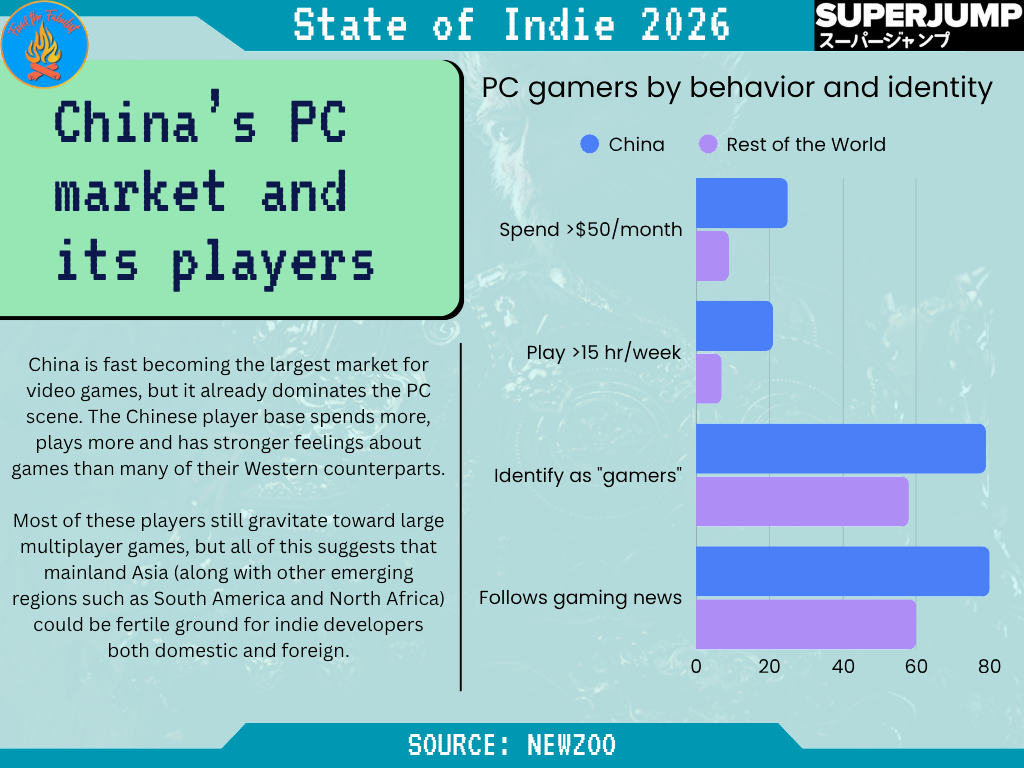
Newzoo produced a dedicated report on China's gaming culture in 2026, and it's illuminating. The sheer size of the Chinese market is widely understood, but the report digs deeper into the underpinning gaming culture and the gravity that these players exert on PC games in particular.
By most metrics, Chinese players are more hardcore than most. They spend more money and more time on games. They are more likely to identify as "gamers" or respond affirmatively to statements like "Gaming is a significant part of my life." Video games also seem to be a less gendered activity among young Chinese than in most of the world.
Of course, this all has to be considered in light of how insular the Chinese (and Korean, for that matter) video game market can be. A few foreign games have found purchase in China, mostly massive live-service games and MMORPGs. But even there, players strongly prefer domestic games. And while indies can do very well in mainland Asia, the big successes are mainly developed in China or in culturally similar countries.
It can seem like an unreachable market for small foreign developers. Then a group of filthy pirates proved that assumption wrong.
A Brief (but Important) Aside About Pirates
In last year's State of Indie, I briefly touched on the concept of game cloning. For those who forgot, this is a form of out-in-the-open piracy in which someone extracts a game's executable and assets, makes trivial aesthetic changes, then puts it up for sale on another site (or, for more brazen thieves, the same site) under a different name. Game cloning certainly isn't new, but 2025 saw stolen games distributed far more widely, including on console storefronts that are allegedly more discriminating.
The new wrinkle in 2026 is how many of those cloned games are circulating on the Chinese internet. Some end up on the Chinese mobile market, but most surface as xiao youxi (minigames) on apps like WeChat and Douyin (TikTok). Xiao youxi are no-download games built directly into the program, similar to the ones you might have seen on YouTube. But while those are treated as silly time wasters in the West, xiao youxi have become a significant part of China's gaming landscape.
What's more, the Chinese piracy groups flipping these games seem to have a keener knowledge of the scene than many legitimate marketers.
The most dramatic story involves Burgie's Cozy Kitchen, a simulation game with a desktop companion component. After clips of the game surfaced on the Chinese internet, the developer reported finding multiple unlicensed copies. The most notable was a Douyin version that topped out at 610,000 concurrent players, a number that – were it on Steam – would put it close to what Dota manages.
The developer's takeaway was that he needed a Chinese publisher who could get a legitimate version out as soon as possible. While this move was born of desperation, it might not be a bad idea for other developers. A Chinese partner with an understanding of that country's culture and media environment could help small games grow there.
But time is always of the essence. As I wrote this, I saw news of a Chinese clone of an unreleased game, created based on a prototype. In the future, developers of certain games may need to secure a foothold in China quickly before pirates finish their games for them.
Whither India?
Of course, China is only one market of many. Big developers are focusing more of their attention on emergent regions, with Latin America, the Middle East and North Africa being named most often. But many small developers are staking their hopes on a country that's almost always left out of the conversation: India.
The world's most populous country has a surprisingly tiny games market. With an estimated 2025 revenue of a little over $10 billion, India is a smaller share than Germany and barely larger than France. Little has been written about the Indian gaming culture, and development there is scarce. Nevertheless, according to Unity, a whopping 74% of development teams with fewer than 50 people consider it a highly desirable market.
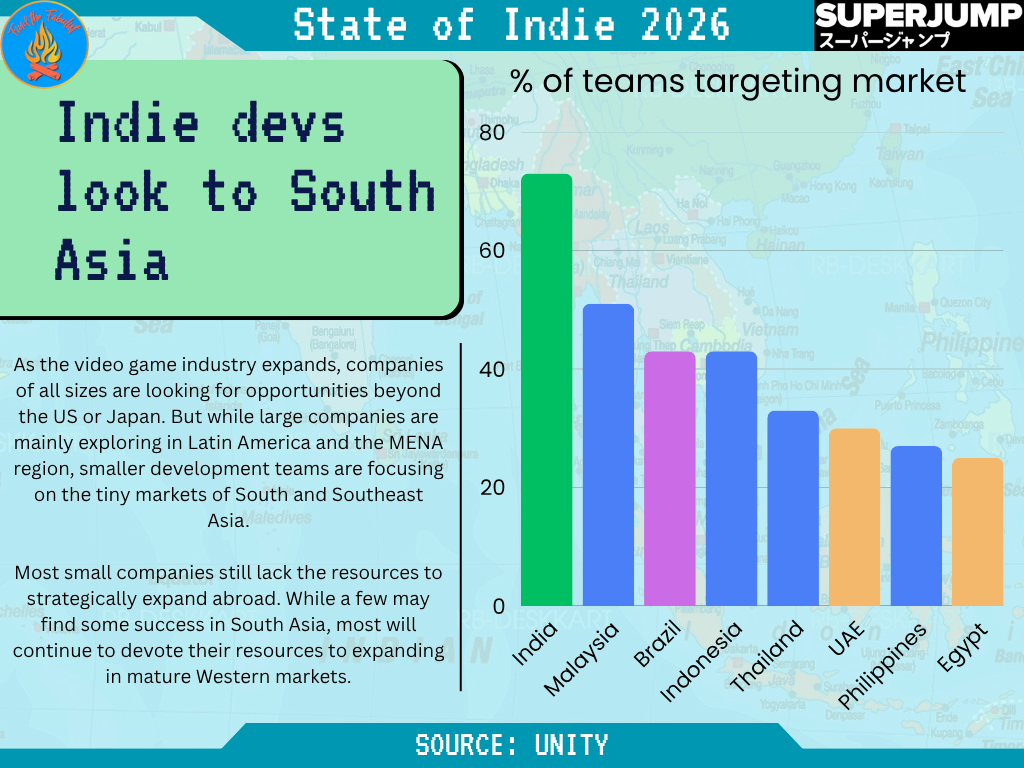
This starts to make sense when you look into where these smaller groups are making their money. Small developers claim to have had far greater success in South and Southeast Asia than in more recognized regions. As such, savvy developers are looking toward countries like India, Malaysia, and Indonesia where they won't face the same domestic competition as in China or Korea.
But there's more to selling games in a new market than just getting another localization. The main thing preventing developers from expanding into India is a lack of cultural awareness, both in terms of its overall culture and its gaming culture. A few teams might overcome this, but most small developers will have to maintain their focus on mature markets.
The Content Creator Game
A growing global market can be challenging as much as it is an opportunity. When you're competing with the entire world, getting noticed becomes increasingly difficult. A few lucky teams might go viral, but the rest are always scratching around for ways to draw attention.
As usual, video and streaming content creators are the main modes of discovery for most small developers, though experiences vary greatly.
"Replies were non-existent at first, but traction grew as Drive Together gained visibility, leading creators to reach out to us," says developer Otakumi Games. "We quickly learned that a solid marketing budget is often the fastest way to win influencers over."
That points to an open secret in the creator space: Promotion isn't free. Many major creators won't cover a game without some added incentive.
Worlds Upon the Wind developer Max Shawabkeh had a lot to say about creator sponsorships. In at least one case, it worked beyond his expectations. "I offered a sponsorship, and he instead did it for free because I was a self-publishing solo dev. That brought in the most players." Others yielded mixed results: "One sponsored creator did a good job, clearly got the game, and brought in folks, but the cost was quite high...Several other sponsored ones were clearly doing it just for the money and produced unexciting content that did not draw in players."
Smaller channels and streams are less impactful, but that doesn't mean that they are useless. "[W]atching them was valuable for finding missing polish and getting enough YT content so players could search for the game and get an idea of how it plays."
"Just from two Reddit posts, a lot of YouTubers found my game, which acted like a domino effect with other YouTubers following after that," says Kai of Code Peas. "After that it was a thing of staying in contact with the community, implementing some of their ideas and changing the game according to their feedback."
Most developers rely on creators despite their ability to use the same platforms for self-promotion. Often, that's a sensible move. YouTube, Twitch and TikTok all demand unique skill sets that game creators usually don't possess, but there are definite exceptions. The developer behind Pancake Studios is the most successful creator for his own game. "None of them were able to crack millions of views while I have," he says. "I don't like outsourcing my marketing to other people."
Regardless of the impact, getting covered by a content creator can signal something important for developers. "Indie game devs and indie content creators are almost the same!" says Up Multimedia. "It's easy to be cynical, but when you connect with someone who just enjoys a creator, even if it is for 20 viewers, it is one of the best things about the job."
Modes of Discovery
Content creators aren't the only avenue for discovery. While Steam's visibility system still prioritizes games that get external attention, there are ways to get noticed from within the platform. Many developers mentioned the recently added Personal Calendar feature as a big booster. As a regular user, it seems far superior to the Discovery Queue, which mainly surfaces games that are already popular.
Events, while not as frequent as a few years ago, are also important. "Every bit of strong wishlist growth I had was from festivals," says Martin Stradling of Spork Tank, developer of Rita. "Social media seems tough as the best successes I've seen are from viral videos, which you have no control over."
The most important channel for game discovery isn't one that's normally considered, but something more low-tech. For younger people in particular, word of mouth is a growing source of information about new games. It might begin with someone seeing a demo video on TikTok or YouTube, but the news spreads through in-person communication.
It makes sense given the dynamics of how younger generations play video games. Middle and high school students strongly prefer multiplayer games, and they're mainly choosing the games that are popular at their schools. Thus, school becomes the best place to learn about those games.
For developers of co-op games, this is a huge opportunity but one that's hard to plan for. Everyone wants to be the game that gets spread around the nation's high schools, but it can't be planned for; it happens, or it doesn't.
Of course, one could say the same thing about any other marketing push. For the small developer, marketing is a game with no clear rules. Setting realistic expectations and celebrating what successes do come might be the best possible approach.
In Summary
- China is continuing to grow in importance, with narrow opportunities for smaller games to make inroads, whether legally or illegally.
- Many developers are looking to grow in South and Southeast Asia, where the markets are small and far less competitive.
- Content creators are still the main discovery channel for indie games, though the results of being featured can vary widely.
So What Comes Next?
As of 2026, I'm officially out of the prediction market. The world of video games is far too unstable and wild to make anything but a blind guess.
To illustrate this point, we need to talk about Call of Duty (CoD).
Call of Duty is, by any metric you care to use, one of the largest video game franchises ever. The games have set records several times for how quickly they sold, and they've been in the top two in total games sold every year for ages. Newzoo, in its yearly report, even puts it into its own bespoke category alongside premium and free-to-play. That makes sense when you consider CoD games are responsible for around 10% of all playtime worldwide.
Except, that is, for this year. This year, it declined.
Why is this? It could be the series itself – CoD has had a few weak entries and some controversy in recent years. But you could also chalk it up to the eroding importance of consoles, where CoD is dominant. It could speak to the broader decline in first-person shooters, which are less popular among younger players. And it could have to do with AAA stalwarts losing ground against similarly large but less conventional companies.
It could be all of these things and a hundred more. Such is the mystery of life.
The fact is that the overall media landscape has been in an unprecedented state of flux for the last few years. It's like we're watching the laws of physics get rewritten in real time. Things we know for sure are no longer true, and staggeringly unlikely things happen every day.
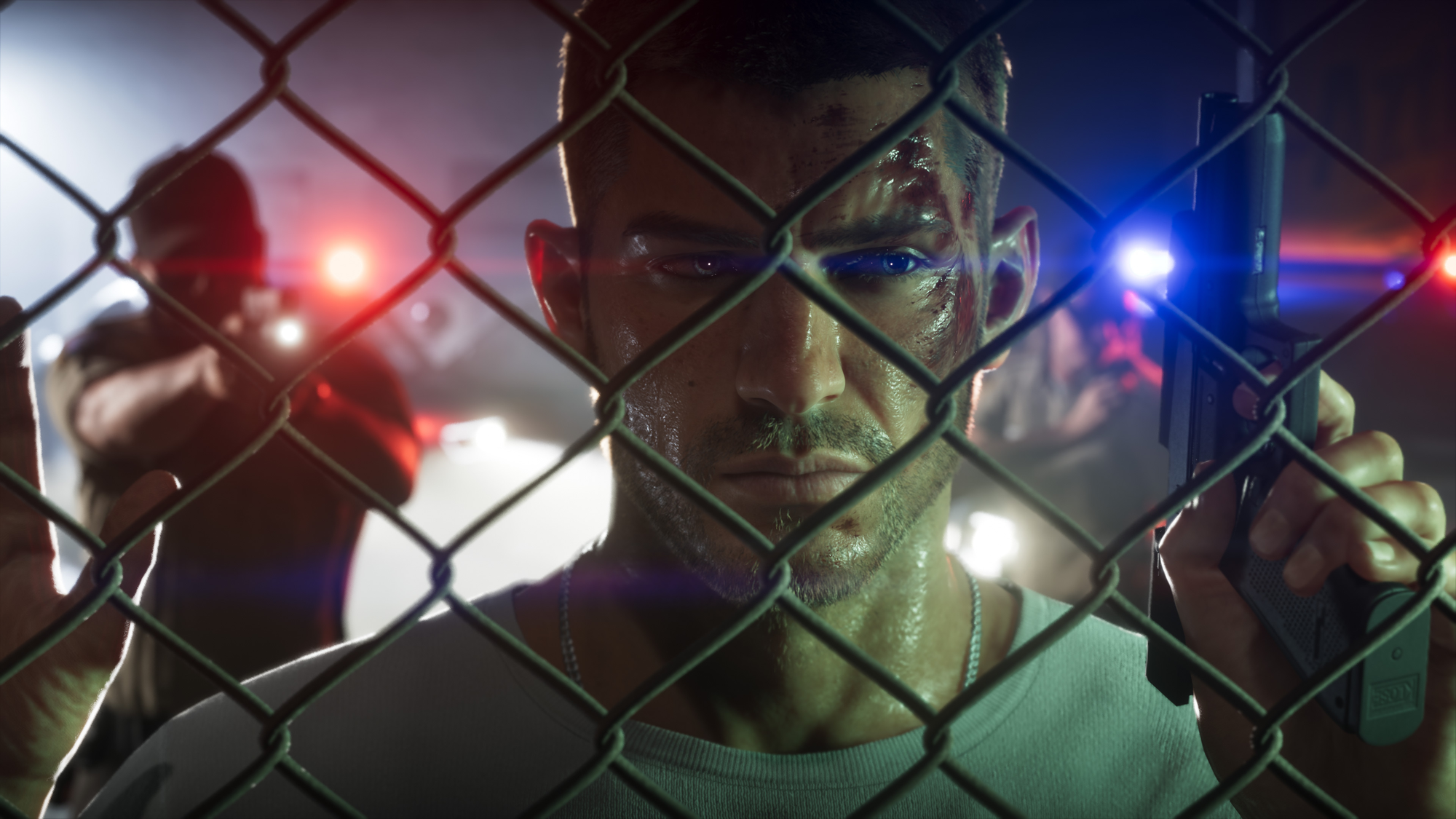
I've been trying to get this edition of State of Indie out early because I'm racing against an apocalyptic event. Grand Theft Auto VI has a release date, and very shortly a lot of people are going to quit pretending they care about the indies. The notion that GTA6 will be a massive hit is the safest bet in video games right now. Commentators love contrarian takes, but no one is taking the opposite side here, nor will I.
Of course GTA6 is going to be huge. Preorders alone are the only thing driving console growth at this point. It even indirectly bumped views on Netflix after they released new footage.
The long-term effects? That's where the crystal ball gets fuzzier.
GTA6 will be console-only for a while, at a time when component shortages are really slowing down hardware adoption. Will the game speed up adoption, or will low adoption limit the game's growth? Given that PC is now the dominant youth platform, might this deepen the rift between generations? And with the live service world turning into a zero-sum game, what happens to some of these other massive forever games?
The way things are going, I wouldn't be shocked if GTA6 sells a zillion copies but still ends up being played half as much as Roblox. And that's in the comparatively predictable AAA sector.
We are cycling through trends in the indie space so fast that there's no telling what people will want a year from now. Hype-heavy games routinely flop. Games that flopped years ago suddenly come back with a vengeance. Winning niches get clogged up with cheap clones so fast that they flip to losers overnight. The current scene is chaos, and things like new hardware adoption and demographic trends matter less than whatever weird little game is the latest to hit meme status.
There's no telling what's to come, so let's just watch the anarchy and revel in it.
See you on the horizon.
Join the conversation
What do you think? Reply below to share your perspective.