The Ghost of Shoshinkai
How a century of corporate DNA shapes Nintendo and Sony's differing approaches to physical media today

January 2028. Sony will halt production of physical discs for PlayStation. This is not merely a change of format; it is the end of the physical frontier in gaming history. The shift is already visible on the retail floor. Xbox's physical presence is receding, PlayStation sections are shrinking into displays of peripherals, and Nintendo's footprint remains expansive — packed with vibrant packaging and physical Game-Key Cards, and still driving foot traffic.
Western technology media often reads Sony's decision as an inevitable digital evolution, or as the sensible elimination of middleman margins. That reading is incomplete. It treats retail shelf space as storage, when shelf space is better understood as a barometer of how a platform holder values its ecosystem. Why does Sony route its customers toward a direct storefront while Nintendo continues to bear the inventory risk of physical media and leave margin on the table for brick-and-mortar stores?
The answer lies beyond quarterly digital margins. It sits in a clash of corporate DNA: Sony, the consumer electronics company shaped by hardware replacement cycles, and Nintendo, the playing-card maker shaped by a century-long defence against the volatility of entertainment. Inside Nintendo's current strategy there is a ghost — the philosophy of Shoshinkai, the distributor network Hiroshi Yamauchi organised in the 1970s, which once dominated Japanese gaming.
This story treats retail as gaming's circulatory system, and reads it through history. As Sony dismantles its own physical defences, I examine why Nintendo's alliance with retail holds, and why that coexistence may decide who survives the digital age.
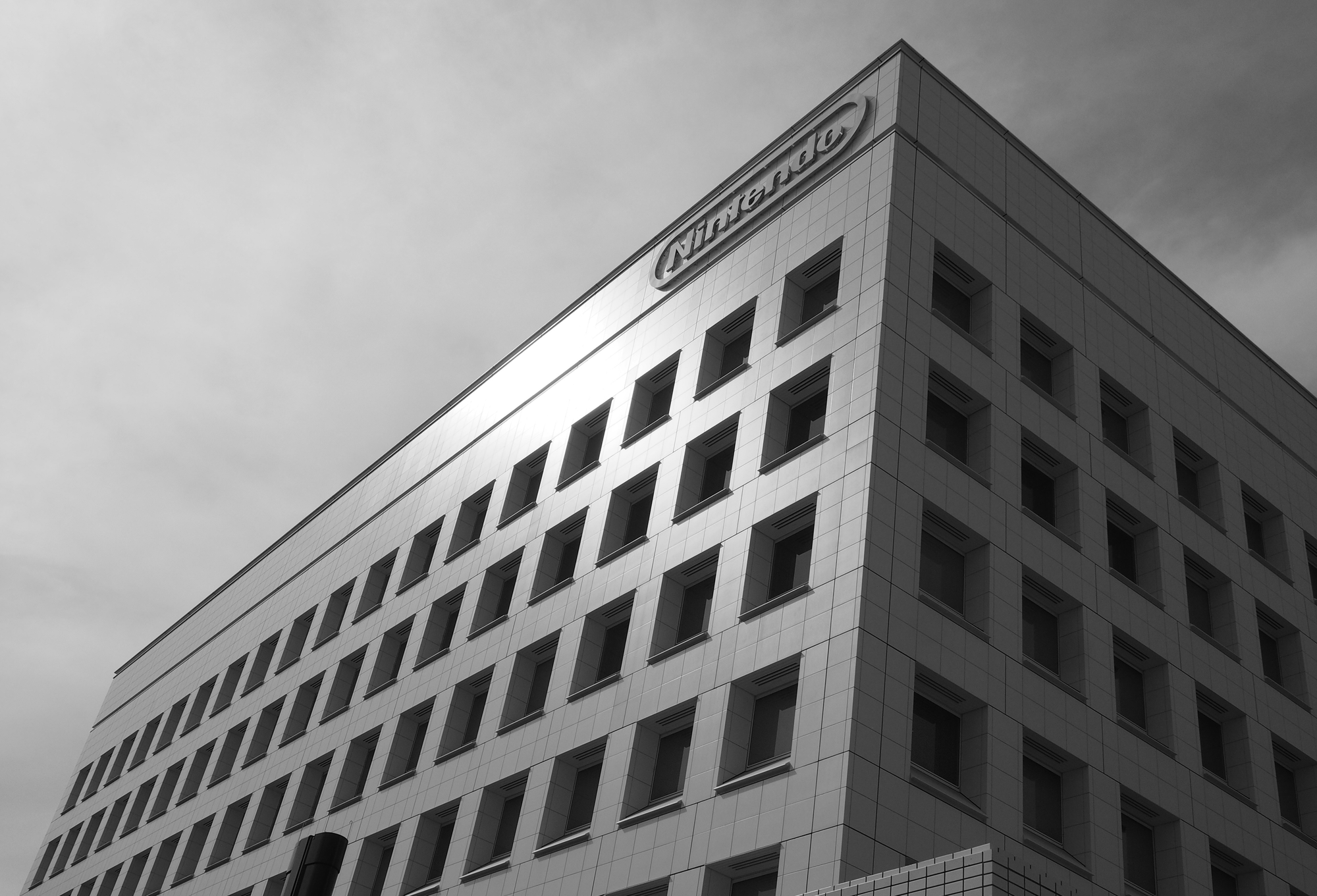
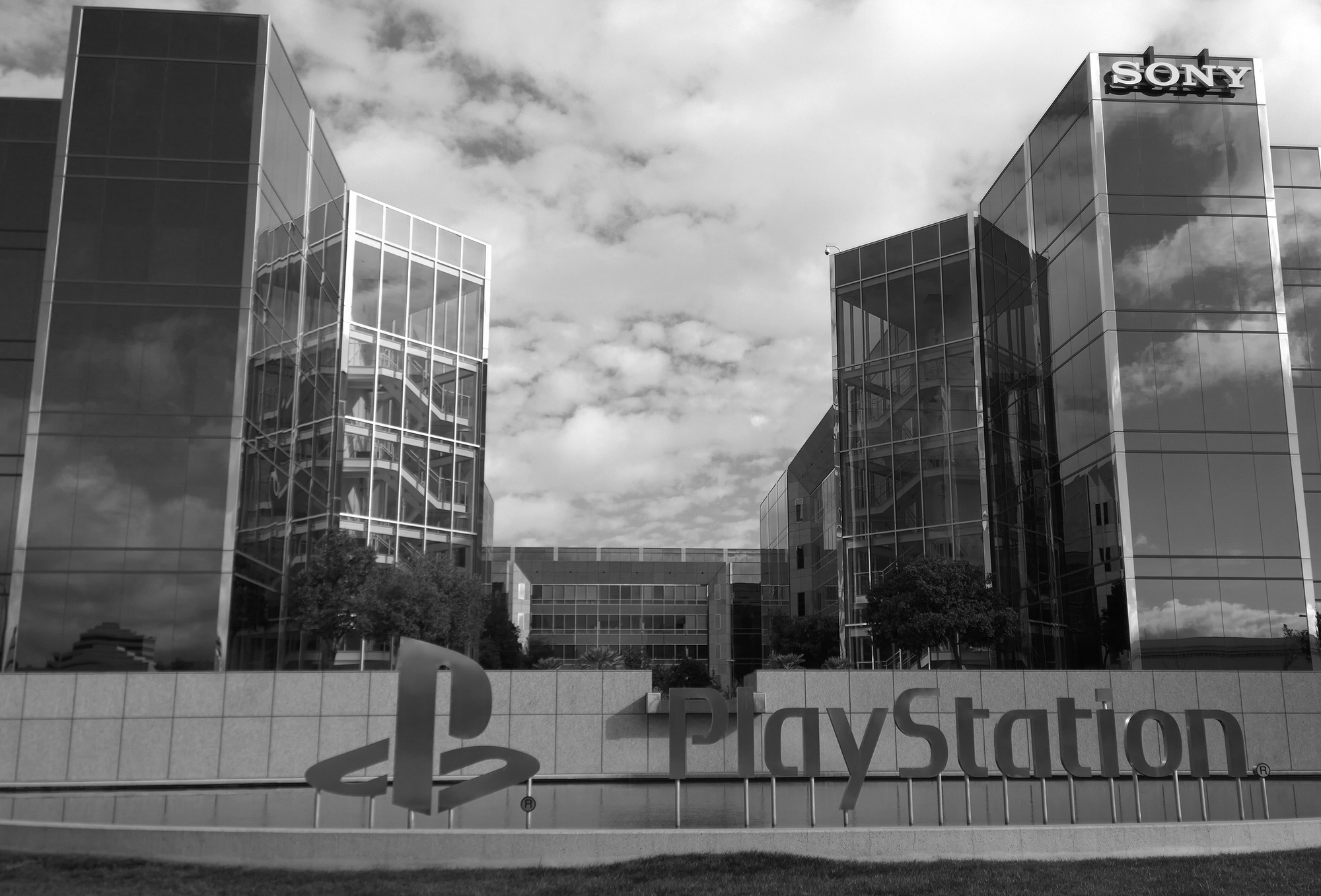
Left: Nintendo headquarters in Kyoto (by Insightwm). Right: SIE headquarters in Tokyo (by mliu92). Source: Wikimedia Commons.
Chapter 1: The Retail Shelf of Trust
The retail shelf is not simply a fixture of plastic and metal. It is the physical expression of an intangible infrastructure — decades of trust built between platform holders and retailers. That infrastructure is now under strain.
Shelf Space is Expensive Real Estate
Floor space is finite. For a retailer, every inch of shelf is unforgiving real estate that must earn its overhead. There is no room for dead weight. So why do retailers still grant significant space to Nintendo's inventory-heavy products while PlayStation and Xbox sections recede? Because Nintendo treats retail as a partner, and its competitors increasingly treat it as a cost.
Shelf Space as a Barometer of Integrity
Many analysts frame the digital shift purely around consumer convenience and leave the underlying commercial mechanics unexamined. Retailers stock Nintendo's physical games and Game-Key Cards because they represent a reliable revenue cycle. Nintendo understands the value of in-store discovery and preserves the conditions that keep its products on shelves.
To understand what Sony is giving up, it helps to name the bargain that has quietly governed this industry for decades. A retailer's willingness to stock hardware has never rested on the thin margin of the console itself. It has rested on everything that flows from it afterwards — and above all on the secondhand market, which generates profit for the retailer at no cost whatsoever to the publisher or developer. The store carries the console, absorbs the shelf space and the staff time; in exchange it keeps the resale economy that the console makes possible. Remove the disc and that exchange collapses. The retailer is left holding the costs and none of the compensating trade.
Once a customer moves to digital, the retailer earns nothing on any subsequent purchase. Shrinking PlayStation and Xbox sections are therefore not only a symptom of digitisation; they are also a commercial response by retailers to platform holders whose economics no longer include them.
Frontiers of the Physical
In July 2026, Sony announced the end of physical disc production from January 2028. Games will still reach shops, but as codes and download cards rather than discs. For Sony, this is efficiency: manufacturing, logistics and retail margin removed from the equation. What it also removes is the disc — and with it the resale value that gave the retailer a reason to keep the shelf.
A console that a shop cannot profitably support is a console the shop will eventually stop displaying. Retailers are not charities. For a few points of digital margin, Sony risks forfeiting its most valuable advertising space: a physical storefront working on its behalf every hour it is open. By 2028, the gap in shelf presence between these companies will reflect something more than relative popularity.
Chapter 2: Sony's Consumer Electronics vs Nintendo's Toys
Why does Sony dismantle this infrastructure while Nintendo defends it? The divergence is not simply a difference in management strategy. It reflects the foundational memory of each company.
The Electronics Maker's DNA
Sony's roots are in consumer audio-visual electronics. Its winning formula has long run on two axes: hardware improvement through superior specifications, and cost reduction through supply-chain optimisation. In that tradition, the PlayStation is a high-performance device, much like a television or a smartphone, and the PlayStation Store is the logical endpoint: logistics and middleman margin removed entirely.
The move to digital is not only appetite for margin; it is also structural pressure. The largest games now strain the capacity of Blu-ray discs and ship with mandatory downloads regardless of format, while AAA development budgets have climbed into the hundreds of millions of dollars. Under that weight, publishers pursue every recoverable cent, and direct digital sales become difficult to refuse. Seen from inside Sony, ending discs in 2028 is not a betrayal but a rationalisation — the shift from CDs to streaming, carrying no particular obligation to retail.
Two Lifecycles
A high-end electronics device is used until it breaks. A toy is discarded the moment the trend passes.
The Toy Maker's DNA
Nintendo's DNA begins in a hanafuda shop on the edge of Kyoto's former Gojo Rakuen pleasure district. Over more than 130 years, the company has learned the central terror of the entertainment business: how quickly and completely people become bored. A high-end electronics device is used until it breaks. A toy is discarded the moment the trend passes. That fear informs almost everything Nintendo does.
To Nintendo, a console is not an instrument for a specifications war but a medium of shared experience. What the company appears to fear most is the loss of physical touch points — the day packaging disappears from the street and children no longer encounter the brand in ordinary life. That outcome would undo Satoru Iwata's strategy of expanding the gaming population, and lead toward the company's oldest enemy: being forgotten.
Numbers or Circulation?
Sony's attention is fixed on the quarterly digital margin. A higher direct-sales ratio satisfies shareholders, but it narrows the market that produces future customers.
Nintendo's attention is fixed a decade out, on the buyers who will one day purchase games for their own children. For that company, retail margin is not a cost to be recovered but the price of keeping its intellectual property circulating in daily life. Consumer electronics logic sacrifices infrastructure for efficiency; toy logic accepts inefficiency to protect continuity. In 2028, that divergence becomes more visible than ever before.
Chapter 3: The Ghost of Shoshinkai
Why does Nintendo protect retail margin? The answer runs back to an organisation that formed before the Japanese games industry existed and disappeared at the end of the twentieth century: Shoshinkai, the distributor network that once held near-total control over game logistics in Japan.
From Daiya-kai to Shoshinkai
Shoshinkai's roots lie in a social club of toy wholesalers called Daiya-kai — regional distributors, stationery sellers and confectionery shops that handled Nintendo's hanafuda and plastic toys. Hiroshi Yamauchi recognised what that network could become.
The instinct was inherited. Nintendo's founder, Fusajiro Yamauchi, had extended the company's reach by tying his cards to an existing distribution network — most commonly credited to an arrangement with the tobacco magnate Kichibei Murai, whose cigarette trade carried Nintendo's hanafuda into shops across Japan. In 1973, Hiroshi Yamauchi reorganised Daiya-kai into Shoshinkai: a disciplined association of primary wholesalers that prioritised Nintendo products. When the Famicom launched in 1983, Shoshinkai became the centre of the market, controlling allocation during shortages and absorbing inventory risk that would otherwise have sat with Nintendo.
The Shoshinkai Model, 1973–1997
Keep the channel fed, and the channel will keep you alive.
That system did not survive contact with its own success. By the Super Famicom era, wholesalers below the primary tier were bundling unwanted stock with scarce hit titles and forcing it onto retailers — a practice prohibited as an unfair trade practice under Japan's Antimonopoly Act, and one that drew enforcement action. Prices stayed high because the risk of buying out entire print runs was priced in. Retailers who resold stock outside approved channels found their supply cut. When Sony entered the market, it built its distribution around direct trading and fixed pricing explicitly to counter this system — and was itself pursued by the Japan Fair Trade Commission for resale price maintenance and for restricting used-game sales, a case it contested for years before accepting the ruling.
Shoshinkai was dissolved in February 1997, amid Nintendo's own distribution reform and mounting regulatory scrutiny of the practices the system had produced. Its founding logic, however, remained: keep the channel fed, and the channel will keep you alive.
Shoshinkai Reborn as Game-Key Cards
Which brings us to a curiosity on today's shop floors. A Game-Key Card is a physical Switch 2 cartridge that contains no game data — it is a key that unlocks a download, and unlike a code printed on a slip of paper, it can be lent, gifted, and resold like any other cartridge.
Nintendo has understood digital distribution for a long time; the Famicom Disk System let players rewrite game data at in-store kiosks in the 1980s. It has never concluded that this makes retail redundant. Game-Key Cards keep a game boxed on a shelf, keep it available as a gift, and keep it resealable — the three functions a download code destroys. The transaction may be digital, but it still passes through a shop.
The frontlines of game media
Game Card
Game-Key Card
Download code
Once redeemed, a download code is tied to the account that used it. A Game-Key Card is not.
It would be too generous to call this pure altruism. Publishers favour Game-Key Cards partly because full-capacity Switch 2 cartridges are expensive, although many players regard them as a dilution of physical media rather than a defence of it. Both readings can be true. The structural outcome is the same: Nintendo's software continues to reach the public through shops that earn something for carrying it, at precisely the moment its competitors are removing that link.
Keeping the Blood Circulating
If shops close and shelves disappear, Iwata's strategy of expanding the gaming population loses its mechanism. Browsing covers with a parent, or handing over cash at a register, is replaced by a menu that recommends what an algorithm has already decided you like.
It is worth conceding that Nintendo's own history complicates the picture. In 2016 it absorbed Jesnet — one of the surviving Shoshinkai wholesalers — and now controls its distribution far more directly than in the Famicom era. Nintendo has not rejected consolidation; it has pursued a version of it that keeps the shop in the chain rather than removing it.
Chapter 4: What the Digital Transition Costs
Investors will read Sony's 2028 decision as a straightforward improvement in gross margin: physical distribution eliminated, the secondhand market closed, revenue flowing directly into a proprietary storefront. Set against the structural pressures already described — rising budgets, swelling file sizes — the logic is easy to follow. What it overlooks is the marketing engine Sony has been receiving free of charge.
The Digital Model, from 2028
A digital game is not an asset; it is a licence to access a file on a server.
The Secondhand Market as a Free Growth Engine
In Sony's accounting, the secondhand market is a competitor. The hostility has history: in the late 1990s, Sony and major publishers campaigned to have used-game sales declared unlawful. The campaign ended at the Supreme Court of Japan in April 2002, which held that the sale of used game software did not infringe distribution rights, and protected the secondary market.
The reasoning behind the campaign was that a used sale returns nothing to the publisher. What that reasoning omits is liquidity. Players buy at full price on day one, finish the game, and trade it in before its value falls — then use the proceeds to fund the next day-one purchase. That cycle is a significant part of what sustains full-price sales.
It also feeds the bottom of the market. Players without much money, and children, find older games in bargain bins and discover franchises at no advertising cost to the publisher. When discs disappear, that liquidity freezes. A digital game is not an asset; it is a licence to access a file on a server. Without trade-in value or bargain bins, the ground that grows future customers is left to dry out.
The Algorithm and the Price Floor
Digital storefronts are built on personalised recommendation, which tends to return users to what they already know. It cannot easily reproduce the student who wanders into a shop after school and is caught by the spine of a game they had never heard of.
A single storefront also holds prices up. In a physical market, prices fall as supply and demand dictate, which admits price-sensitive buyers. In a digital-only market, a three-year-old game holds its recommended price until the platform decides otherwise. The barrier to entry rises for exactly the young audience the industry needs, and the storefront drifts toward serving committed enthusiasts alone.
The Risk of Market Contraction
A market that loses both retail presence and resale liquidity does not simply become more efficient; it becomes smaller. When packaging disappears from ordinary life, games become invisible, absorbed into the undifferentiated mass of the app store. This is the outcome Yamauchi and Iwata both worked to avoid: not defeat by a competitor, but being forgotten.
Intellectual property without physical touch points loses its continuity between generations. PlayStation risks narrowing into a club for committed, affluent players. Toward 2028, that is the real cost of the decision — not a collapse, but a slow contraction of the ground the business grows on.
The Nature of the Market
Forecasts about gaming's future tend to concentrate on hardware: teraflops, AI-assisted development, streaming latency. They misread the nature of the business. Entertainment does not end inside code on a remote server. It is an analogue culture sustained by human economic activity — a lineage running back to Ralph Baer's Magnavox Odyssey in 1972, and carried since by shop lights, registers and conversations between families in physical spaces.
What 130 Years Suggests
Nintendo's defence of retail is not nostalgia or moral superiority. From hanafuda carried through cigarette shops, to the Famicom, the Disk System, and today's Game-Key Cards, it reflects a commercial position: a market stays alive when the people who carry your products to the public have a reason to keep carrying them.
Entertainment is a long argument with boredom. A storefront governed entirely by algorithm, or a subscription catalogue with nothing to hold, struggles to generate the attachment that keeps a medium culturally warm. The weight of a case in the hand, and a child counting out money at a counter, are not sentimental details; they are how the market renews itself.
Direct digital distribution may not, on its own, secure gaming's future. The alternative belongs to a company formed beside a Kyoto pleasure district, which entrusted its fortunes to a community of distributors called Shoshinkai and has re-engineered that idea for the twenty-first century. As one competitor withdraws into its own storefront, Nintendo continues to keep its symbols in circulation — through the shops that put them in front of people who were not looking for them.
Join the conversation
What do you think? Reply below to share your perspective.