Thoughts on Being a First-Time Game Design Consultant
Observing game development from the outside-in as a first-time game design consultant

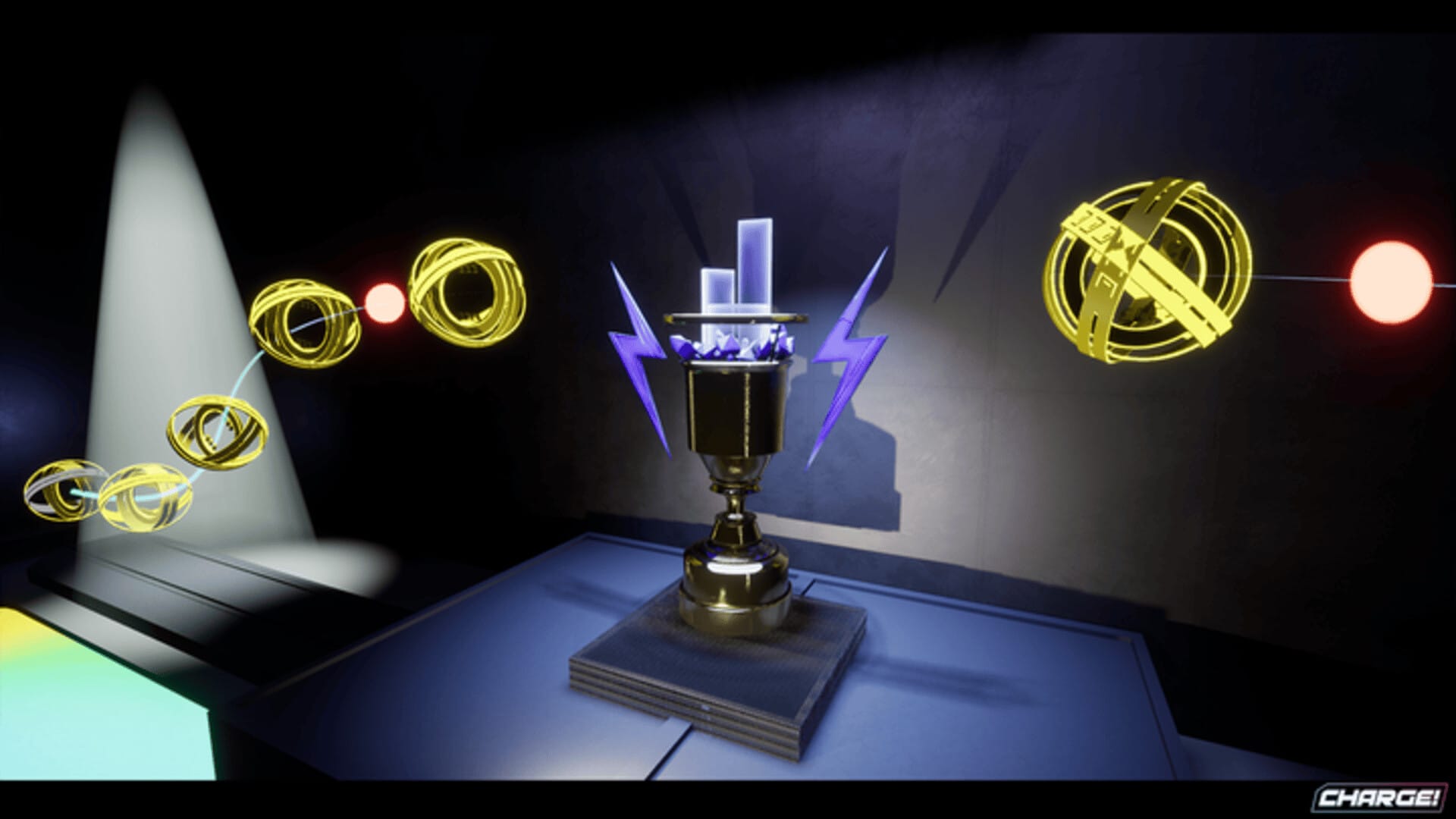
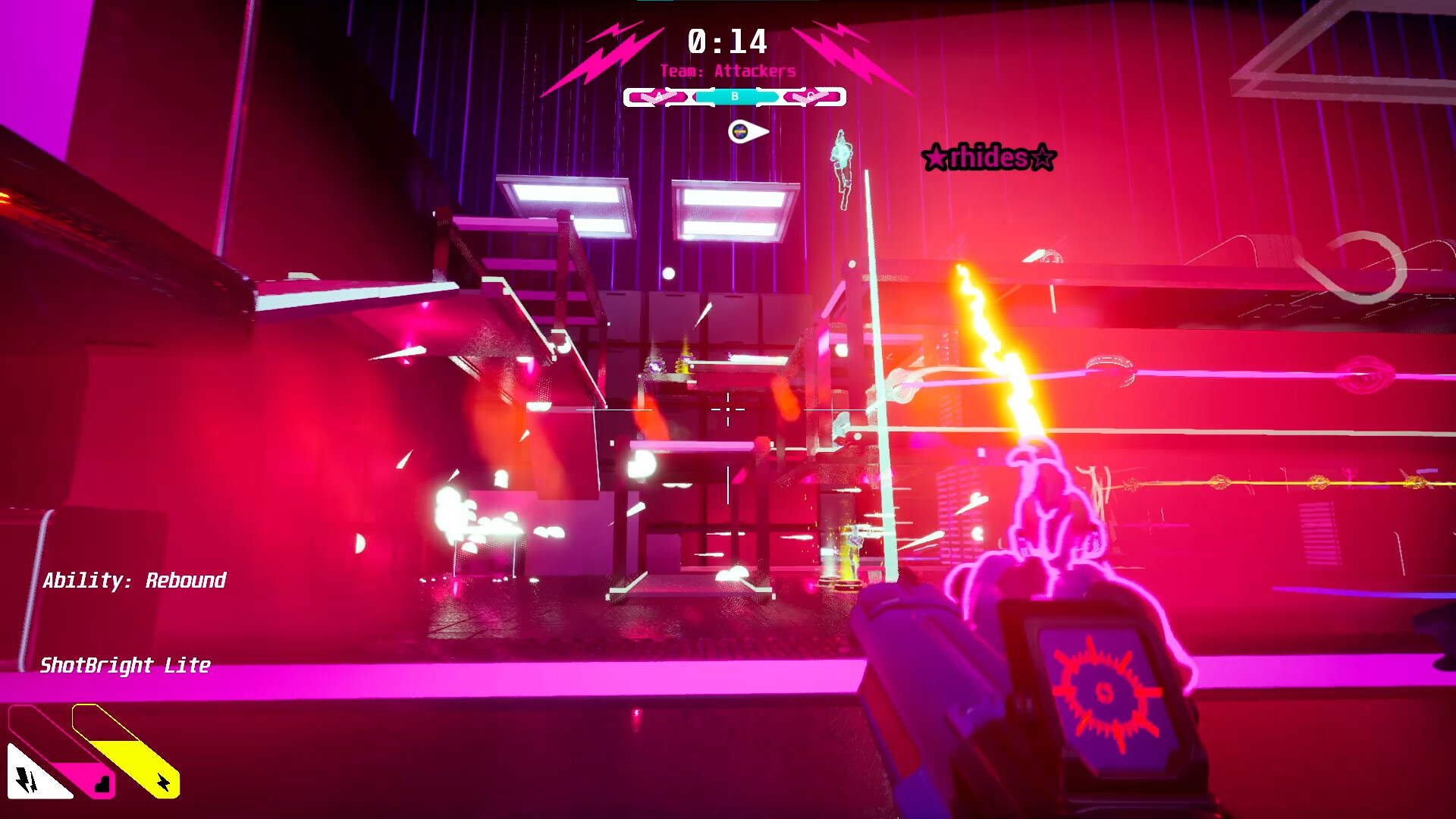
I've had many projects and plates spinning these days between writing books, the YouTube channel, and all these design articles I've written. Another challenge I took on in late 2024 and through 2025 was offering my expertise as a consultant for a smaller indie company, Honor Games. Their first release, Charge!, is out now, and they allowed me to go over my thoughts on observing a game development cycle for the first time in my career.
My Role
Honor Games reached out to me in 2024 after seeing my article on Command & Conquer, wanting me to help them with an RTS project. However, after hearing about my skill set and knowledge with other genres, they asked me to consult on two other projects, one that's still in early development and their shooter, Charge!. My job was to put my encyclopedic knowledge of game design to help them move the design along, assist with playtesting, and see the game through to completion.
As a point of clarification, I have not been paid by Honor Games to promote the game, and any payment for my time would be based on the game's profits. This kind of structure is a popular one for many newer development teams, but it does lead to some problems that I'll discuss further down.
The Early Steps
As someone who frequently plays games directly from developers, I've seen games at various stages of completion, though usually it's either "consumer-ready" or just at the friends-and-family stage. And as a lifelong gamer, it is a bit jarring to see a game with no assets whatsoever, then seeing things take shape over the following months. Looking at the footage I took one year ago compared to just before release, it is a night-and-day difference. That's also why it's so important for anyone interested in talking about design to speak with developers and see the process, which will come into play in a topic a bit later.
When I signed up, the game had a test room, a basic prototype, and a design doc with some early thoughts. Over the year and into 2025, I was able to play-test the game at different stages and see the Graphical User Interface (GUI) development and design.
What I had seen in past consultations, however, were the issues that arose from trying to take the early ideas further.
Building and Rebuilding
Part of the reason I was brought on was my expertise in the game dev process and FPS structure. While the throughline of Charge! was "multiplayer shooter," the kind of shooter changed many times, which took up a lot of time in 2024. The original concept was to make the 'eSports title of the future', complete with seasonal play, microtransactions, leagues, etc. This was scrapped due to the cost and time to develop, and a smaller scope was eventually agreed upon.
This is a good lesson, as the design doc I first read gave an overall framework of the game, but did not go into detail about the actual mechanics of play. There were many ideas and brainstorming, but nothing that could be used as a starting point. A lot of the notes in the design doc were centered on a project that was already figured out – it detailed steps 4 and beyond, but they hadn't done the first 3 steps.
For designers reading this, when you are thinking about your game at the point that you're going to build it, you need to decide what exactly your mechanics mean. This doesn't mean that every game development project requires a fleshed-out design doc on Day One, but you need to be able to tell someone, including your team, what someone does when playing your game.
Source: YouTube.
So many developers struggle with the idea that the first game is going to be "it" for them. They spend the time trying to create that one perfect game, without often having the experience of working on previous full-scale projects.
From the outside, I saw for the first few months that no one could answer the question, 'What does a match in this game look like?' Parts of the design doc referenced systems that were confusing or didn't have enough detail to let them start building. An important lesson for designers is that you must be able to balance what you want to make with what you can make. That became a bottleneck for the team, as a few weeks went by in this cycle:
- Talk about what we wanted to do
- Come up with an original idea
- Fail to iterate on it and think about another option
This returns to the fact that the core gameplay loop took months to settle on. Saying, "My game is a first-person shooter," does not describe the actual loop. I've spoken with novice developers outside of Honor Games who also have that issue – they don't understand the difference between saying what their genre is vs. the gameplay loop of their title. One of my first suggestions was for the team to draw a line in the sand by which point they could accurately state what it looked like to play their game.
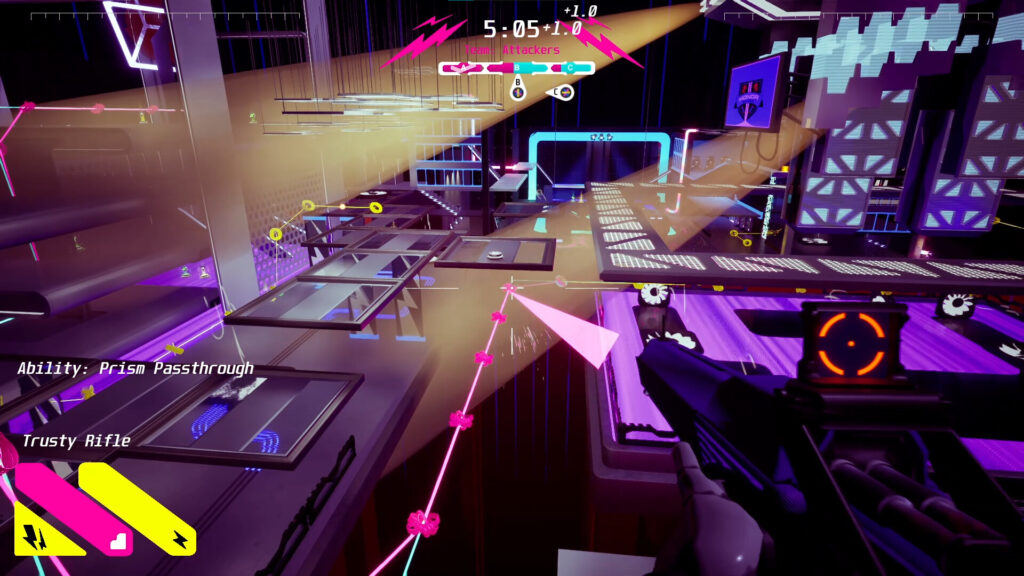
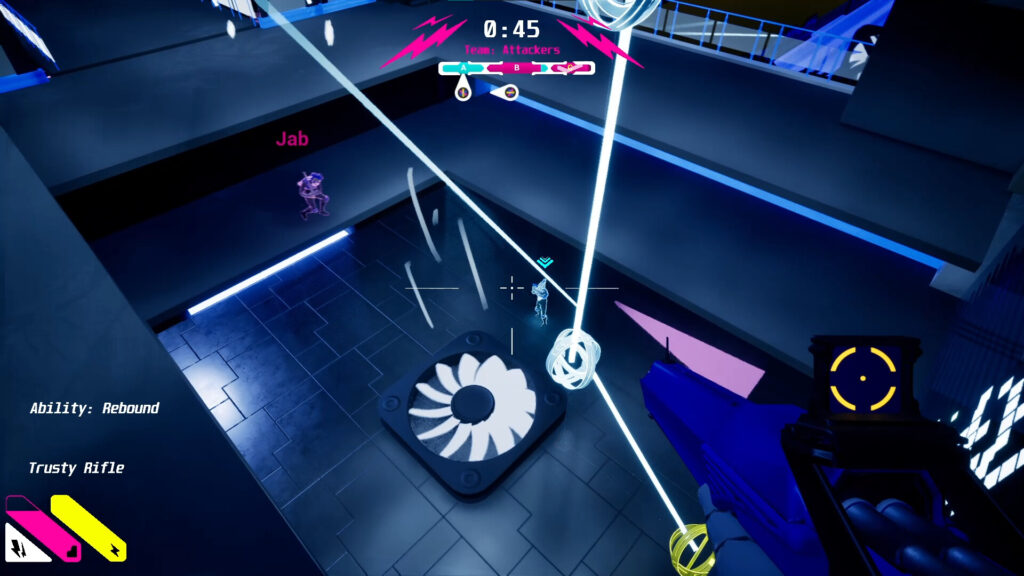
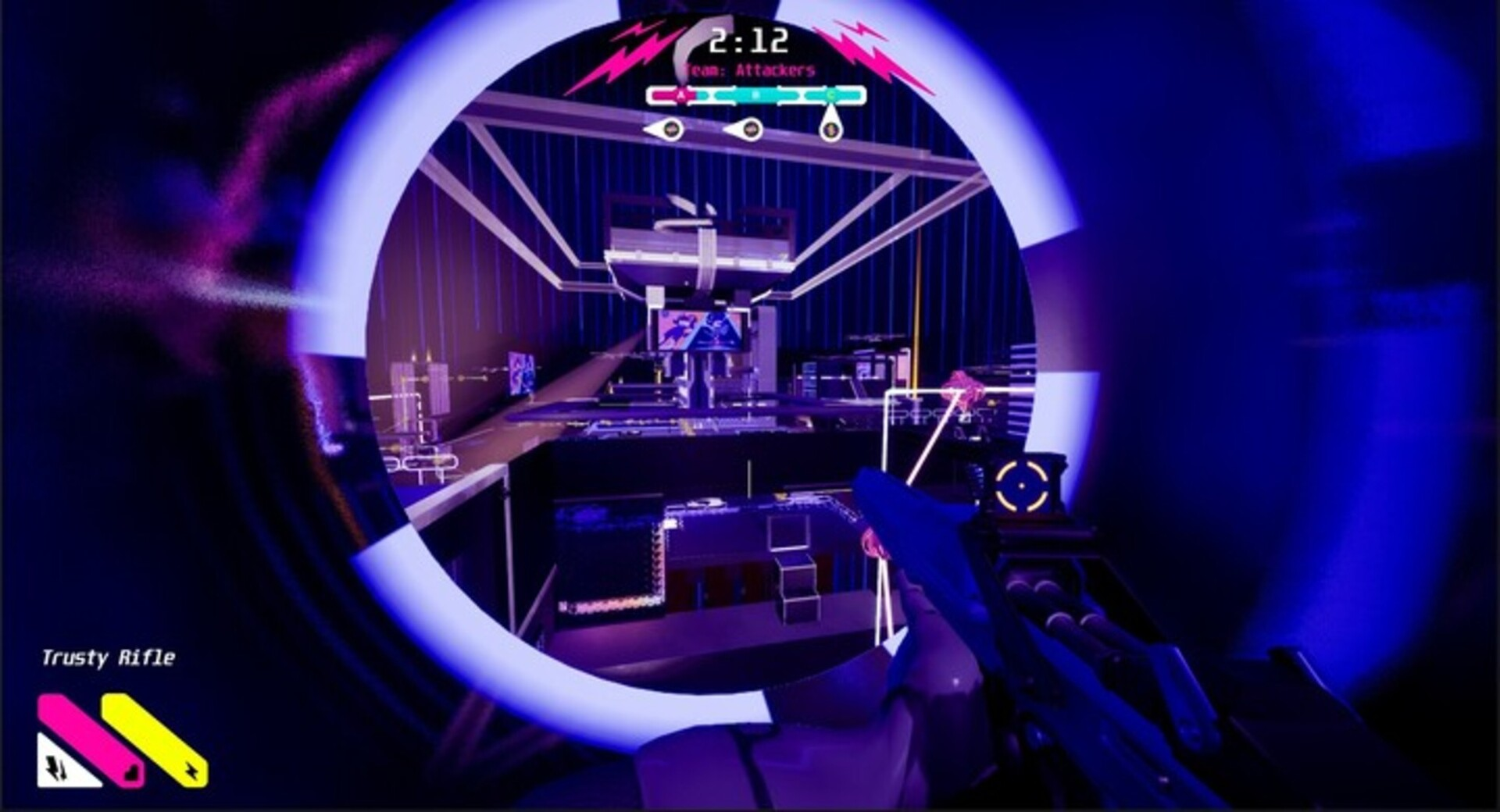
A big example that went through multiple iterations was the use of mirrors and mirrored surfaces. The original idea was that there were mirrors set up whereby players could angle shots at others. Then there was an entire point of having utility grenades that could do different things, like making walls and surfaces mirrored. Eventually, this was scaled down to a "reflection" power-up which led to some amazing footage that was used in the marketing.
I've seen plenty of novice and first-time developers struggle with this point – not setting their core gameplay loop, dancing around the point while working on everything else. You cannot put the cart before the horse in this respect, as it always leads to wasted time, energy, and often getting burned out on the entire project.
Hands Off
Part of the problem that led to lost time and delays was due to an unfortunate facet of this team's structure. No one at Honor Games was receiving a paycheck, which meant there was no incentive to push for rapid changes and decisions. It took months of hemming and hawing before people were brought onto the team who could push changes and lock in design decisions. Part of this was hiring a designer to assume the lead role, after which the project began to have a path forward.
I feel some of this had to do with the mindset of going from being a modding team to a complete game development team. Honor Games' first foray into game development was attempting to make a conversion mod for Command & Conquer 3. Working within an already developed framework and assets is different from making everything from scratch.
As the switch was made from modding to their new iteration, no one was occupying the role of project manager for the first year. I felt that no one wanted to be the "bad guy" to tell everyone what to do, and with no money at stake, no one wanted to take on the additional responsibilities. Much like the lead designer, a manager was brought on to help guide the game's development. When the project ended, I asked the manager for their thoughts on working with the dev team:
Working with Honor Games for the short time I was there allowed me to grow more in my production skills. In the beginning, my production mentor mentioned I should join an indie game to get a new project under my belt and surprisingly, a few days later, Eric Chou (CEO of Honor Games) reached out to me asking if I could be a Producer for Charge!
One interview later, I landed the revenue-share role and I joined a team that wanted to produce a fun, laser tag inspired arena game.
Since it was volunteer hours, I would do what I could after my job's hours and help where I was needed: Roadmap to game’s completion, launch demos/game on Steam, run meetings, take notes, update the CEO, check in with the leads, social media posting, post-production (check sales, update team, stream, roadmap for future development), etc.
I’m thankful for Honor Games for giving me a chance to prove I can work with a team and help them deliver their game Charge!. Retrospectively, it helped me grow stronger and see areas that need improvement and what areas I’m strong in on a team. If Honor Games gets the funding it deserves, I would love to join the company again since it was great to work with everyone there and with Eric. – Kelsey
Having tried my hand at working with friends and locals in the past, I saw the same issues here that I did with trying to make a game without stakes or management. Everyone loves to give ideas and talk about how great something will be when it's done, but very few people want to get down to work and do it, especially for a small project, and even more so when there is no pay.
Small projects can turn into endless labor, with people either getting burnt out or just tired of working without pay and leaving. Thankfully, the additions of the development lead and project manager gave Charge! a structure and, more importantly, an endpoint to shoot for. Everyone knew at that point the game wasn't going to be the next Call of Duty, but at the same time, with the project finished, no one was going to lose a house over this game.
For Honor (Games)
Win or lose, having a finished game under your belt is a huge deal for everyone involved. For me, it means I can now definitively say that I've done consulting work for a finished game project and will be happy to keep working with Honor Games. For the rest of the team, they also got to experience the joy and nightmare of taking a game idea from nothing but a thought to its finished state. While it might not be what everyone wanted from the original concept, if the team wants to keep working together, they will be in a better place for it.
Now that Charge! is available on Steam, the team deserves praise for having an end product. Everyone must start somewhere, and getting your first game done isn't (and shouldn't be) the end of your career, but the beginning of something new.
Lastly, here are some thoughts from Eric Chou, the owner of Honor Games:
Hello,
I’m Eric, Executive Producer on Charge! Upon reflection on the project’s development and release, the biggest lesson and takeaway I have is the importance of vision. I had a very basic vision for the project: laser tag with mirrors. The vision was too basic, and there were countless questions in terms of nitty gritty design that demanded and needed definition., which I was not ready for at the outset. Where I intended freedom, others saw a lack of structural design.
As this was our first commercial release, we as a team all learned a lot. Everyone stepped up to the plate, and we delivered a polished product that has a lot of potential. We shall see if we will release updates and further iterations, but as of now, we have no plans on doing so. It’s also important to remember, we were largely a volunteer based team, which I think we’ve done very well with the constraints we had.
I want to thank everyone who has participated, and hope more players can enjoy our debut title.