Torneko- The Unlikely Father of Mystery Dungeon
Tracing the origins of a beloved franchise's spin-off

You are not a hero! You are just a merchant.
Mystery Dungeon lives up to its namesake; not just in its trademark game design, but also in its own shrouded history and how it was conceived. For many players, their first encounter was likely through the Pokémon Mystery Dungeon games. For others, especially during the early PlayStation days, they may have dabbled in a Final Fantasy spin-off called Chocobo’s Dungeon. There are other spin-offs bearing the moniker, and it wasn’t until the international release of Mystery Dungeon: Shiren the Wanderer for Nintendo DS in 2008 that most players outside of Japan were introduced to the IP's original namesake.
Well, that's not quite true.
The first true Mystery Dungeon game was released exclusively in Japan in 1993, a spin-off in the Dragon Quest franchise taking place during the timeline of Dragon Quest IV. In this title, the main protagonist is none other than the shopkeeper Torneko, and needless to say, the importance of his story is encapsulated by the game’s grandiose title - Torneko’s Great Adventure: Mystery Dungeon.
Genealogy of Mystery Dungeon
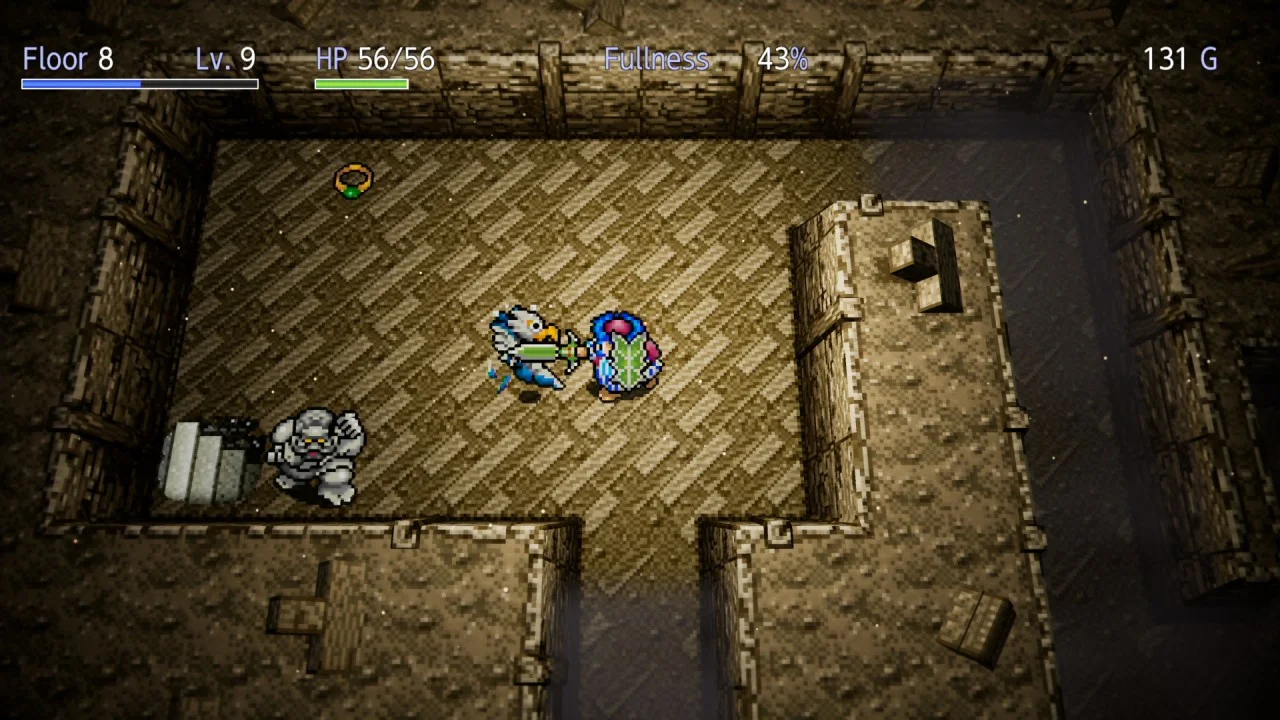
Everything we know and love about Mystery Dungeon, be it Pokémon or the main Shiren the Wanderer canon, can be traced back to Torneko’s 1993 dungeon-crawling misadventure(s). All the core elements of the design were set here: randomly generated floor layouts of a multi-layered labyrinth, a random assortment of items and monsters, and the punishing difficulty of sheer random luck. The most defining element of all, of course, is the permanent consequence of defeat and failure: losing all items, gold, adventure progress, and experience points.
Mystery Dungeon is about starting from scratch over and over again, but the reward is in the endless possibilities of how each journey may unfold. Luck can go either way; sometimes rare and powerful items show up early, yet it's just as likely you'll be suddenly outnumbered by monsters. Despite this chaotic ebb and flow of luck, there is still methodical growth and learning here. Players may lose experience points, but they gain valuable experience and hindsight from each playthrough, and this intangible growth alone manifests organically in the game design.
The moving parts come together to create a rhythmic dungeon RPG that quickly turns into sheer addiction. This game encourages just one more go each time, rewarding persistence and perseverance. Mystery Dungeon games vary in their difficulty and even in how strictly the fundamentals are enforced, which has allowed for a variety of experiences and entry points. Younger players looking for something engaging but still forgiving will find the Pokémon spin-off is the best place to start, but those looking for a pure, unadulterated experience can take on the challenge unique to the main Shiren the Wanderer series.
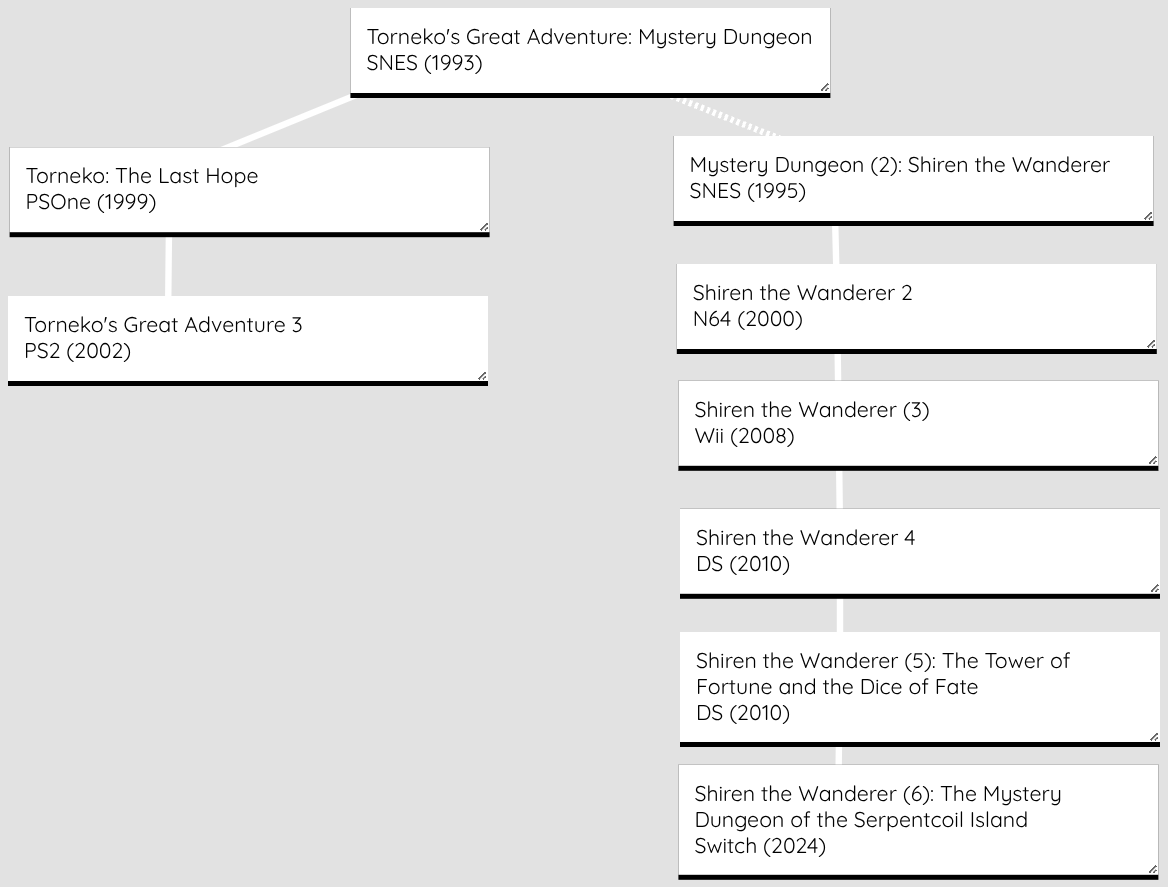
It all starts with Torneko’s Great Adventure, before the second Mystery Dungeon game established Shiren and his setting as the IP's core identity from that point forward. Meanwhile, Torneko went on two further adventures of his own.
With so many games, ports, and spin-offs, a simple diagram summarises the continuity of the mainline Mystery Dungeon franchise.
What is the most defining game in this diverse franchise? If we follow the continuity of Shiren the Wanderer, then he is a hero who thirsts for adventure, so for him it is about heroic displays and taking on great challenges. Anyone looking to go through the dungeon-crawling school of hard knocks will gain a lot from The Mystery Dungeon of Serpentcoil Island, with its addictive replay value and interesting network features. For an experience that retains the excellent 2D sprite artwork of the series, then The Tower of Fortune and The Dice of Fate is still an excellent entry point for anyone seeking an epic signature adventure.
For the ideal starting point, it would still have to be Torneko’s Great Adventure: Mystery Dungeon, as it is the very foundation of them all; officially and canonically the first game in this enigmatic franchise. When it comes to fundamentals and challenge, it strikes a sweet balance; it’s neither too punishingly difficult nor too easy. As such a foundational and genre-defining game, it’s a wonder why it wasn't localised or ported for so many decades. Finally, as a surprise announcement and shadow-drop release during the last Nintendo Direct (09/09/2026), the foundational 1993 game is finally available on all major gaming platforms worldwide as Dragon Quest Heroes: Torneko's Mystery Dungeon -Classic HD.
The HD remaster is fine for what it is, and it certainly won’t be loved by purists, but it gets the job done in making the experience globally accessible on modern gaming platforms. For both newcomers and series veterans, this is a great title to explore, not just for its historical value and influence, but for the sheer addictive and relaxing gameplay loop it offers.
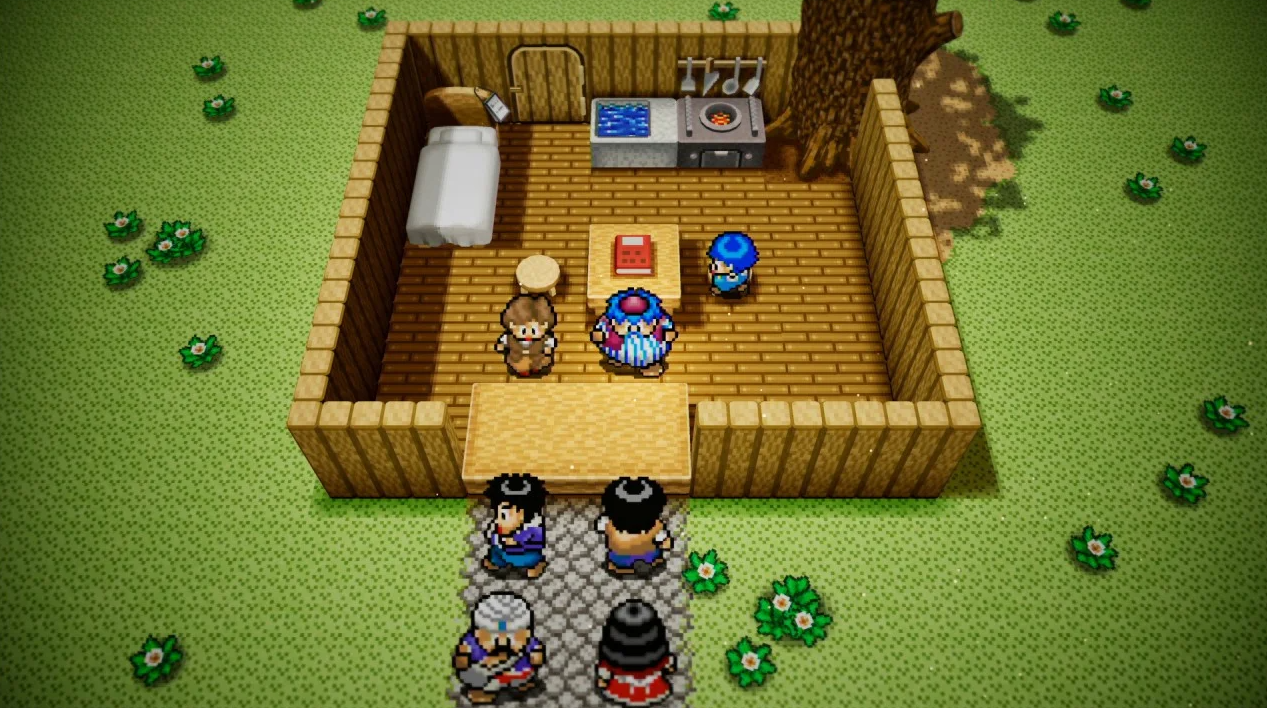
Torneko's Mystery Dungeon
Let’s take a good look at Torneko.
Protagonist? Yes. Merchant? That’s his job title.
Hero?
Absolutely not.
Torneko and Shiren couldn’t be more different as protagonists. The split in the franchise made sense: The former only wants his trade business to expand, while the latter is a road warrior and hero in the truest sense.
Thankfully, adventures aren’t just for heroes. Merchants looking to succeed in business can also venture forth with a sword in hand, ready to battle monsters. Saving the world and fighting evil are not the only reasons to battle monsters; some adventurers want to earn some coin. We're not just talking about disposable ale income, no, but about investing in an ever-expanding retail operation: selling the best wares to actual heroes (and perhaps other dubious characters).
The gameplay loop is about exploring the depths of the dungeon, pushing the limits of stamina and hunger, and getting stronger in the process. Except, hang on, Torneko is not a hero! He’s a merchant, so it’s all business to him- cost versus benefit. All the strength training and perceived bravery are only to the extent of making him a profit. In fact, solving the mystery of the treasure tucked away in the dungeon is completely irrelevant: he only wants to know if the darn thing is worth its weight in gold (or hopefully, more)!
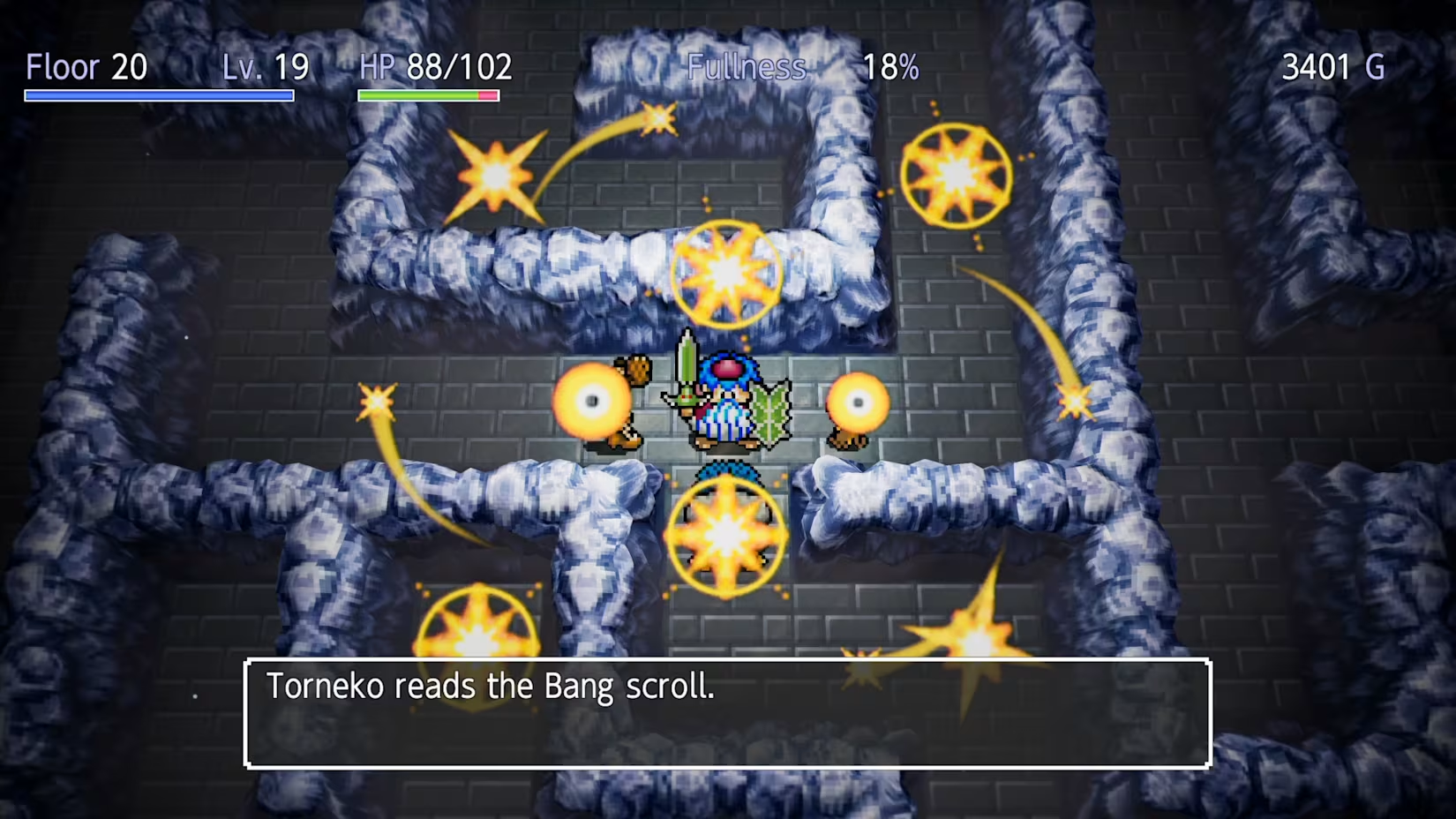
As he ventures into the dungeon while keeping his insatiable hunger at bay (don’t forget to collect his packed lunch from the Mrs.!), the real progress is how much wealth he can accumulate on his travels. Upon defeat, he may lose his items and training, but he keeps half his gold, which goes straight into the shop. Dungeon exploration may be tough, but the positive feedback loop of seeing the financial investment pay off creates a sense of tangible progress, encouraging repeated plays where story progression is marked by major business milestones.
For our unlikely not-hero, it’s also about being smart when picking his battles. It’s less about beating the dungeon and more about knowing when to call it a day. An opportune reading of the Evacuation Scroll means he not only gets to keep all of his gold, but can even put all the valuable weapons, scrolls, and items he’s collected up for sale to earn a hefty profit! It’s all about that sweet, sweet coin, and witnessing the business expand with every passing season.
Danger lurks in every corner of the dungeon, though the worst thing that can happen to a merchant is not facing a big scary monster, but losing money. Therefore, the most heinous fiend to look out for is a disgusting creature called Bag o' Laughs, which is anything but a laugh when it nicks all the gold and makes a run for it. No fate could be worse for a profit-chasing merchant, so all the strength training, equipment upgrades, and spells should be laser-focused on eliminating these abominations with just one clean hit.
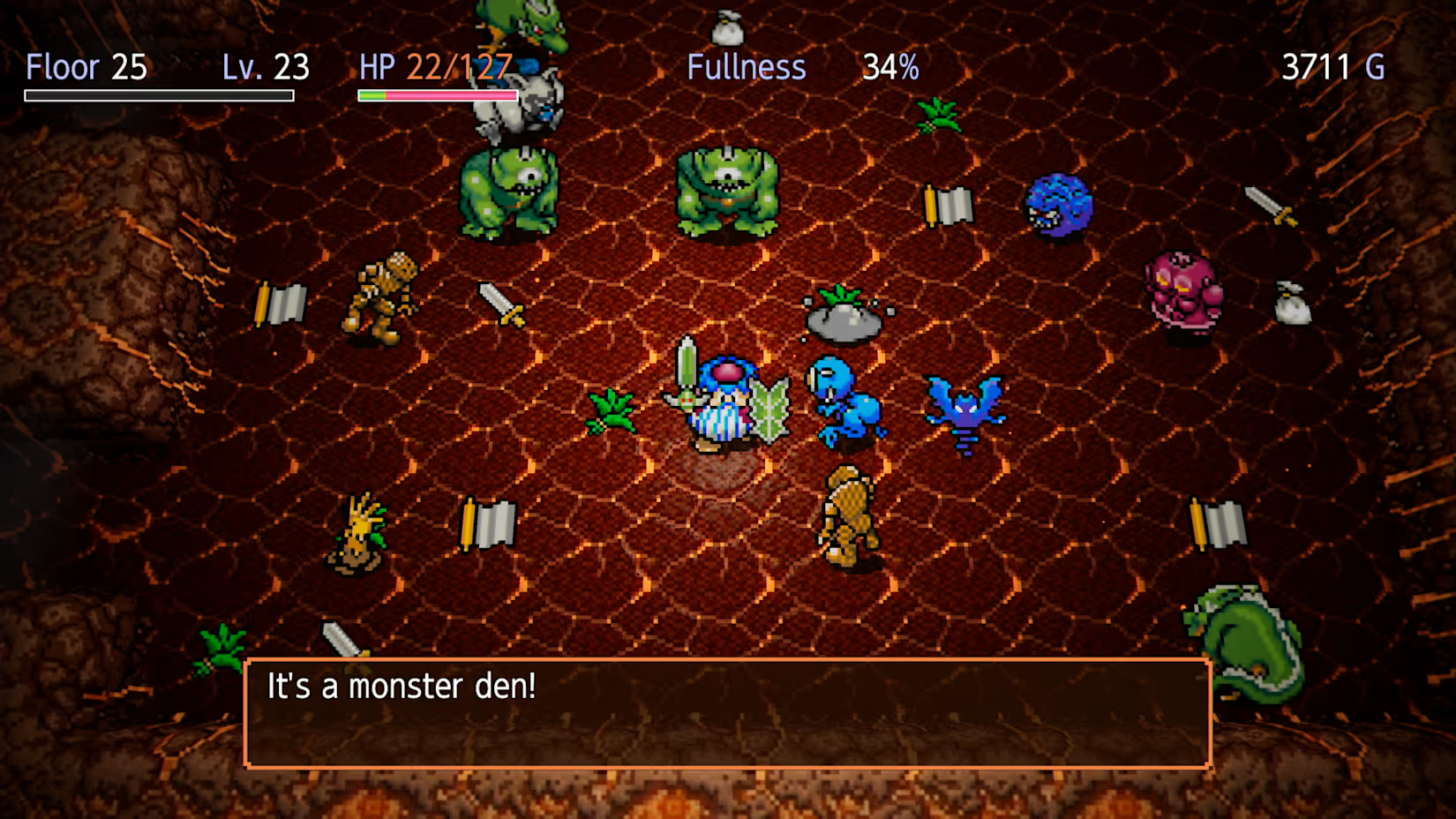
Some players may end up guiding Torneko to the ultimate treasure, but what he really wants is a successful business that can provide a cosy and charmed life for his family. And honestly, a guy who puts his hide on the line just so his kid wouldn’t have to... if that isn’t a hero, then what is?
Join the conversation
What do you think? Reply below to share your perspective.