Aether and Iron's Worldbuilt Intricacies
A rich, thriving world brought to life by beautiful art and creative combat

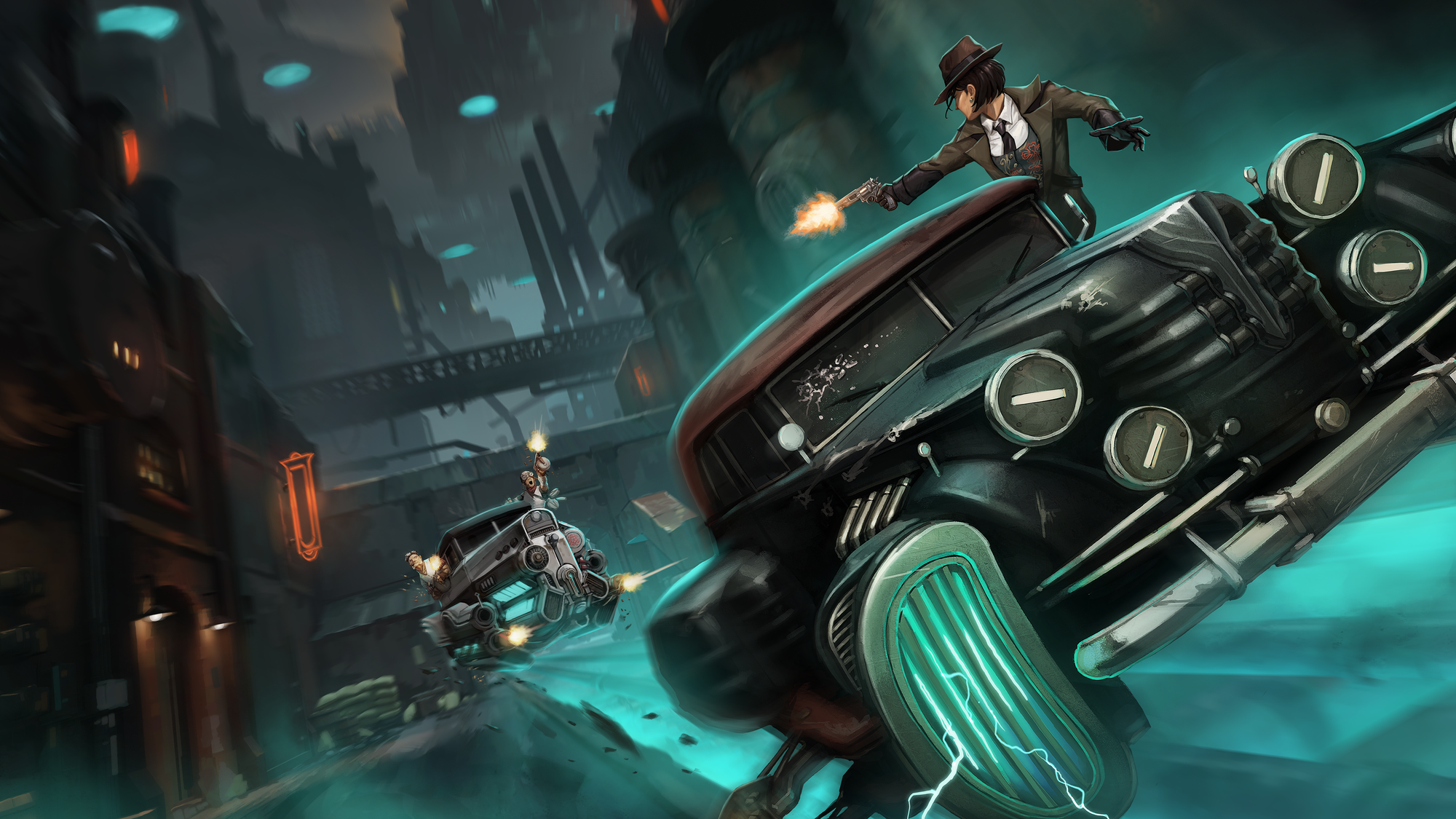
It always begins like this: a slick city office, rain steadily beating on glass windowpanes, a shadowed figure seated at a desk peering out beneath a heavy-brimmed fedora. We all know that noir and noirish films beget a certain aesthetic language, starring what's typically a jaded man torn asunder by the underbelly of his once-beloved city, functioning now as a washed-up PI chasing leads and sweet-talking the ladies. Aether and Iron, developed by Seismic Squirrel, holds a loving lens up to this particular storytelling fabric, but embroiders it with well-wrought fantasy mechanics and fantastic leads.
I've read books with similar world-building finesse, not in the actual similarity of the elements, but in the compelling manner of their distribution. There are simply some parts worth the whole, and Aether and Iron gives me the flip-through-ability of some of my favorite fantasy world reads, particularly City of Stairs by Robert Jackson Bennet, and The Aeronaut's Windlass by Jim Butcher. Again, this isn't a similarity of execution, but rather of evoked feeling: like those books, I don't want to put the game down, and its nooks and crannies of lore are as compelling as its main throughline story.
Having a Heart in the Underworld
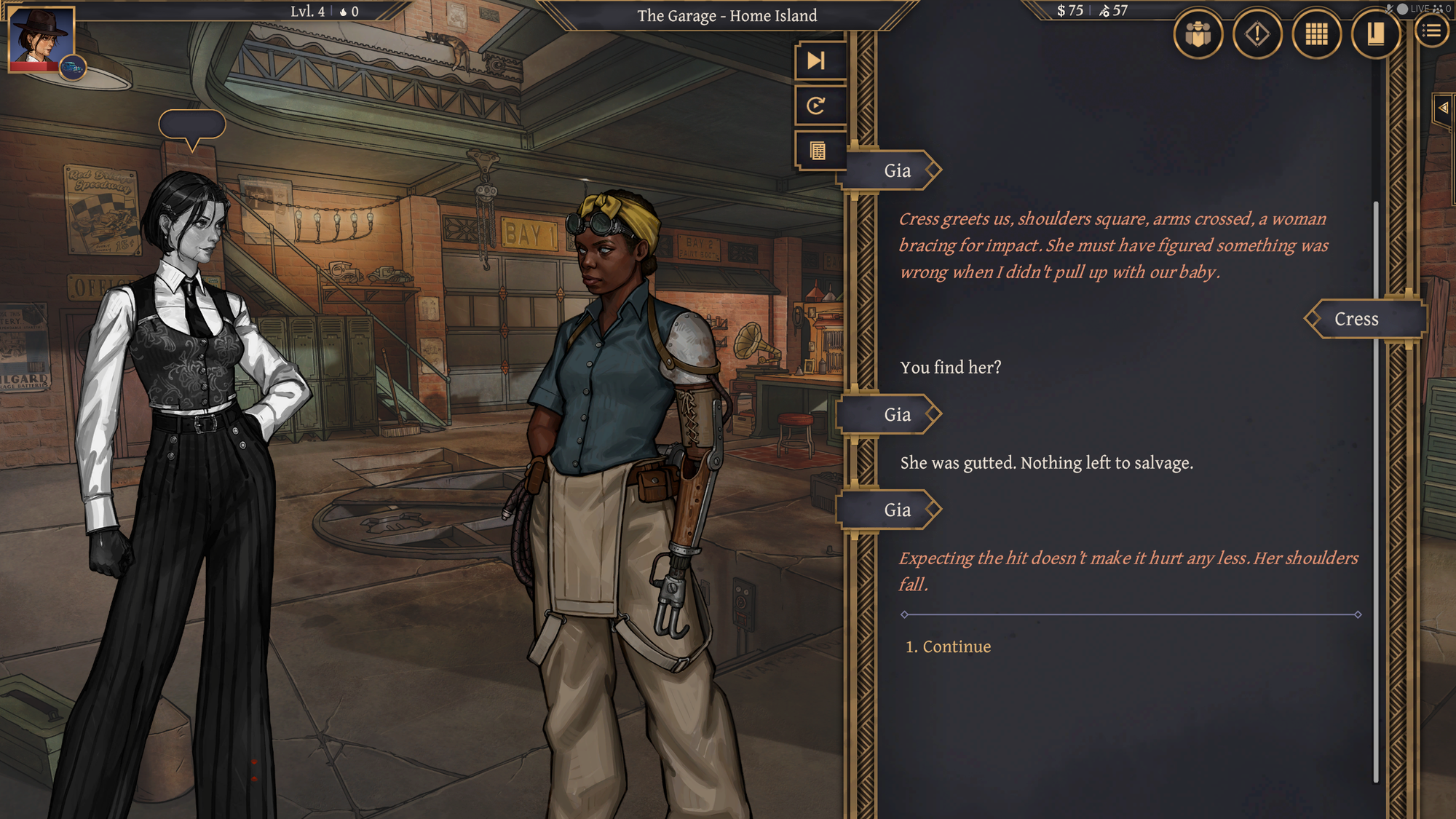
Aether and Iron focuses, initially, on our protagonist, Gia, the suave and at-ease smuggler, who is tasked with transporting wayward runaway Nellie to her requested rendezvous point. That goes awry, of course, and the two instead quickly become bosom buddies of the 'jaded, reluctant mentor paired with perennially optimistic hero' variety. In these two initial characters, we see a world unfold as intricately as a slowly opened storybook. An art-deco-infused New York forms the backdrop of a floating world, in which islands of built city neighborhoods are kept aloft by the hard work of unseen aethoneers – men and women who toil in the aether-infused membranes of the islands' vast networks of interior machinery. These "rats" of the underground are often uncelebrated necessities, yet they are mistreated by the very people and systems they inevitably keep afloat.
"...the details of the world, from the meditations on the lack of stars in the Lowers (literally, the lower cities) to the idea of the dead paying a last fare coinciding with the fact that cab drivers are sort of underclass in the city, form a cohesion of flair that's deliciously rich."
This eponymous aether is a source of energy, with a decent amount of it concentrated very visibly in the dense center of a hurricane-like vortex known as the Well. Nellie, the genius, naive student, probably holds the key to finding out what's causing this sinister storm's expansion; she just needs to set up some experiments on it first.
At least, this is the fulcrum of the introductory segment.
From there, Aether and Iron branches out as a political, smoke-drenched, and savvy narrative, where your choices to either prioritize yourself or others reflect a growing character arc. I am, simultaneously to this game, playing Baldur's Gate 3, another story that centers on character choice, and it's been fun to see how both of these 'roll initiative' games approach freedom. Aether and Iron is much lighter on diversity of options, but I think this lack of digression is essential for a game as tightly coiled as this. It is far more in the vein of Disco Elysium or Citizen Sleeper, where your rolls are based on a certain number of die (all 6-sided, in Aether and Iron), and you can get buffs or increase your stats in any particular area by leveling up a skill tree.
The game features many moments displayed through conversation, as is the way of more visual-novel-style games. We follow the action through Gia's voice-over narration more so than having every detail of an encounter displayed visually, although there are nice sketches of pivotal moments interspersed throughout. Her particular method of relaying information is thick with that noir-ish style; it's a lot of smooth-talking, snarky responses and darkly wry observations overlaying crooning, streetwise, brass-forward lounge music. But the details of the world, from the meditations on the lack of stars in the Lowers (literally, the lower cities) to the idea of the dead paying a last fare coinciding with the fact that cab drivers are sort of underclass in the city, form a cohesion of flair that's deliciously rich. As Gia, we are, after all, essentially a getaway driver.
Ram, Bam, Traffic Jam
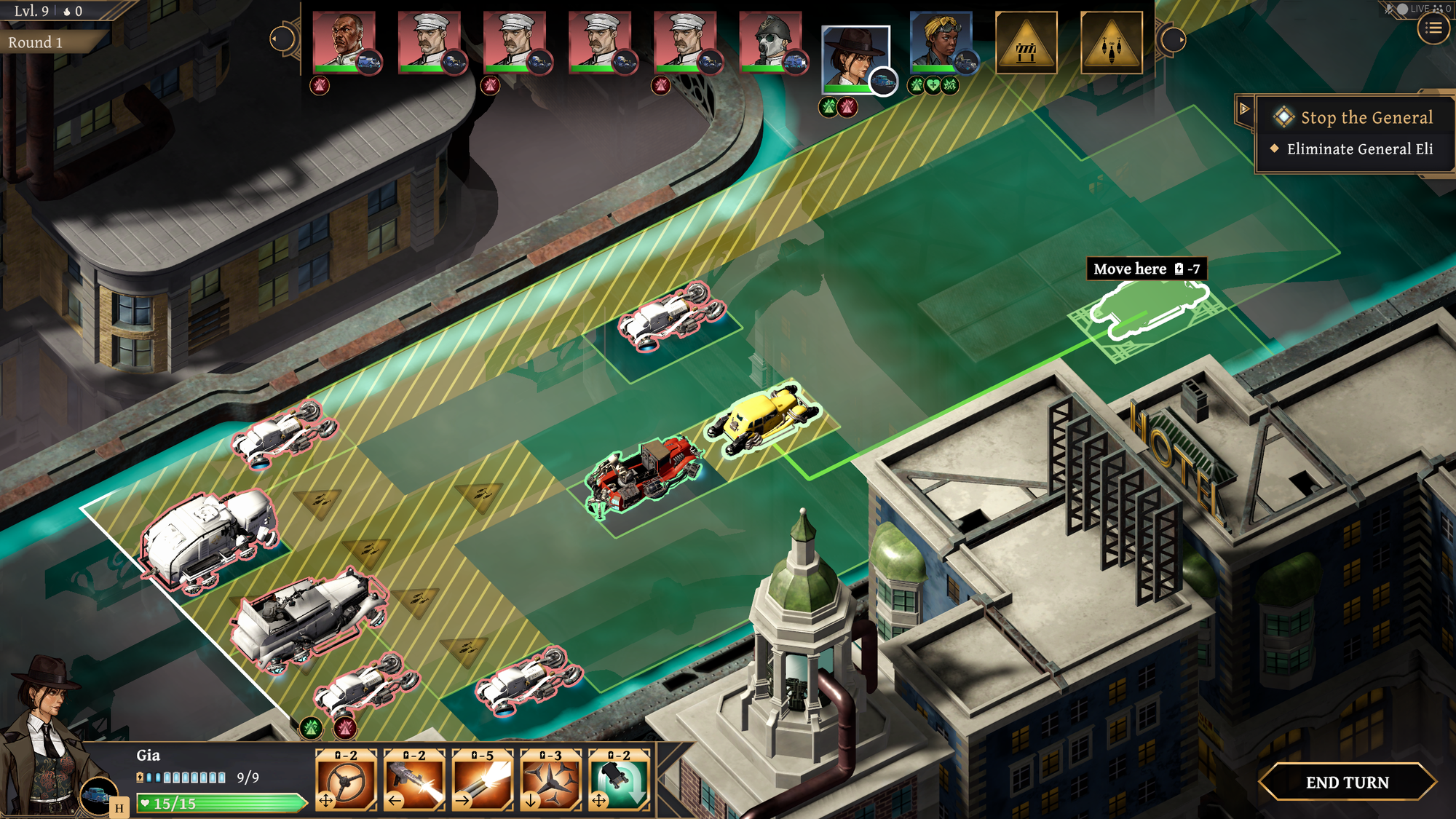
Gia's driving skills form the basis of the game's combat, and it's pretty much automotive chess. It was, admittedly, something I wasn't sure I'd get fully into at first, but after a few frustrating losses to an early boss, it began to click for me: I needed to be proactive and think through both the environmental aspects and the second-hand ones. With the latter, for instance, you might be bashing a car into a yellow lane so that it takes damage next turn, or strategically knocking out certain smaller cars from an attacking fleet in order to mitigate future damage. You can save the big boys for later.
One of the show-stealing aspects of Aether and Iron is the character and world design.
This turn-based battle system is robust enough to support strategic shifts in your approach, and it seems actually reliant on you 'losing and learning', so to speak. There's also the issue of contraband – as a smuggler, you're sometimes paid in illegal goods, and you can keep these concealed in certain compartments in the cars, so checkpoints don't nab you. You can also pay off thugs with these items. This is a small aspect of the larger elements of world-building and scene-setting, but I think they deftly increase the player's sense of immersion. If you have a lot of 'heat' on you, it makes you also more liable to being suspected at checkpoints, and that adds disadvantage to skill rolls, so keeping a few items to pay off officers is handy.
There are occasional difficulty spikes with these battles that I hadn't planned for, which 'soft-locked' me from progressing. This was, perhaps, the only instance of frustration I had, but this was generally because the story was so compelling that I didn't want to bother with a visit to the garage for upgrades. But upgrades are important in the same way that leveling up your characters and adding to your party are. You can re-spec certain cars to excel at distance, heavy-hitting, healing, etc., and the same goes for your characters; they can be good at inference, mechanics, deduction, among others, and these can elevate your modifiers to rolls and also aid you in the mobile combat. As I tend to rush story-based games, I had to learn to backtrack and think more carefully through potential combat situations, and when and where I might have a 'surprise encounter' while en route to my next destination.
Crafting a "Deco-punk" World
The character and world design aspects really steal the show in Aether and Iron. I already mentioned this feeling like a novel, and that is evident in the care taken to articulate the narrative through the design, and vice versa. I've been watching a bit of Seismic Squirrel's Dev Diaries and Aether Hour series, available on YouTube, to get a better feel of the development process, for I am nothing if not insatiably hungry for craft.
I watched their video Meet the Artist Behind Every Character in Aether & Iron to learn more about how these characters were created, because I absolutely adored the art direction of the game itself. I am very much anti-generative AI in creative spaces; I've written personally about the failings of AI art regarding the locality of creation and the threat it poses to the general health of art's individualization and the practice of effort. Aether and Iron's art is so refreshingly celebratory of a stylized personal attention.
The artist behind the characters, Mika Tanagi, and the game's Art Director, Gary Jensen, discuss the process of collaboratively 'building' a world and finding a voice for the story through trial and error in the video. This was one of the best parts of engaging with the game itself; I adore learning from other creatives, so having these BTS videos available to players so they can see the process was wonderful. The team seemed to really explore the dynamics of art in the world, from initial experimentation with more 'sci-fi' concepts, as discussed in their video, to eventually settling on their 'deco-punk' identity.
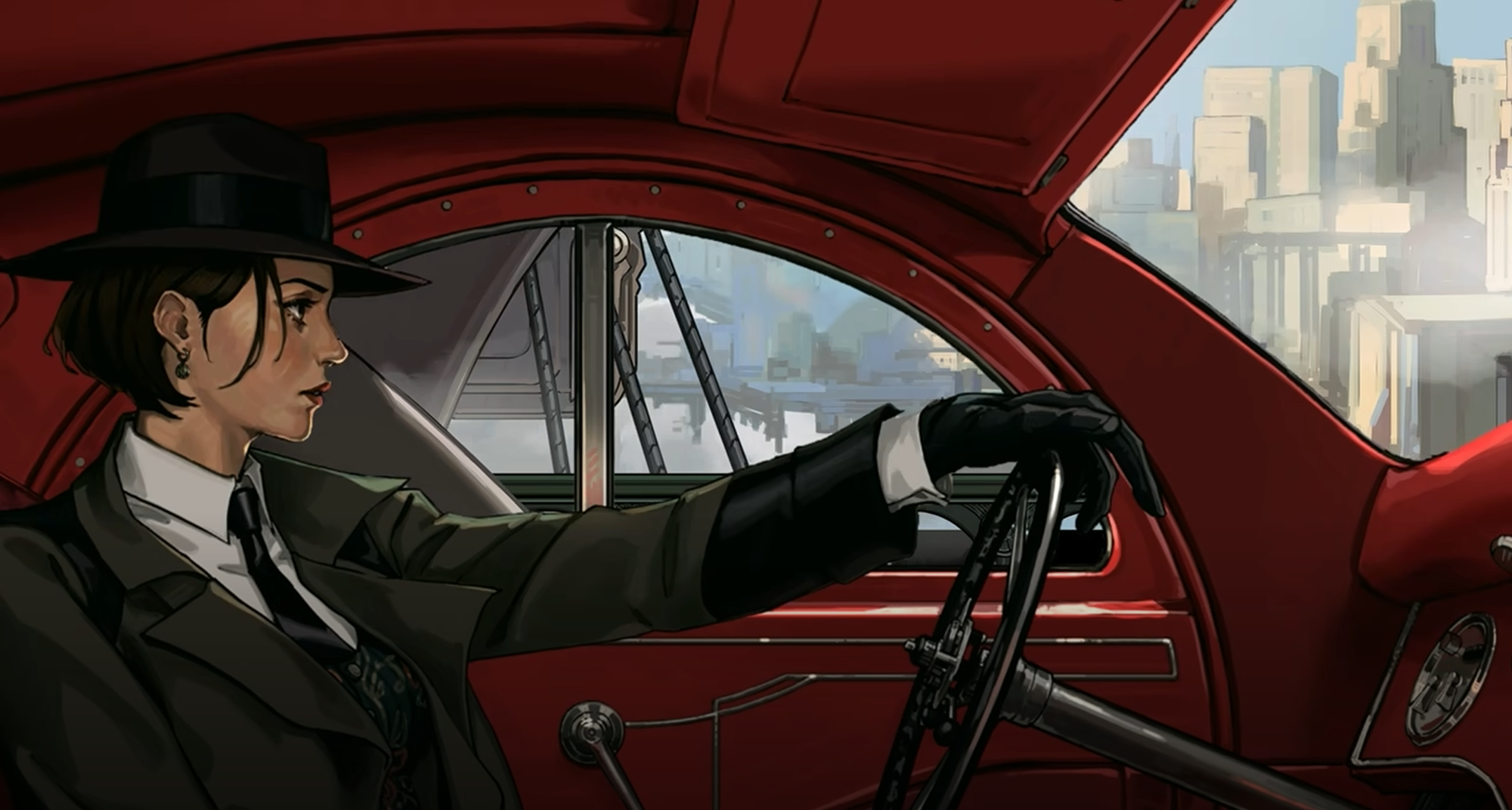
I genuinely want to see more of this world, because it's full of such potential when it comes to characters and the various nooks and crannies it visually realizes, which is really a testament to the strength of identity and breadth of the world these developers and artists have created.
I loved seeing the drafted alternatives of each character and learning about the hand everyone had in the styles at any given time. I find the process fun and exploratory, never wasted (as someone who drafts endless scenes in her stories), and, like mussel colonies, the new iterations build atop the old. You can see evidence of their inspirations (such as J.C. Linedecker) in the art's polished and yet beautifully 'rougher' edges, so that it resembles an actual, hand-painted/drawn character sketch. The backgrounds of the setting pop, each distinguishable but also visibly part of the connective tissue of the game's identity. All of it, including the UI, feels cohesive. Of course, these characters need to be brought to life, and the game features full voice acting, which does a wonderful job of conveying the emotions, from Nellie's bubbly eagerness (occasionally – and purposefully, I imagine – dynamically juxtaposing more 'serious' characters) to ex-aethoneer-turned car mechanic Cress's quiet gravitas.
I genuinely want to see more of this world, because it's full of such potential for the characters and the various nooks and crannies it visually realizes. This is really a testament to the strength of identity and breadth of the world these developers and artists have created. I have not yet beaten the game, but as I progress, I learn more and more about the various people who inhabit the other islands, meet new frightening and domineering 'barons' who rule the streets, and find myself increasingly intrigued by new enemies and potential allies. Aside from a few bug issues, Aether and Iron is a polished and well-crafted game, with its world, art, characters, and narrative as its most exciting elements. I definitely enjoy the combat too – but, truly, in the world of games, there is nothing better than diving into a fantastic story, and Aether and Iron delivers that in spades.
Join the conversation
What do you think? Reply below to share your perspective.