Frostpunk Is Too Damn Hard, and That's Just Fine
Surviving past the edge

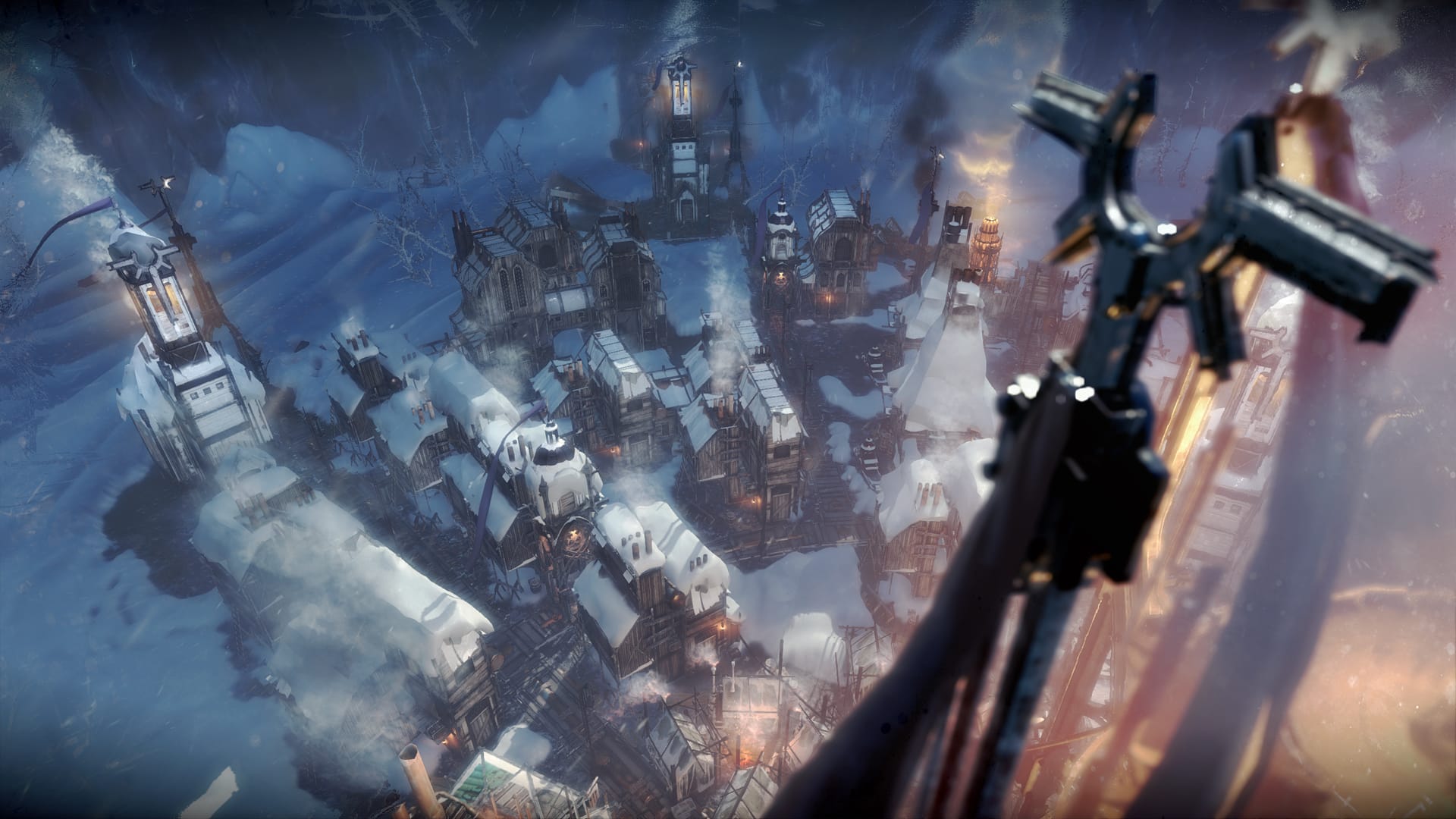
I've been playing Frostpunk for the better part of two weeks (well, I stopped for travel, but I was obsessively playing it). I even listed it as one of my favorite games, not of this year. It's a game I'd seen pop up in the PS5 subscription-based game collection, but in the past, it'd just float by my periphery whenever I browsed for new titles to play. And listen – I love me a cold winter game. I really love me a cold-winter, steampunk-inspired story sim.
Frostpunk, though, is a different kind of game. It's notoriously difficult and completely unforgiving. It's a game that frustrated me to no end, yet I could not put it down.
The Last Everwinter
I've never been the biggest fan of strategy-based games. I am, to put it plainly, very daft when it comes to forethought. I'm a 'one thing at a time' kind of gal. I can wear many hats; I just need to carefully take one off before I put a new one on. I am focus-based. I like minutiae. I panic like that little penguin when too many things go wrong at once, and this game is essentially 'too many things going wrong at once.' Frostpunk forces you to contend with a variety of wildly changing factors, with public opinion and weather being the most volatile among them. You have to resource manage, and, if you can, future-proof some of your stockpiles. Considering the climate and various limiting factors you're up against, this is an insane ask.
The game's core story is compellingly simple, though, and it forms the boning to the game's corset (okay, so I just got done with wedding dress shopping), the pressures of which are cinched so tightly against the player that it often feels like you're being set up to fail. This is a world ending due to the sudden and inexplicable onset of an ominous, frigid winter. No one's quite sure where it came from or how it came to be. Early expeditions north seeded the arctic landscape with heat-producing generators. The choice to go north, although it seems irrational, is largely due to the prolificity of its rich resource deposits. Massive, manufactured dreadnoughts were expected to bring hordes of desperates to the last bastions of human civilization. Your job, then, is to successfully be that last bastion.
Frostpunk's conceptual challenges stem from the cruelty of its environmental factors and the understandable exhaustion of its populace. You're saddled in the initial scenario with a ragtag group of citizens – including children – who you need to command to gather coal, wood, and steel. It's simpler, in the beginning, when you have relatively mild temperatures and a smaller ring of homes to heat. As time goes on, though, the demands inevitably increase.
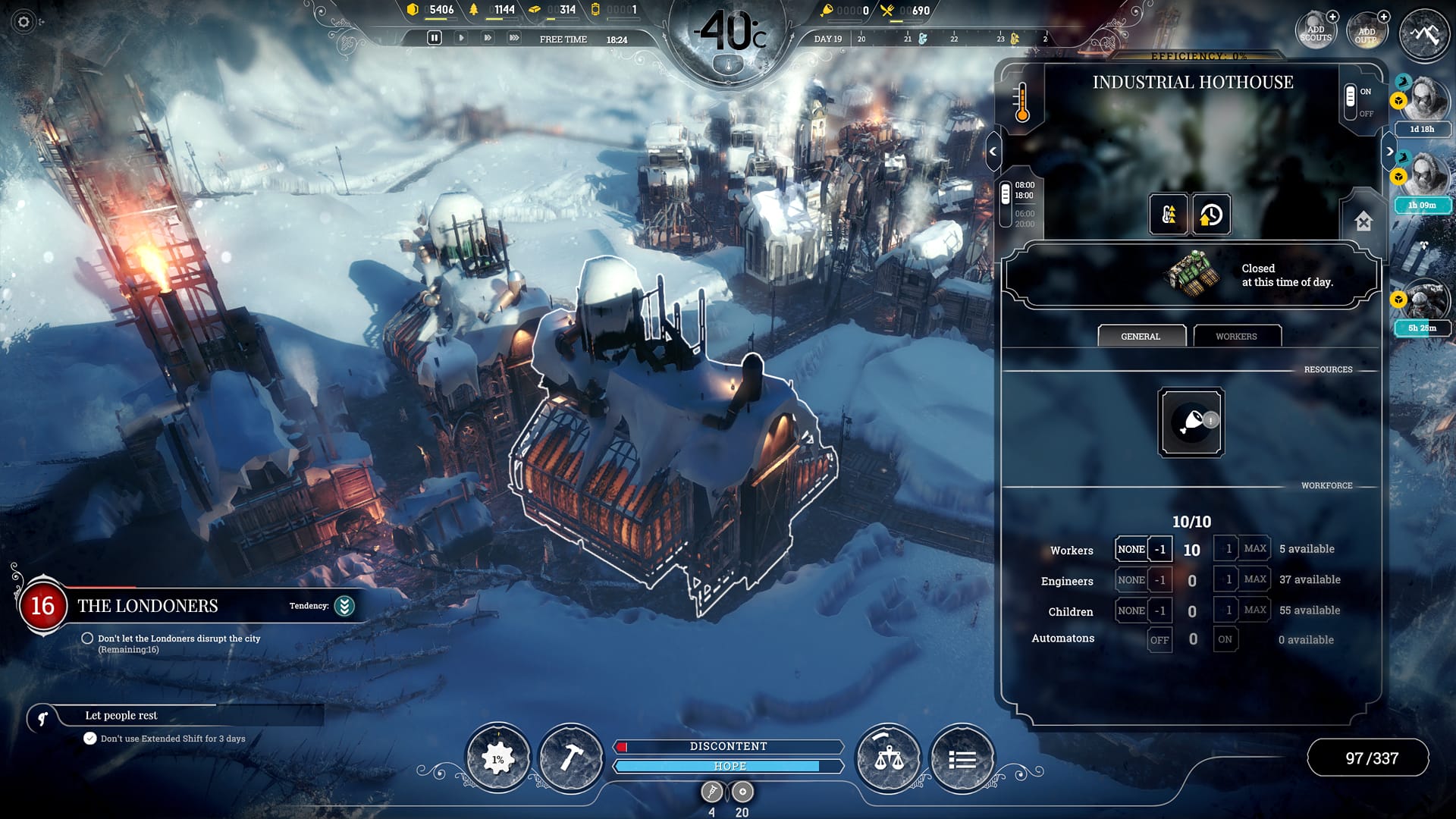
The generator at the center is your city's beating heart, with coal as its lifeblood. It provides heat to an expanding area at an expanding strength (both of which you'll need to upgrade to) and will be your final defense when the 'weather anomaly' reaches your city. There are various scenarios you can try besides the "main" storyline, and each of these tailors the challenge to a specific circumstance. But the beginning one – where you settle into a new city – offers the best opportunity to learn the game's systems and cadences.
This initial story, titled "A New Home", introduces you to all the clanking gears of the game's mechanics. You have a day-night cycle, shifting weather, ore and steel deposits, hope and discontent meters, hunter huts and hothouses where you can requisition food, and you can introduce either draconian or more palatable laws depending on the severity of your circumstances. I tend to play games with a cleaner moral edge, so I tend towards gentler choices, even if it results in my failure, which in this case is banishment. You can create a cemetery to bury the dead respectfully, or you can simply dump bodies in snow pits to harvest organs later. Your people will, of course, have things to say about either choice.
The game's exceedingly interdependent systems mean you need to be aware, at all times, of what is going on where.
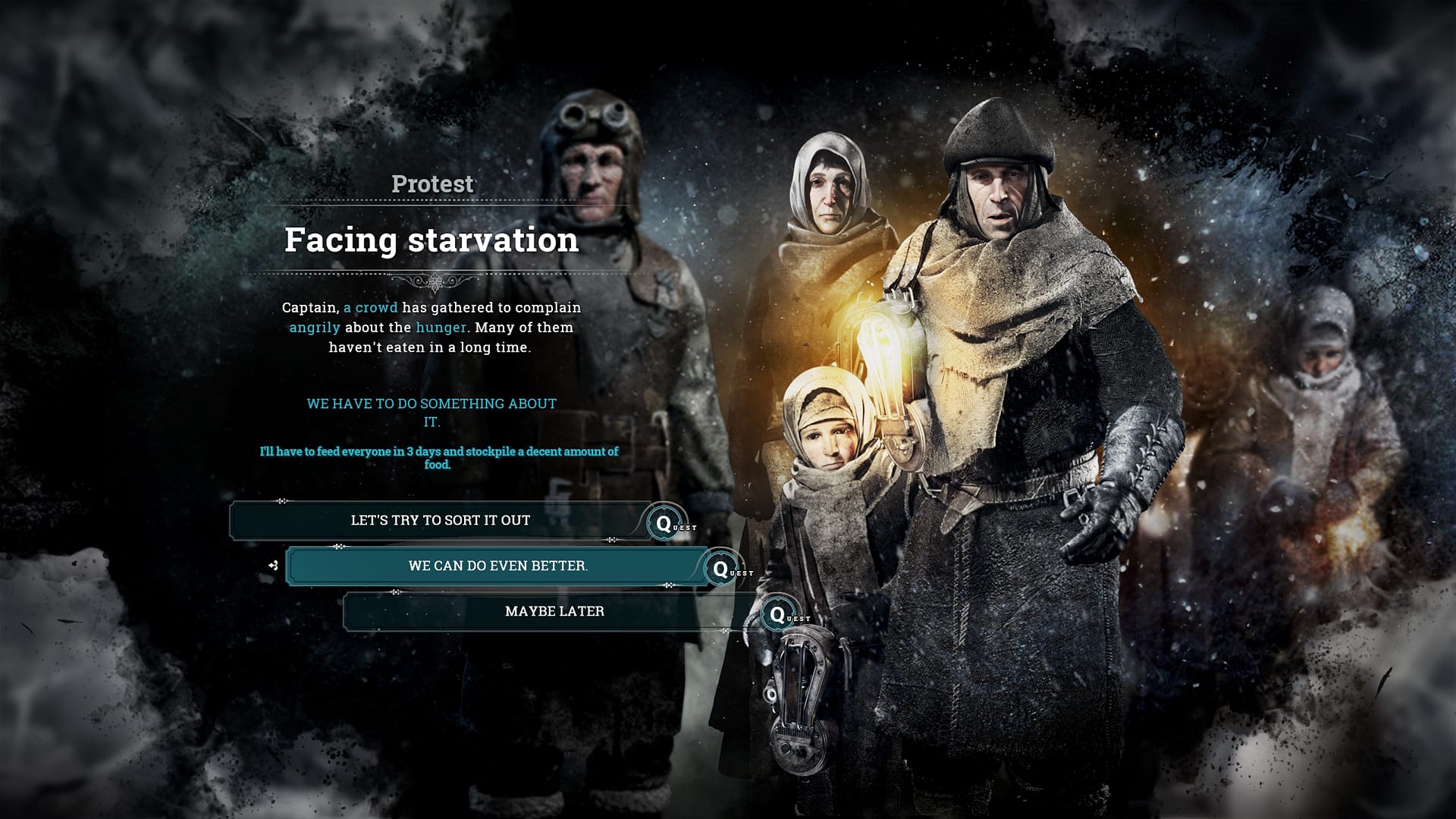
Beyond the laws that you can enact for survival, there are two paths that your city can take to succeed: order or faith.
Technocracy or Theocracy
The path you choose for your city's direction – and this is the direction for the people's wellbeing, not necessarily just their survival – will hinge somewhat on how easily you can navigate the beginning setup. That setup is, depending on your difficulty, 150 people and a few scattershot deposits of coal, steel, and wood. You have to build the homes for your citizens (using wood), run the generator (using coal), and eventually build other buildings (using steel and wood) to then produce more of all three. My first priority was always to build houses, and after that, I tackled building workshops for research, which is the most important little part of the strategic gameplay. Research allows you to "level up" your abilities, such as better insulating medical tents or adding heaters to workplaces. You have two kinds of labor available to you as well: workers and engineers (and children if you're feeling really, you know, pragmatic).
Engineers can work pretty much anywhere, but workers cannot work where engineers do, such as in specialized fields like research, medical tents, etc. Your first few days of trekking to piles of stuff to gather stuff to then use that stuff to build other stuff is fairly cyclical. But when the first cold day hits, you need to make sure your people have heated shelters and workplaces. If they don't, they get sick, and then you need to build more medical tents, and if you don't build enough, people die, and other people complain, and then bodies litter the streets, and then hope falls and discontent rises, and you are in deep crap by then.
The game's exceedingly interdependent systems mean you need to be aware, at all times, of what is going on where. Are the outer workplaces too cold? When citizens get frostbite, do we amputate or give them extra rations? How do we afford those? Is there enough food coming in and being prepped at the cookhouses? Will we have enough coal stockpiled to ramp up heat during the next cold front? When you choose a path of order or faith, you essentially give yourself a plaintive "oh shit" button to potentially tackle upcoming issues. Faith gives people places to worship and rekindles purpose in otherwise miserable lives. Order does much the same, but there is a level of authoritarianism that slips into each if you see them to their fully realized pathways. Order has a city watch, faith has faith keepers, and either can be deployed against your people if needed (or wanted).
This system of laws makes your choices permanent, so you need to decide fairly early on if you want to do more morally contestable things, such as legalizing child labor (and as my fiancé and I quoted whenever we did it: "the children yearn for the mines") or helpful (if unpopular) things, like resorting to soup rather than full meals. As you gather resources and level up research for new items in the workshop, the real flow of the game begins to ripple outward. You must juggle myriad pressing issues with very little grace given, so there are times you have to make decisions that you typically would not make as a more beneficent ruler. There are also moments when things become so bleak that you regret not making an earlier situation possible – such as prioritizing leveling up the generator's output rather than workplace insulation, or vice versa. You only have so much time, so many days, and so many people, and every new attempt saw us faced with a different challenge.
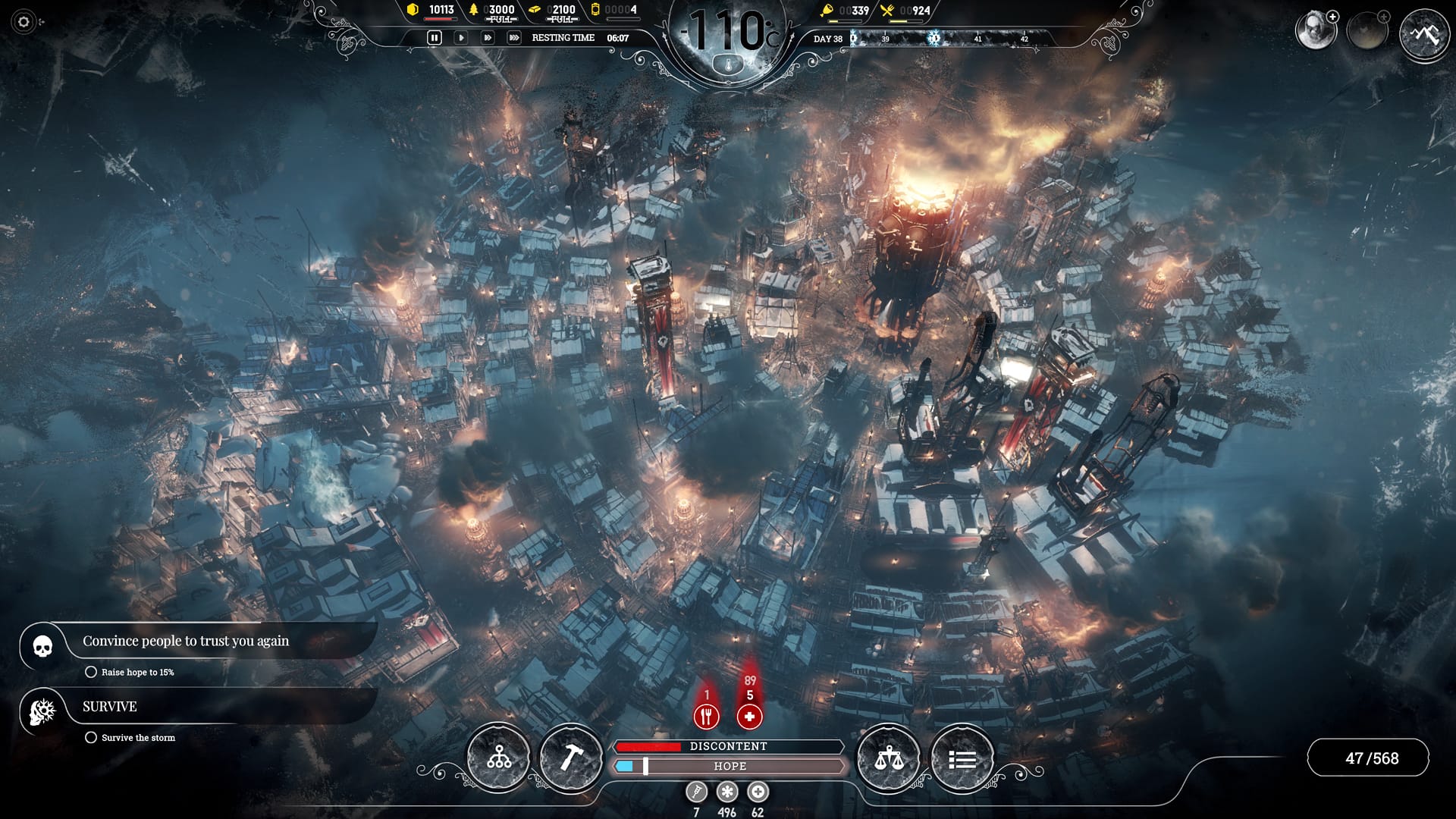
For all its beauty, cold is a desolately quiet monster.
At one point, we'd think we had it down pat, and then discover we'd run out of food, or that we stored too much coal and wasted resources building tons of storage depots rather than sawmills. Other times, we'd fail to properly plan the city layout, resulting in houses having to be built farther from the generators' warmth as more and more survivors seek out your city. One of the most interesting and lore-heavy components of the game is its topside exploration. You can send scouts to various locales, and each of the locations in the main scenario has a story to tell. I regretted, one time, not sending back an extremely helpful automaton my scouting team had encountered, and instead broke it down for parts. I could have used that cold-immune, 24/7 workhorse when the going got tough, because automatons – which you can eventually produce yourself – don't have the caveats of human fragility that your people do and can work, albeit less efficiently, virtually forever.
A Heady Ambiance
I was lucky enough that during the great (real-life) winter storm of '26, we did not lose power. This was odd, as most of the city I live in had huge swaths that went dark. It was bitterly cold. I played Frostpunk the entirety of the time we were stuck inside. I was lucky to be able to do so, but boy, did it paint a bleak picture. Any time my fiancé and I heard ice crackle on the rooftop – because something heavy kept falling onto it – I would think "this is it, the power's going out." I figured we'd have to bundle our cat in blankets, light our tea lights, and huddle together until repairs were made to the lines.
When we went outside a day after the storm blew past, we saw trees beaded with thick ice. It was beautiful, but the weight of that ice on the limbs had cracked so many of them right down the middle. It reminded me, once I "woke up" from my Frostpunk obsession to stare at a blue sky, just how deadly ice and snowstorms really are. For all its beauty, cold is a desolately quiet monster.
Frostpunk is a game I will play again, but it's not necessarily an easy game to play, in terms of "vibes." It's not just difficult, it's also a very hard place to settle in for a quiet night of gaming. You are beset by pensive music and constant reminders that people are cold, or starving, or desperate. In the main scenario, you even eventually have an antagonistic faction – the Londoners – who seek to go back to London in hopes of having a better shot than they currently do in the middle of the northern wastes. In this game, London has pretty much already fallen, so the fruitlessness of the pursuit is more indicative of people's delusional desperation to survive rather than actual practicality. Your additional job then becomes to sway them to stay. Frostpunk is, I would say, the opposite of a cozy game. It is a very tense game. And the honest truth – I did not play this game at its original difficulty. I was too overwhelmed by the constant failures and, in order to see it play to the end, figured I would give it a shot on an easier setting.
The easy setting is much easier, but I also think I did myself a bit of a disservice by backsliding into it, although I would have undoubtedly put it down before beating it if I'd had to truck through it on the basic difficulty. I also played this game a lot during those few days we were stuck inside from the storm, so perhaps my impatience was a product of repetition ad nauseam. I have since played one other scenario, called the Fall of Winterhome, on its basic difficulty setting. I then customized two of the settings to be gentler on me, while keeping the others at their standard difficulty. I'm the last person to deny when a game is "too hard." I will openly admit to lowering difficulty, because I think, in a way, perfecting those systems is part of how I learn systems. I get something "down," and I can move on to the next.
Building a Future
All in all, Frostpunk is a beautifully crafted game with a system of resource management and reputational upkeep that manages to seamlessly integrate challenge and reward successes. If you can manage to keep your workers warm and fed and circumvent frostbite, you can focus more on providing people with extra rations, or you can keep children from working by building them the equivalent of daycare centers. You can build prosthetics, create public houses, and provide people with a stress outlet in the form of fighting rings.
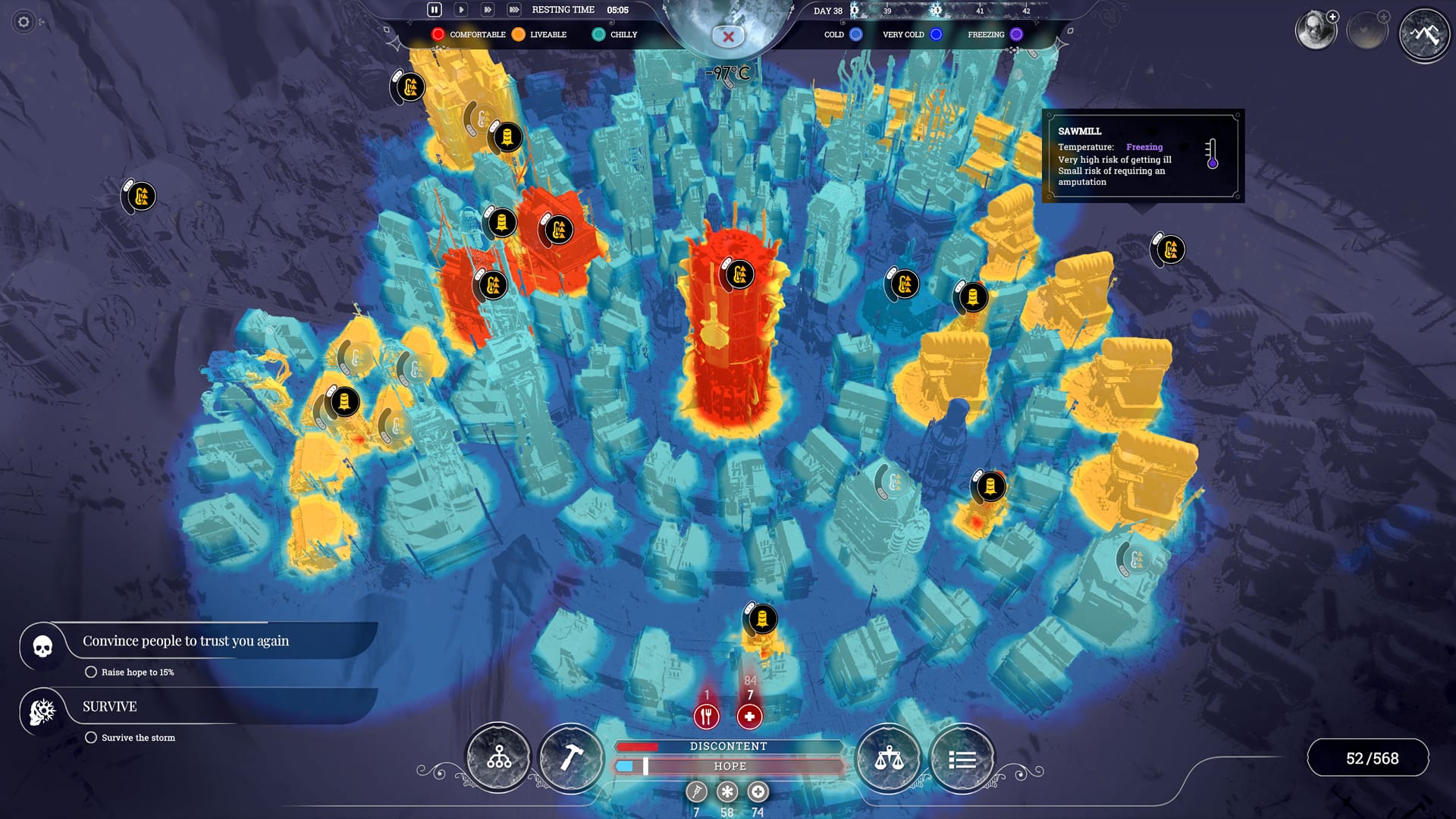
When I finally got my people past the "weather anomaly" that serves as the main scenario's final phantom boss, I felt a sense of immersive relief and pride. Sure, I wasn't playing the game at its most challenging, but it still kept me constantly on my toes. There's something so satisfying about having a functioning city, where you can revolving-door materials to build, where all of your citizens have a house, where you level up your generator and outfit your workhouses with automatons so that the city can be almost hands-off. I haven't gotten there yet, but I desperately want to try. You can attempt this on the game's nifty Endless Mode, which is exactly as it says: an endless cycle of days and nights that you play until you fail.
I've since tried a few other simulation games – with far lower stakes – but nothing has quite scratched that Frostpunk itch. I might try Frostpunk 2, but I've heard it has a different focus of management. This original one is a clever little game, with a very palatable UI (there's even the above-pictured heat map toggle, and I lived in that view) on console. It's currently available as a part of the game collection for PS+ subscribers, and since we still have six more weeks of winter to schlep through (thanks a lot, Punxsutawney Phil!), now's a good time as ever to cuddle into a quilt and try to keep the fire lit.