Reality Isn't So Kind: How Final Fantasy VIII's Child Soldiers Defy Destiny
Final Fantasy VIII critiques warfare by placing responsibility at the feet of the innocent

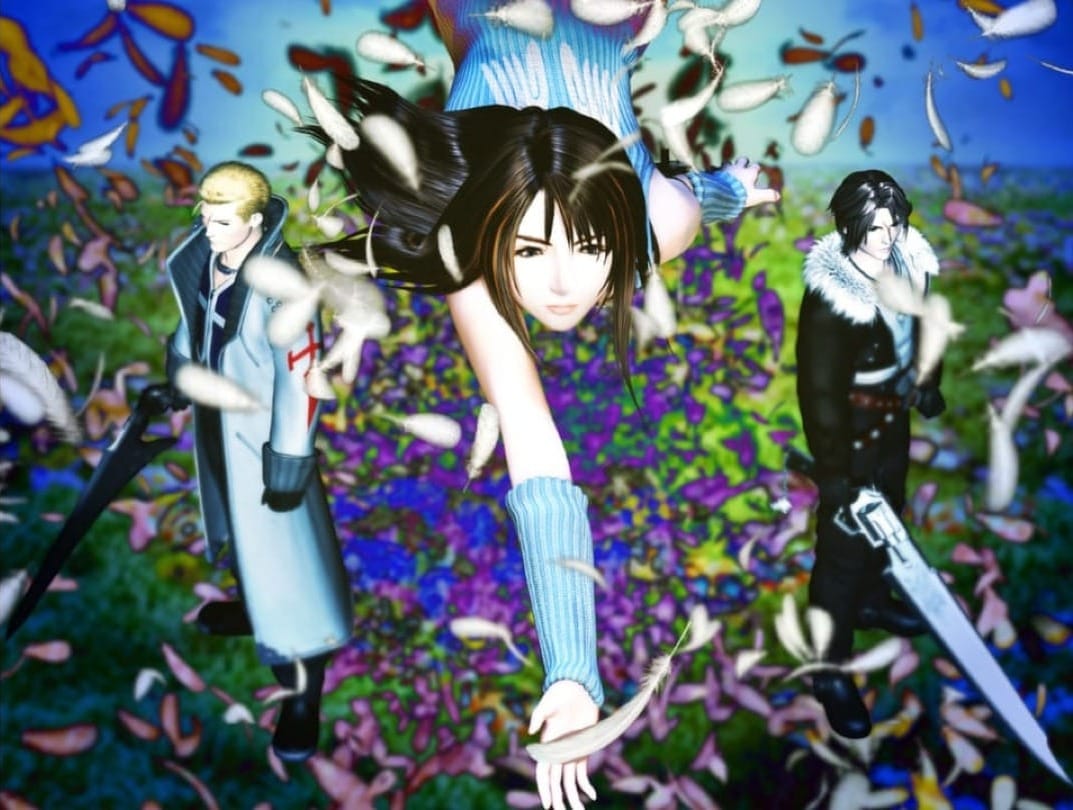
The day is long. Beginning with an early morning training session that ends in blood and scars, followed by a teacher-led field test against the Guardian Force Ifrit, Squall finds himself on unfamiliar shores, the intrepid pre-graduate SeeD mercenary tasked with securing a portion of the Galbadian-occupied city of Dollet.
Pridefully, Seifer Almasy pushes Zell and Squall onward, where they meet the new transfer, Selphie, at the top of a ridge. Tired, battered, and sidling war crimes mid-seige, they follow Seifer to an abandoned radio tower, where the abandonment of their post has them play unwitting heroes before a withdrawal order.
Briefly, Seifer asks Squall about his personal dream.
"The way I look at it," says Seifer. "As long as you make it out of battle alive, you're one step closer to fulfilling your dream."
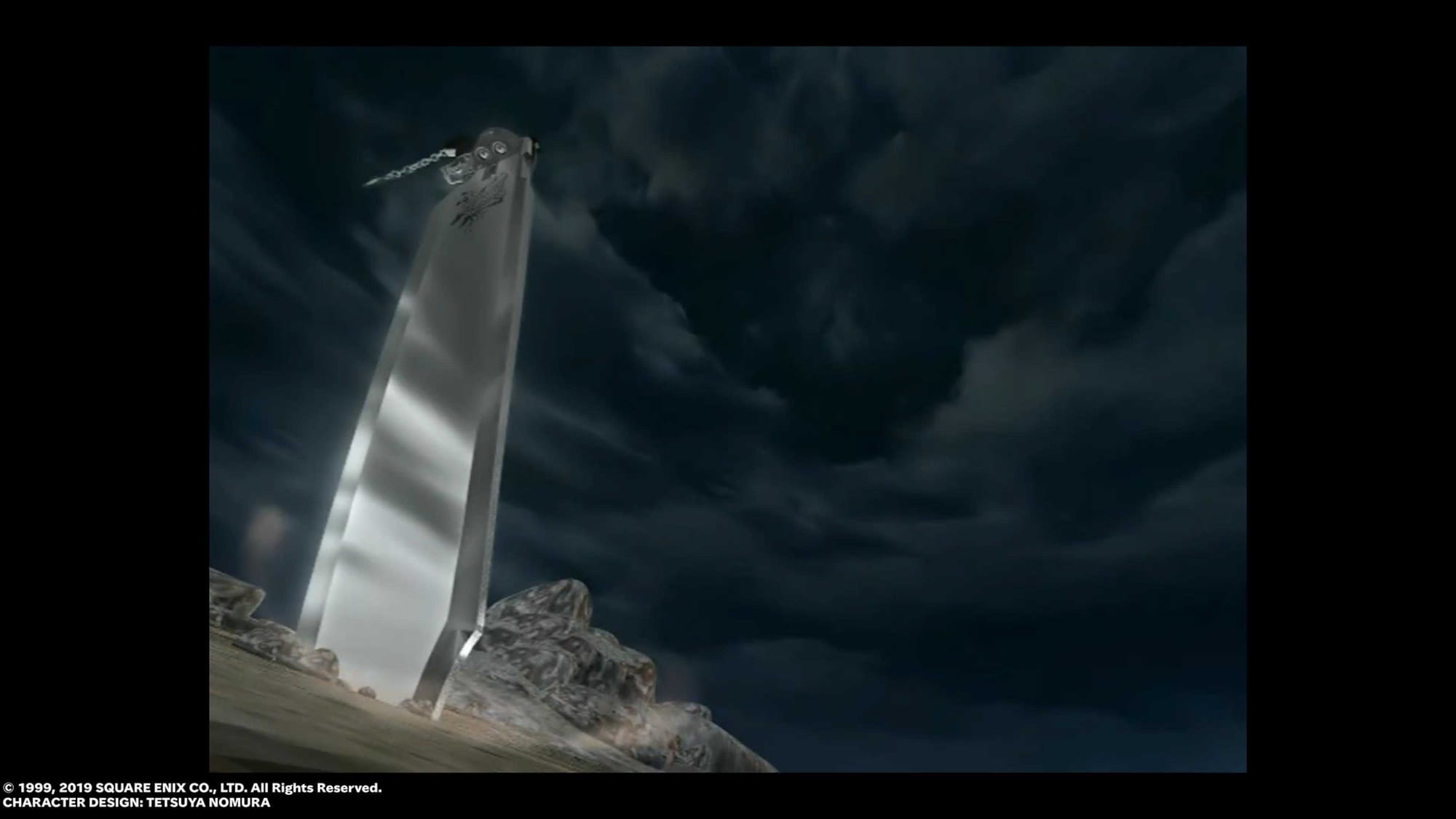
It's a romantic one, Seifer says, though players familiar with Final Fantasy VIII know the outcome of his misguided aspirations. Inspired by action films and the abandonment of boyhood, Squall's rival dedicates his solipsistic dream to manipulating another. And Seifer's dream is this: to be a sorceress' knight, to follow in the footsteps of a childhood motivation, to play the hero. Seifer may come across as a bully, but he's very critical of the world as presented. Despite being part of the student-retained "Disciplinary Committee," Seifer's laid-back attitude underpins a character that doesn't respect the status quo.
Later in the game, after Squall and company have been abducted and imprisoned by the Galbadian military, Squall faces torture at the hands of an opportunistic guard. The torturer demands to know the true goal of SeeD—something that Seifer, a failed student who didn't graduate, supposes is a secret universal truth of those who complete their exams.
While Squall's sophistry (and frequent apathy) are defensive, this dismissive joke ties into the game's underlying themes, driving the anti-violence philosophy espoused when the party reaches Fisherman's Horizon, and deeper still, the thematic identity of adept child soldiers in a world of ineffectual adults.
"...Flower." Squall can barely lift his head from the pain of torture. "The true goal of SeeD is to spread seeds all over the world, to fill the world with flowers."
No, the goal of SeeD isn't anything ecological. Seifer and Squall both experienced caged, manipulated dreams. The only environments affected by these young soldiers become battlefields.
Soft Imperialism
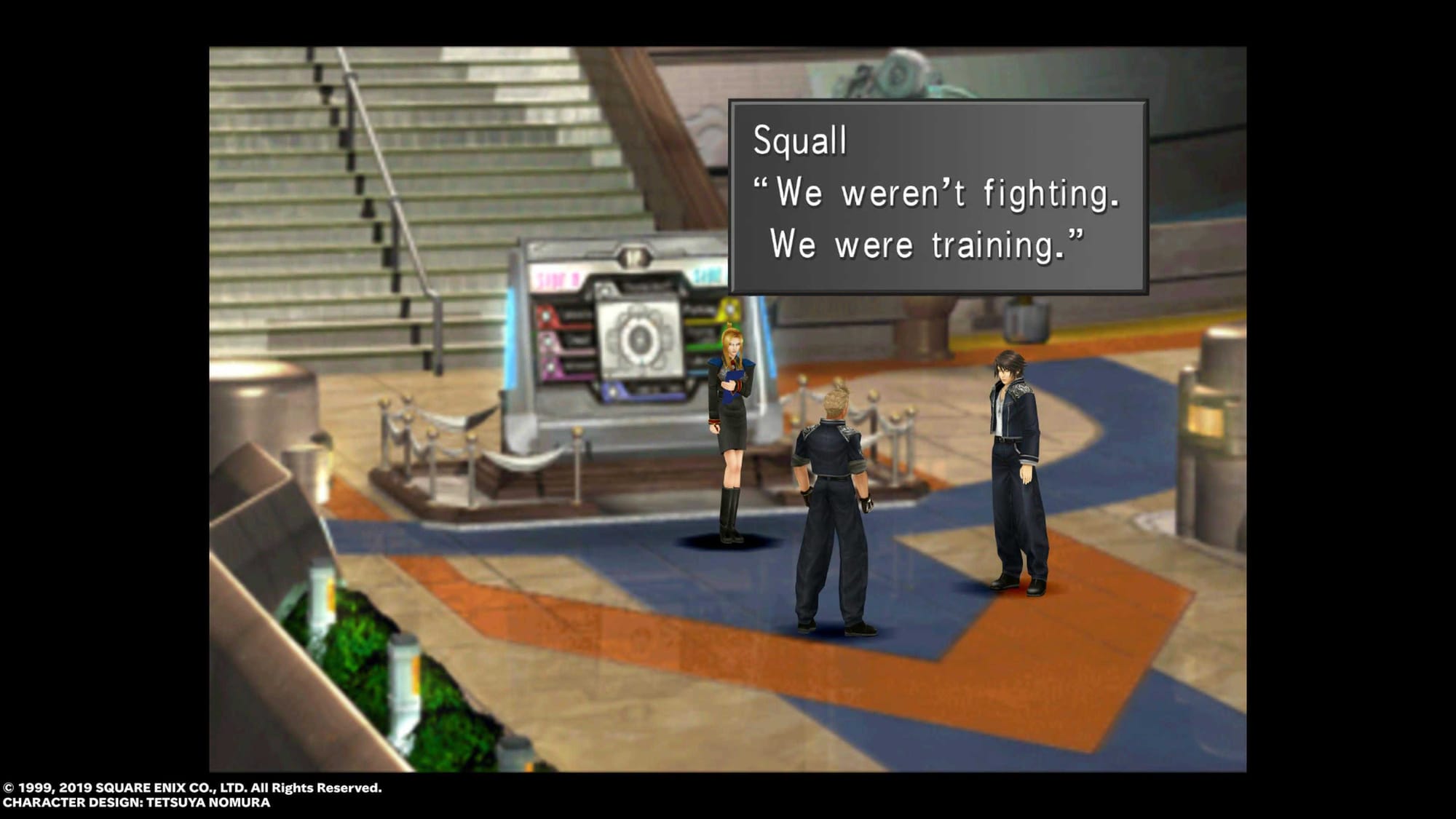
Squall is faced with the sins and circumstances of his actions more than once in the course of Final Fantasy VIII's story. At Fisherman's Horizon, a sealevel utopia governed by a socialist mayor and populated by peace-loving engineers, Squall confronts the reality of his actions as a student of warfare. The apathy that guards him from responsibility is stripped away as he is forced to face the fact that war and peace are not a simple binary.
SeeD mercenary interference, even when left to small squads of two or three, can be enough to upset governments, political agendas, and entire communities. Paid warfare shapes the world, allowing both activists and opportunists to recreate the setting, law, and standard.
Squall tells Mayor Dobe at Fisherman's Horizon:
"It's hard for me to explain. I wish everything could be settled without resorting to violence...and there would be no need for battles. Like you've been preaching, it would be wonderful if things could be settled by discussion. The only problem with that is that it takes too much time. Especially if the others are not willing to listen. So I believe that fighting is inevitable at times. [...] I think the world needs both people like you and people like us."
The Timber region's early-game exploitation by SeeD is framed as salvation. Rinoa, revealed to be an excitable activist and the rebellious daughter of a Galbadian general, begs Balamb's headmaster to grant her Squall, Zell, and Selphie. These newly graduated cadets do not have the life experience or the political acumen to comprehend the gravity of their duties. The 18-year-long Timber rebellion has been fronted by underground resistance groups who, in the wake of the second Sorceress War, fight for independence from Galbadia.
While Timber rots beneath fascist rule and faces continual hardships due to the clashes between resistance groups and the military, its retrograde standards assign it as an independent nation. Galbadia's firmer "peacekeeping" force shuts down railroads and prevents mainstream outside news from reaching local citizens.
Rinoa's misguided activism and Team Squall's violent interference feel like justice and salvation. Inevitably, their actionable plan leads to a disruption in the city; the party attempts to assassinate a high-profile Galbadian leader, only for Squall to clash again with Seifer. Their naive tactics result in further retribution for Timber; instead of sticking with the citizenry, Rinoa and the others abandon the region as the war escalates and their mission changes.
Timber, while temporarily "saved," must contend with the Galbadian army alone. As resistance groups continue to fight for independence, the ever-changing direction of SeeD manipulates the political atmosphere—a wedge between countries and regions imbalanced by warfare. Initially, they are presented as guns-for-hire who have the power to enact regime changes or defend war-torn regions, and Squall is a representative of the sort of apathy the apolitical Gardens espouse.
SeeD are not heroes; they are the willing but naive weapons of a private military.
What is SeeD?
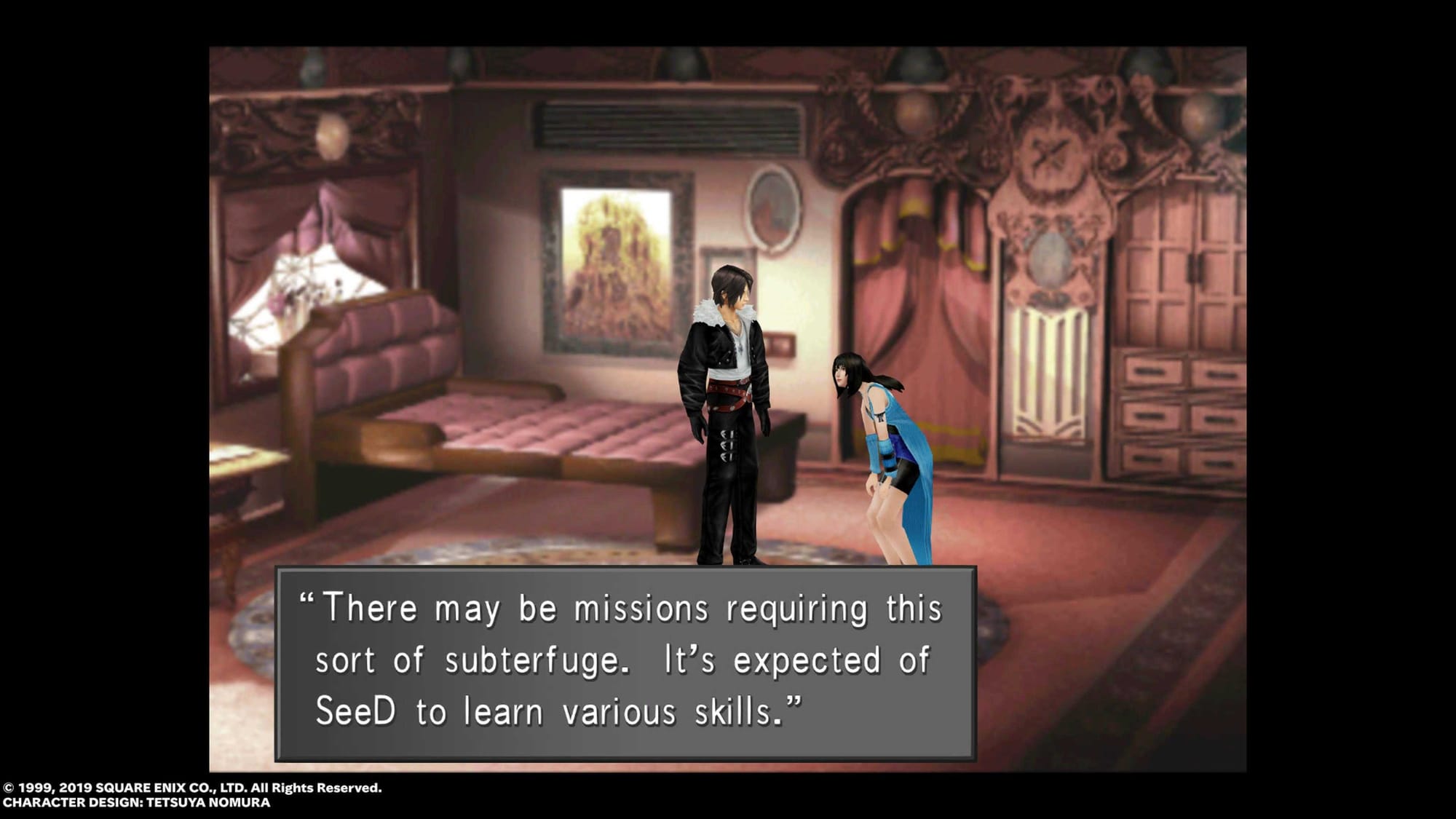
A corps brigade of military students, a mercenary force, a private army—SeeD is made up of young operatives who graduate from Garden, an international military academy that deploys their undergrads, students-in-training, and graduates on paramilitary missions that range from battle support to undercover operations. SeeD members provide support, protect civilians, slay monsters, and can also be utilized for surgical missions.
Balamb Garden is the centralized base that trains SeeD cadets, but sends its members to other Gardens, including Galbadia and Trabia. SeeDs are set apart from other world militaries because their operatives can utilize para-magic (a synthetic recreation of Sorceress magics) and brutally powerful but heavily controversial Guardian Forces.
SeeD forces are primarily made up of children. Many undergraduates are homeless orphans displaced by previous wars. In that fact, the SeeD organization does not have to worry about refilling its ranks—the continued military actions and violent regional shakeups all but ensure more children will be absorbed into the SeeD program.
While the true purpose of SeeD is more mythological than its leaders initially admit, it is fronted by the Headmaster's desire to have a military corps that can do some good in the world. His flat naivety is repeated post-graduation, where he tells the cadets he wants SeeD candidates to "think and act for themselves." A cold, disconnected, haughty sentiment to place at the feet of human weapons.
Uncivil Unrest
Child soldiers are not a fantasy fiction. While they may be used as plot devices in games such as Final Fantasy VIII and Metal Gear Solid, this is a real-world problem that grew exponentially between 2005 and 2022. Dangerous military organizations rely on child soldiers because they are easily captured and coerced. Children are conscripted as anything, from fighters to scouts to messengers to guards.
The density of Final Fantasy VIII's plot casts a shadow on the dispensability of Garden and its child soldiers. It is not by accident that SeeD members must be between the ages of 15 and 19, or that the organization prefers the malleable minds and bodies of children. The anti-humanitarian actions of Garden are the ultimate example of "the ends justify the means." Headmaster Cid and his cronies place unbelievable pressure on cadets like Squall, whose young lives are so entangled by the pursuits of Garden that they cannot envision themselves in a place without it.
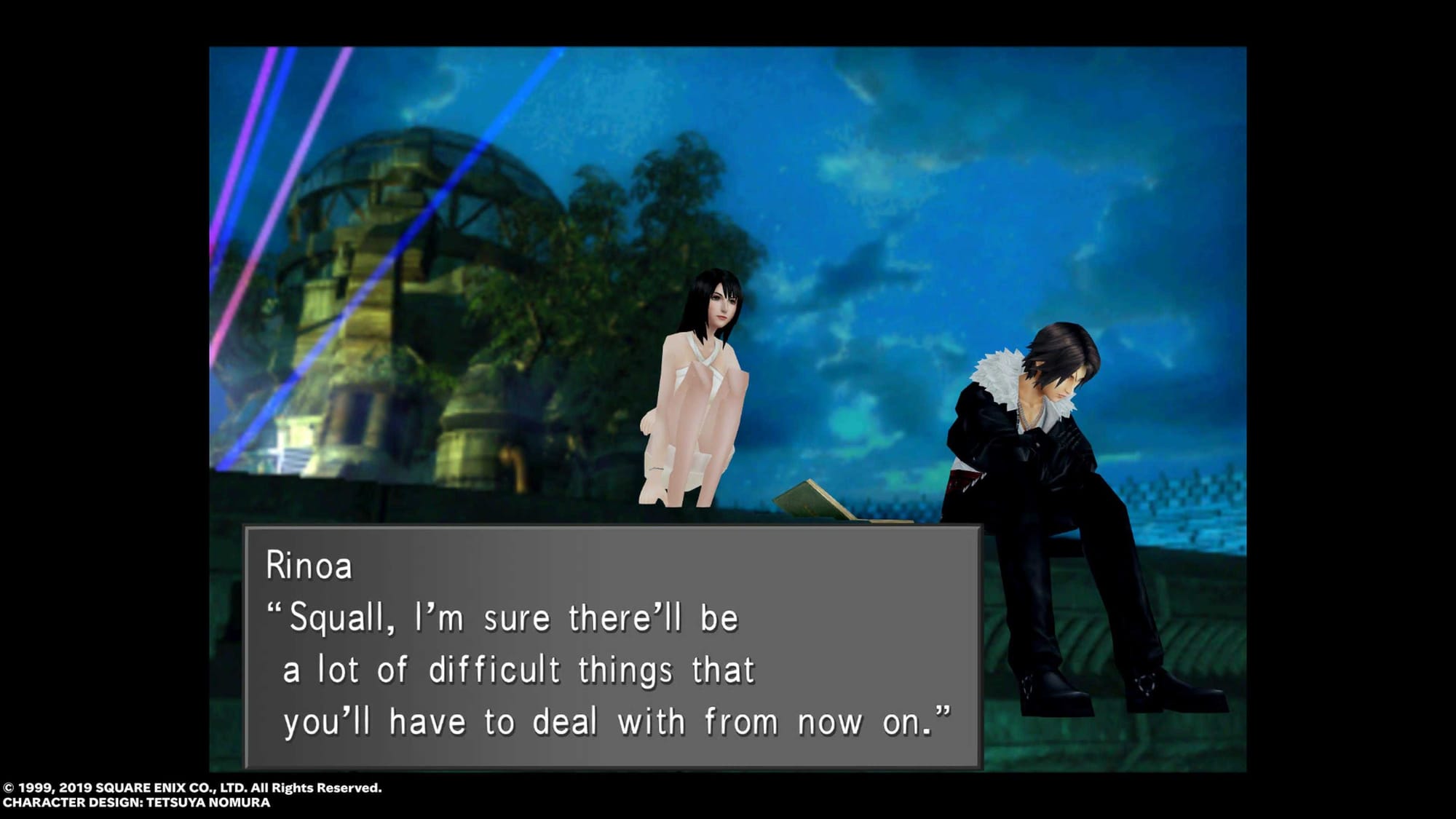
To this end, there is no happy ending in Final Fantasy VIII. Garden is not dissolved, and its place in the world is actually reinforced by Squall's incidental run-in with Matron at the end of the game, where he seals his destiny by creating a causal loop.
War never changes, because SeeD doesn't know anything else.
World at War
If you bear the misfortune of being in your 30s (or older), you have no doubt borne witness to the war crimes of the United States military during the 20th and 21st centuries.
The invasion of Iraq happened in 2003, when I was just fifteen years old. America is an oil-dependent country, poor in its own resources, historically ignoring the needs of its citizens as it pours taxation into military might. America, as an empire, rules and defends through fear, invading other countries to create regime changes or dismantling other governments entirely by replacing figureheads with American-approved political powers. We are reactive, violent, and cruel.
In Metal Gear Solid V, the Militaires Sans Frontières is headed by Big Boss in the 1970s. This "Army Without Borders" is a private military that provides its resources to all clients, and its self-appointed "soldiers without borders" program does not make judgments based on nation, creed, or ideology. Noble, certainly, but militaries for hire commonly care about resources above all else, and the actions of Big Boss and Master Miller show this. Big Boss's ideology initially prevents him from becoming a warmonger. Still, the nomadic, Cold War-era MSF carries out operations that destabilize entire regions, recruiting and kidnapping soldiers from all over the world to join their operation. Like SeeD, they stabilize their recruits with propaganda, creating a mighty force that owes singular allegiance to a mythology.
While the tyrannical military actions of Galbadia in Final Fantasy VIII cannot be defended, Garden's less-than-scrupulous tactics allow an apolitical third party to create and recreate the world at will. The rise of Galbadian and Estharian powers in Final Fantasy VIII is the direct result of the fallout of the Sorceress War two decades prior, just as SeeD is a reaction to the potentiality of another powerful sorceress like Adel.
Players are shown early on that SeeD can be used for good, such as thwarting Galbadian forces in the Dollet region or aiding Rinoa and the Timber resistance in defending their city. However, the will of the Garden is, ultimately, up to its Headmaster and investors, and the so-called "good" they generate is backed by bureaucracy and gil.
Love Blooms on the Battlefield
It is the nature of SeeD to die in someone else's war. The love story between Rinoa and Squall is underlined by the fact that Rinoa has the luxury of choosing her battles and battlefields; Squall, in contrast, is a creature of Garden.
The characters themselves exhibit various pathologies and traumas that emerge during the course of the combat. Squall's cold disposition and disconnectedness are a shielding apathy. "As long as you don't get your hopes up, you can take anything...You feel less pain." Selphie's dogged, dark humor strips down the reality of their cause, from absurdity to direct violence. Irvine, his traumas most notable to the story itself, fails as a sharpshooter, choking at the exact moment he is to assassinate the Sorceress in Galbadia. Zell says, "You tell us to go, we go. Even if it is a losing battle," resigning the cocky humor of his character to the reality of being a SeeD.
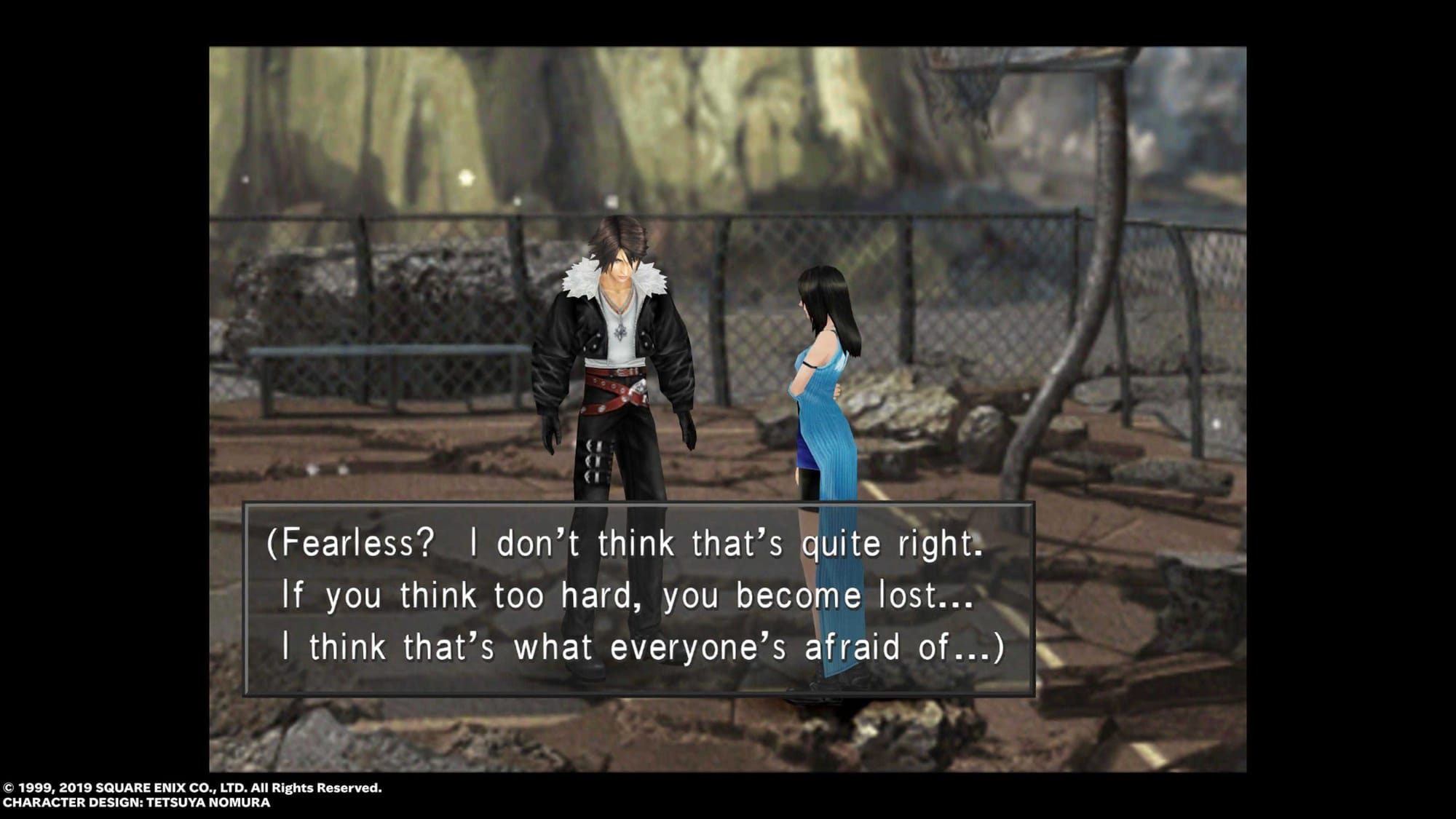
During wartime, the more conscientious among us ask ourselves how we can go on enjoying our daily lives in the face of such despair. Like Balamb and Galbadia, America is often at war with itself: we watch via social media as masked cowards use lethal force on everyday citizens, and entire cities are caught up in the wake of violent chaos, pushed onward by a military engine that neither makes sense nor has the favor of the people.
Rinoa does her best to undo Squall's emotional armor, occasionally needling him in an effort to remind him that he's an actual person, and not just a mercenary of Garden.
"Gosh, you're such a pessimist. There are no guarantees in the future. That's why TODAY, the time we have now, is important. Squall, we wanna help you, as much as we can, for as long as we can. We all love you. There, I said it. Please don't freak out. We just wanna live, y'know, live through this time with you, together."
Right and Wrong
Every action has an equal and opposite reaction. During their mission in Timber, Zell lets his anger get the best of him, reacting strongly to Seifer's rogue actions. Hearing this, President Deling threatens to use the entire military force of Galbadia to crush Garden. As retribution for the attempted assassination of the Galbadian Sorceress, missiles are sent to Trabia Garden, and the player is only allowed to see the aftermath. SeeD soldiers become unwitting heroes as war escalates and the Sorceress takes control of the Galbadian military. Children are placed on the frontlines.
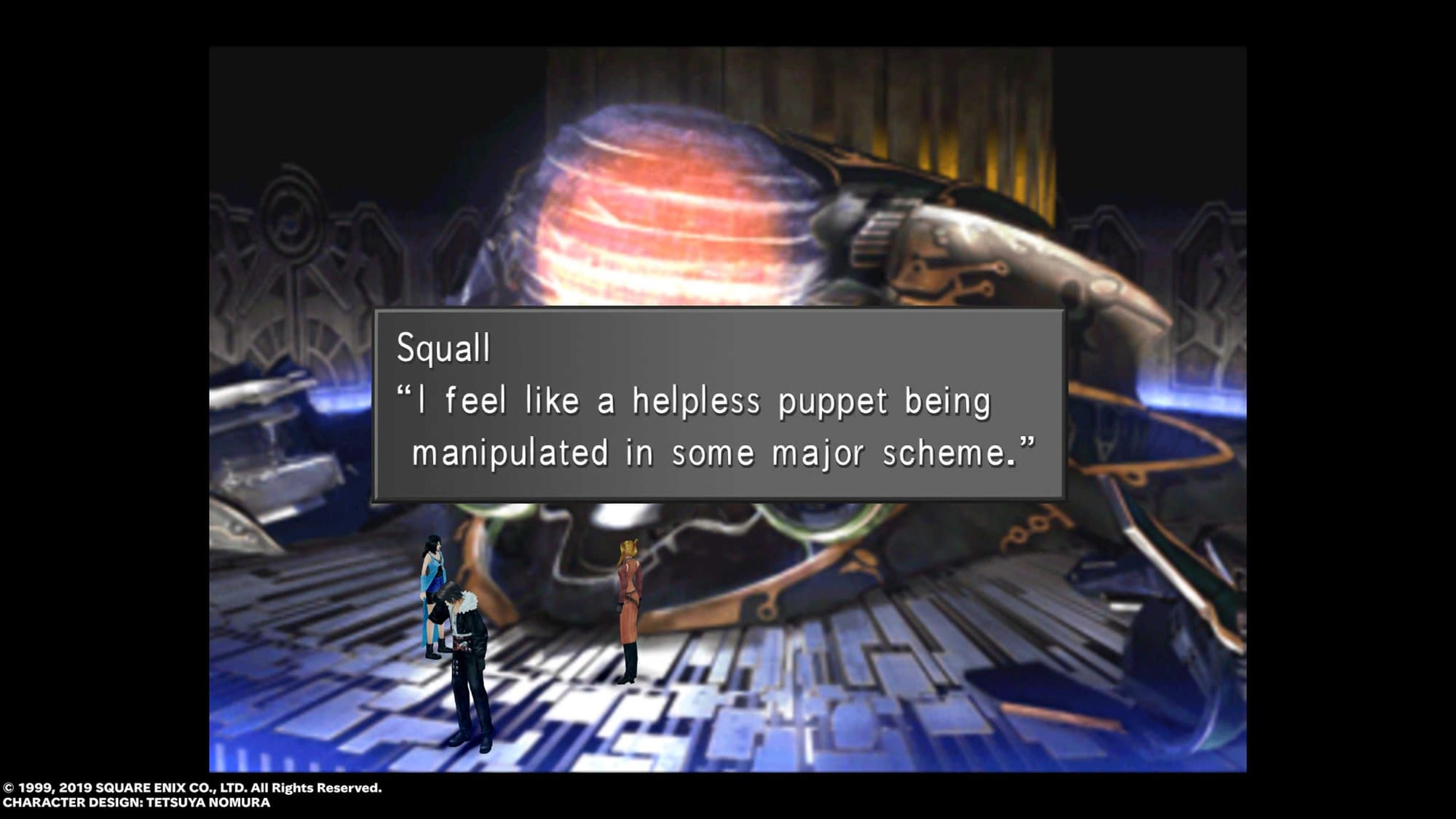
"What's the point of talking about it now!? You don't know what's going on, either! This is crazy. I don't know what's goin' on anymore. I feel like a helpless puppet being manipulated in some major scheme."
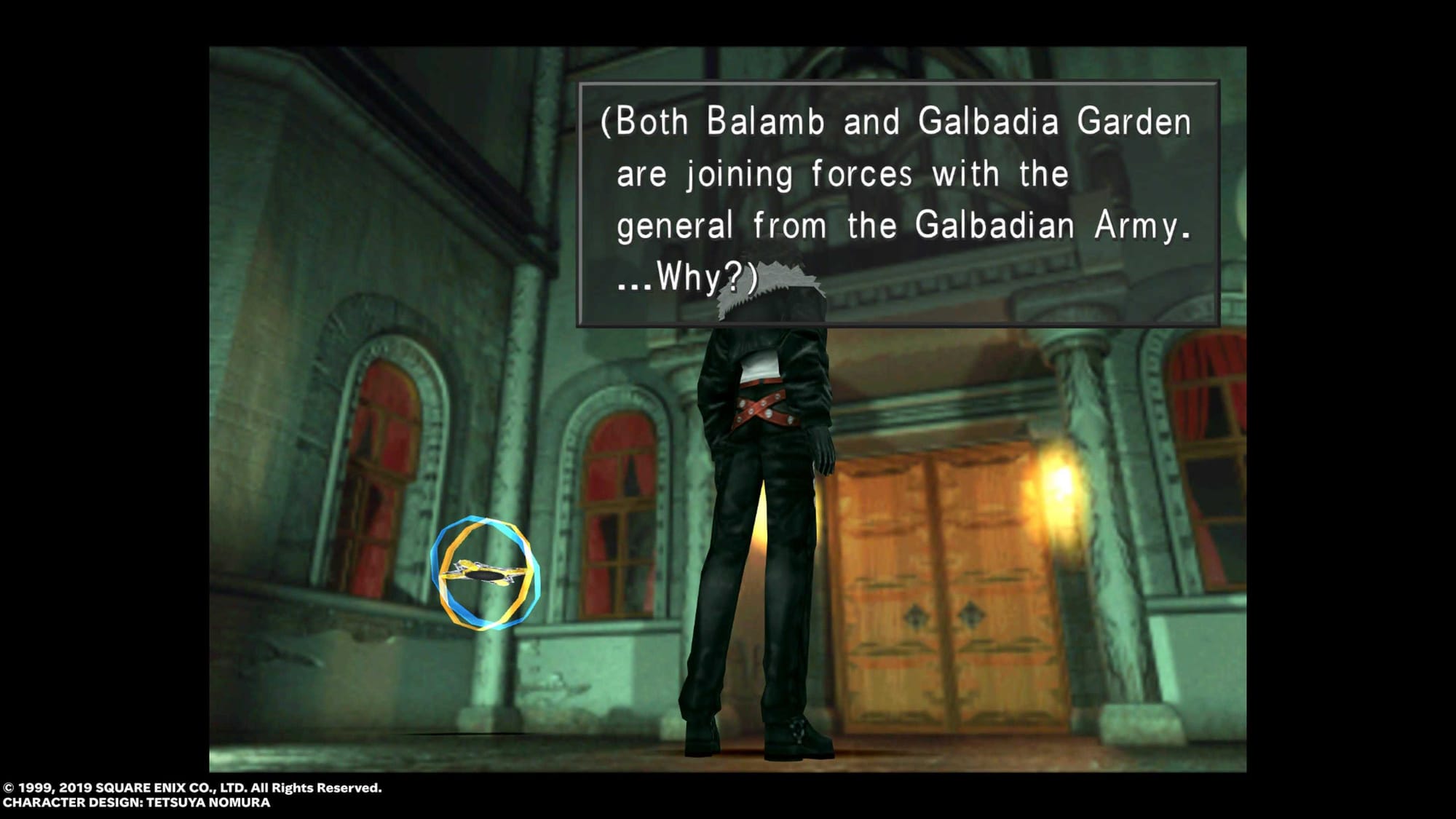
Later, when Squall must face the truth of Garden's dark investments, he realizes that the true goal of SeeD is not so simple as he was led to believe. His childhood naivete is stripped away as he is forced to confront the darker truths of being a child soldier. Directionless, Squall doubts those around him, including the Headmaster of Balamb Garden.
"SeeD will defeat the sorceress. The Garden will train SeeD members. The many missions around the world are only training for the final battle against the sorceress. But now that the sorceress has become a major threat, our true mission has begun."
Headmaster Cid admits that all of SeeD's training, including their real-world tactical missions that have resulted in student and civilian death, has all been for a singular purpose. Garden may not be a sovereign nation, but it operates as one. As with America's invasion of Iraq or Venezuela for oil, warfare is rarely ever about the pursuit of freedom or emancipating a beleaguered citizenry from a dictator. It's an opportunity disguised as a revolution.
"Right and wrong are not what separate us and our enemies. It's different standpoints, our perspectives that separate us. Both sides blame one another. There's no good or bad side. Just two sides holding different views."
Squall is forced to reckon with the human cost of warfare. SeeD missions are not just extensions of Garden's power; they have real human costs.
Liberi Fatali
"We're not kids anymore... We're strong enough to take care of ourselves. Make our own decisions...We're confronting a big one right now. Do we fight Matron or not...? I say we fight...Shoot for a common goal...Hey, at least it'll keep us together a little longer."
Irvine reminds Squall that it doesn't matter what's come before; it's the actions of today that make a difference. Ultimately, it is camaraderie that forces Squall to change. As a group, they no longer owe allegiance to Garden. Squall admits that he wishes they didn't have to fight, that maybe a path of peace could be possible if they had the time and resources to explore it. When he becomes Commander, he realizes he can no longer weigh the cost of individual lives; Squall is responsible for every single person who fights on behalf of Garden.
Too often, children must carry the sins of authority, stripped of any choice by the adults and figureheads in their lives. Even into adulthood, there are moments when our lives feel choiceless, when we are forced between despicable action and frustrating inaction. Irvine reminds the party that it was never their choice to join Junction Guardian Forces, it was never their choice to fight, it was never their choice to be part of someone else's army.
Irvine resigns himself to his past.
"You've all heard this before. How life has infinite possibilities. I don't believe that one bit. There weren't many paths for me to choose. Sometimes, there would only be one. From the limited possibilities I faced, the choices I made have brought me this far. That's why I value the path I chose...I want to hold true to the path that HAD to be taken."
As children whose lives have been ripped apart by war, Squall and the others continue on the only path they've ever known. These children of fate have been born into a world that only wishes to use them. Irredeemably, "fate" and "destiny" are utilized against them, limiting possibility and potential. But Squall makes an effort to face this destiny head-on, to cut away the worn paths laid out for him.
Quotes from Final Fantasy VIII were pulled from the game script.