Rolling a Natural One-Shot
Roll the dice

I set out with a question and a goal: How practical is it to create a decent Dungeons & Dragons one-shot adventure using dice rolls via the random tables published across various 5th edition sourcebooks? And can I use this experience to create a simple, repeatable process?
Sure, there exists a generous bevy of sites and books containing wonderfully realized premade one-shots, primed for use and exploration. I wanted to channel creativity and chaos into one-shots that feel more like my own though, and that don’t take weeks to finalize.
And before you ask, hell no to using AI to create an adventure for me. This is a journey of discovery, creativity, and learning. AI only impedes and atrophies such things on this mental quest.
Roll Call
My gang and I still use the 2014 5e ruleset, so these three sourcebooks were the most useful in my pursuit:
- Dungeon Master’s Guide (DMG)
- Xanathar’s Guide to Everything
- Tasha’s Cauldron of Everything
Across those three, I found 90+ random tables that could be used to create an adventure. I couldn’t assume what would or wouldn’t be useful, so I rolled a die on each of them. After all the rolls were done and recorded, I had my dataset for “One-Shot #1”.
Then I did it again. And again. I would make three one-shots, and discover what tables I found most valuable in this process.
And let me tell you, my literary adventurer, I cast one wide-ass net.
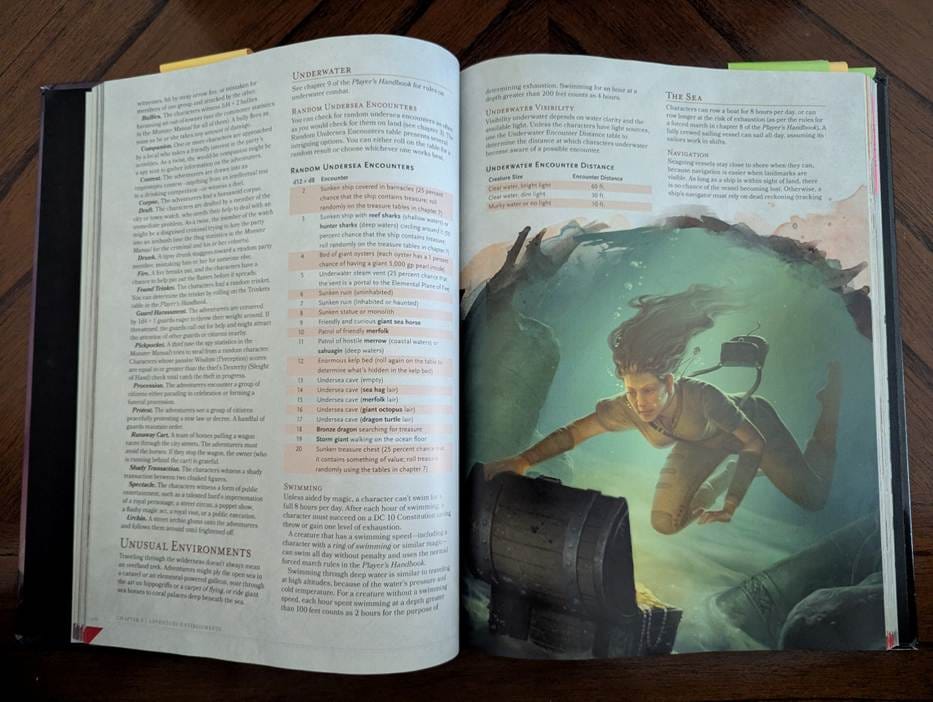
There are random tables on everything from Forms of Government to Moral Quandaries. Villainous Schemes, Monuments, Random Undersea Encounters, Sentient Magic Item Features, Settlements and their buildings, and if it’s raining and how strong the wind is that day.
I sat there gazing upon my pages of dice roll results, feeling overwhelmed by the sheer quantity of information available, when something clicked. This here is just a puzzle whose shape and size are yet to be decoded.
I have cast the animal bones out of a clay cup and must read their portents. Interpret the tea leaves, divine meaning from the stars.
Intentional Apophenia
Before you host a dinner, you have to set the table. Thus, we must delve into some light world-building in order to set the stage for the adventure. Ask yourself about your campaign setting. Where is it taking place? The Sword Coast? Elsewhere in the Forgotten Realms? Eberron? Poland? Once you know, you can utilize your rolls.
Slowly but surely, I figured out a path to impose some light order upon chaos. Three rolls in particular were essential for me here:
- World-Shaking Events
- Framing Events
- Party Origin
Both World-Shaking Events and Framing Events provide a solid launch pad. My first set of rolls was “Rise of leader or an era” and “Arrival of marching Modrons.” My Party Origin was “A funeral brings the characters together”.
Okay, there’s some basic framework; now to study the other dice rolls to determine how they could connect and produce a legitimate narrative. I decided not to include every single roll within an adventure, as sometimes it just doesn’t make sense. You’re not going to include a Random Undersea Encounter on your desert adventure. Or maybe you can; that’d be sick, honestly.
The point is to use the rolls to help guide your mind as you construct a story. You’ll find some rolls to be more meaningful than I did; cool, run with it! This process requires your own creativity after all.
Villain and Dungeon-related rolls felt like logical next steps to flesh out the adventure further, and were where the symbolic skeleton started to gain some metaphorical meat on its make-believe bones.
- Villain's Scheme: Immortality, acquire a legendary item to prolong life
- Dungeon creator: Humans. NPC class of creators: Druids
- Cults and religious groups: Elemental Water Cult
- Dungeon Purpose: Temple or Shrine
Beautiful, it’s like the adventure is writing itself.
Connect the Dots, Color by Numbers
Here’s a bit of my thought process as I moved onward:
The villain seeking immortality is the “rising leader/era”, and their scheme of acquiring and using a legendary item to achieve their goal has triggered the arrival of marching Modrons. These Modrons are constructs that are attracted by heavy disruptions in the fundamental order or balance of the planes… so this legendary item has to really cause some havoc in its use. Looping in the funeral Party Origin, I’ll say a mutual friend of the characters discovered this scheme and was killed.
The villain’s home base is a temple built by an elemental water cult of druids. Now, what god would a water cult leader seeking immortality worship at their temple? Umberlee, the chaotic evil “Bitch Queen”.
I had rolls available for “Magic Item Special Features”, describing an Elven-made artifact adorned with forest-like symbols of nature, to be used in religious ceremonies related to a deity. This would be the legendary item our villain uses. But whose item is it then? What deity would Umberlee take action against? Light research led to Grumbar - the primordial elemental deity known as the Earthlord. These two gods have something of a rivalry.
At this point, I feel like I’ve cracked the code, and what were previously viewed as random bits of data began falling into place like the final stretch of a jigsaw puzzle.
Our villainous worshipper of Umberlee will utilize the Elven artifact of nature in some kind of ritual offering. Umberlee doesn’t grant god-like powers out of the blue, so this offering has to be huge – far beyond the simple coin that sailors toss into the sea to secure safe passage from her wrath.
The villain will corrupt this ancient artifact through weeks-long religious rituals, forcibly changing its attunement to the element of water from that of earth. This shift would physically manifest in the region by causing the entire peninsula to sink into the ocean as an offering to Umberlee. A massive swath of Grumbar’s domain would instantly become Umberlee’s.
Would the offering be good enough for Umberlee to grant our villain immortality? Maybe! Maybe not! Depends on whether the players can discover and thwart the scheme.
And boom, there we have it: a fully realized framework for the adventure. I continued onwards into more minute details like loot tables and encounter planning, and drew up some maps in a graph paper notebook.
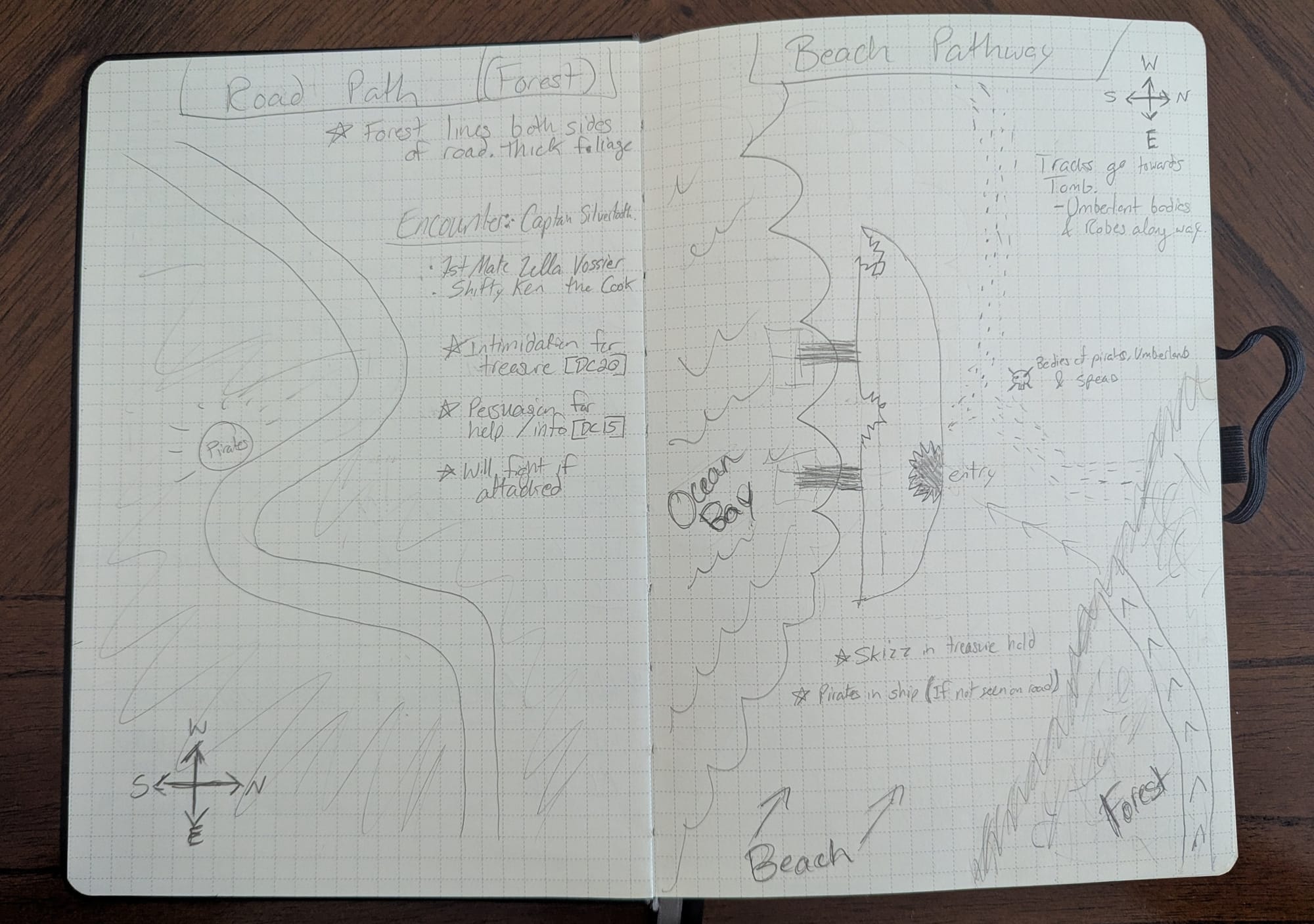
I did try to create a dungeon layout using random tables since there’s a whole section on it in the DMG, but it kept growing into never-ending directions, and it became too convoluted. I’ll give that a more earnest shot in a future adventure dedicated to dungeon crawling.
Now it’s one thing to create an adventure, and a whole other thing to see if it runs well live.
Roll a Performance Check
Eventually, I ran this one-shot for my group. We’ve been playing together for about eight years now and are midway through our second long-term campaign. We break for a one-shot if everyone can’t make it to a session, as there are seven of us spread across three states in the Northeast US and we only play in-person.
Below is the introduction I wrote. Regarding their “fallen companion” whose funeral brings everyone together, everybody wrote a first and last name on separate pieces of paper, and I pulled from a hat to create a name:
Your party stands in a wide semicircle in the forest clearing, rain lightly stinging exposed skin as the wind lashes through the trees. The weather mirrors the mood of the moment, for at the focus of your semicircle stands a modest pile of stone; a cairn of rocks under which your mutual friend lies buried. A mutual friend and ranger of the Forest of Tethir, Andy Pantstain, was investigating disparate reports of chaos in the region. Natural disasters? Odd mechanical creatures? Cloaked figures? Pirates? Whatever they found, it resulted in their death. Each of you heard of their passing and responded to the news by journeying to this place. By chance you all arrived at the same time - To pay respects, to figure out what happened to your friend, Andy Pantstain, and to finish what they started.
After some initial light roleplay, they were ambushed by Modrons! I like an early fight to kick things off.
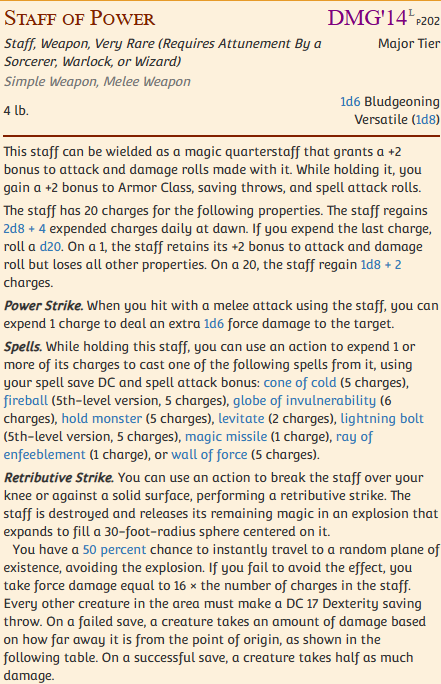
The night ended with one of my players destroying the Staff of Power he obtained (thanks to “Magic Item Table H”) to magically nuke both the villain and himself, saving the day in spectacular fashion. The remaining adventurers then partied it up in the forests, Return-of-the-Jedi-style with Grumbar and the rangers of Tethir. Meanwhile, the spirit of their fallen party member – Ung Blackshell – reunited with Andy Pantstain in death and became buddies with the nature deity Silvanis.
All in all, we had a blast, and I gained a great appreciation for this luck-fueled process of creating adventures. It felt genuinely helpful and exciting that random chance was providing the building blocks, as each piece felt less precious to me in a way that made the story far easier to edit or cut up – especially when improvising live. I learned something about myself as a creator.
I can get too “in my head” when working on a project, potentially leading to every thread being overanalyzed to oblivion and me tossing it in the bin after stalling out entirely. Hell, I got 2,000 words into this very article and hit that detrimental cycle. I trashed the entire draft and started from scratch seven months later.
Revisiting this piece with fresh eyes felt fruitful, and it flowed more easily. It led to me running another one-shot this past month. Using my prototype process, I finalized the next one-shot within a few days, and again we all had a great time. I might be more of a “pantser” than a “plotter” after all!
Roll again with advantage
It felt far easier to outline the other two one-shots since I had identified a process the first time around. This time through, I found a few other rolls particularly useful:
- Adventure Patron / Introduction / Climax
- Moral Quandary
- Twists
- Group Patrons
Note that “Adventure Patron” differs from “Group Patrons” immensely in terms of available resources. Group Patrons has twenty pages dedicated to it in Tasha’s Cauldron of Everything, whereas Adventure Patron is a single random table in the DMG.
Pro-tip for if you’re really crunched on time -- it’s legitimately possible to roll up the entire framework for a one-shot only using the Group Patrons section in Tasha’s. It’s extremely straightforward and still has room for your own infusions. Here’s an example of what I rolled up using the Group Patrons section, summarized for brevity:
“You are pupils of an ancient being, a Lich. Through magical message drop locations, you receive orders and tasks from your undead master, and the most recent drop gives you an important mission. A high-profile minion of another powerful figure is in a position to betray their master, to the benefit of your patron. You must convince them to defect to your organization or extract them from now-hostile territory.”
Supplement the above with random tables to fill any gaps, such as how strong the wind is that day, and you’re golden!
Reduce, Reuse, Recycle
Will I follow the exact same process in the future, rolling on every random table? No way, but now I know which tables played vital roles. I’ll look back upon this experiment and use the most helpful ones. And if too many ideas sprout from brainstorming on the results – and believe me it will happen – I’ll keep and use them in a future campaign, short story, or wherever! In the words of Childish Gambino, “I guess it all goes somewhere, you know that?”
I’ve believed in that line for a long time. It eventually turned into a mantra of “every experience is valuable”. The similarly worded concept of “no effort is wasted” is gaining traction out there too. It’s cool to see.
You can use the recommended tables I included at the bottom of this article to try it out yourself, or go totally ham and roll on all the tables too. I guarantee you’ll get something out of it either way.
I’ve created a few one-shot adventures over the years, homebrewing each one over the course of weeks or months. It’s awesome to realize that I can create a solid adventure in just minutes by using only what chance provided.
A little bit of time, effort, and luck provides the opportunity for a story to grow. All it needs is for you to become the trellis that its vines will take shape around.
The Tables I Used Most Often for One-Shot Outlines
- World-Shaking Events (DMG pg. 27)
- Leader Type (DMG pg.27)
- Adventure Villains (DMG pg. 74)
- Adventure Patron (DMG pg. 74)
- Adventure Introduction (DMG pg. 74)
- Adventure Climax (DMG pg. 75)
- Framing Events (DMG pg. 79)
- Moral Quandary (DMG pg. 79)
- Twists (DMG pg. 80)
- Villain’s Scheme (DMG pg. 94)
- Dungeon Location, Exotic Location (DMG pg. 99)
- Adventure Patrons (TCOE pgs. 83-103)
- Party Origin (TCOE pg. 139)
Join the conversation
What do you think? Reply below to share your perspective.