Dishonored: The Lessons of Corvo & Daud
Arkane's masterpiece has much to teach us all

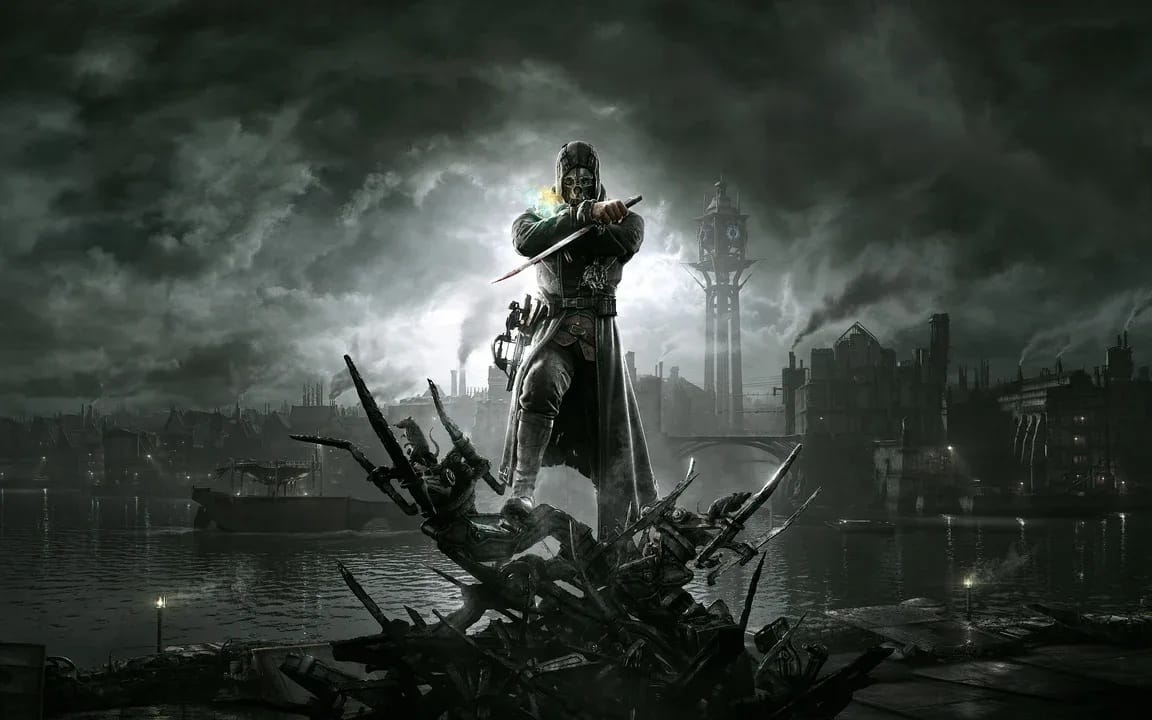
Nearly a decade has passed since Dishonored 2 was released in November 2016, prompting me to revisit the origin of the Dishonored series.
When I began this essay, we were living amid a pandemic that had infected millions, upended the lives of tens of millions, and deprived so many people of their lives. Businesses run by families for generations shut down; hundreds of thousands lost their jobs. Political unrest was at an all-time high, with massive protests, attempted insurrections, and all-out wars becoming another simple fact of life. Chaos spread like a fever throughout the world, as infectious as the virus that dominated our lives. And through it all, the most fortunate and most advantaged continued to prosper.
It is fitting that I’d write about Dishonored, a game about a plague, during a pandemic. Dishonored is a stealth game released in 2012 by Bethesda Softworks. It chronicles the story of two rogues: Corvo Attano, the former bodyguard of the Empress of the Isles, and Daud, a highly skilled assassin, the man who killed the Empress. Unknowingly, they work together to bring about an end to the plague that has gripped the empire, while taking down the empire’s most unsavory figures who seek to use the plague to further their own political ambitions.
Dishonored began as a spiritual sequel to one of the earliest stealth video game series, the Thief trilogy. The game offers a wealth of insights, lessons, and messages that resonated with gamers upon its release. However, I would argue that Dishonored’s moral framework resonates even more strongly in our current climate, both as a warning and as a vision of a more hopeful future. Because of this continued relevance, it is worth examining the game'scentral themes: suffering, compassion, charity, and redemption.
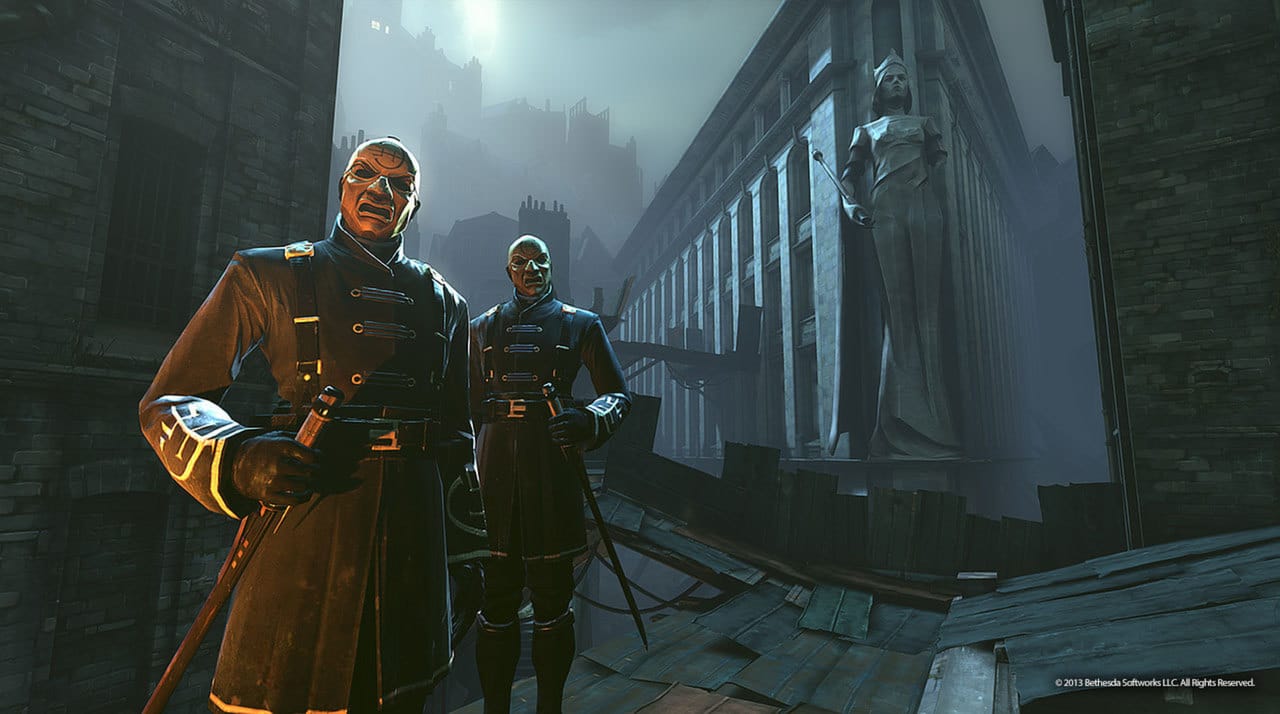
Suffering is not foreign to the human spirit, nor is it foreign to Dishonored. The world of Dunwall, the city where the game primarily takes place, is not a nice place to live. Overnight, the plague wipes out entire families, leading to massive suffering. People in positions of power, such as Arnold Timsh, Hiram Burrows, or Waverly Boyle, freely use the plague to advance their grip on power. Institutions such as the Abbey of the Everyman, analogous to real-life religious organizations such as the Church of England, have grown fanatical in their desire to stamp out dissent in the name of warding against heresy. People are dragged away from loved ones by the City Watch to be quarantined and die with other infected individuals. And above it all, the trickster deity called the Outsider looks down on everything and laughs.

Aside from the generalized suffering of the city overall, you have more specific examples of individual suffering. High Overseer — a position analogous to archbishop — Thaddeus Campbell plans to poison upstanding police officer Geoff Curnow for his upright nature, in the middle of a meeting to discuss their personal differences. A pair of police officers tries to steal a woman’s medicine meant for her child, saying their positions of authority outweigh the value of the woman’s infant’s life. A duo of gangsters traps Griff, an old man, in his own curio shop and refuses to let him out until he pays protection money, falsely accusing him of having the plague.
Our protagonist is no stranger to this same suffering.
A Lesson in Compassion
At the start of the game, someone framed Corvo Attano, the player character and protagonist of the main game, for the death of the empress and the kidnapping of her daughter, Emily Kaldwin. His former allies, who arranged the assassination, hoping to turn the public fully against him with a manufactured confession, tortured him for six months. They nearly executed him, forcing him to escape prison and collaborate with a group of rebels, the Loyalists. To gain his revenge, he must take down Hiram Burrows, the former spymaster turned Lord Regent, as well as his fellow conspirators who ordered the assassination, and find Emily.
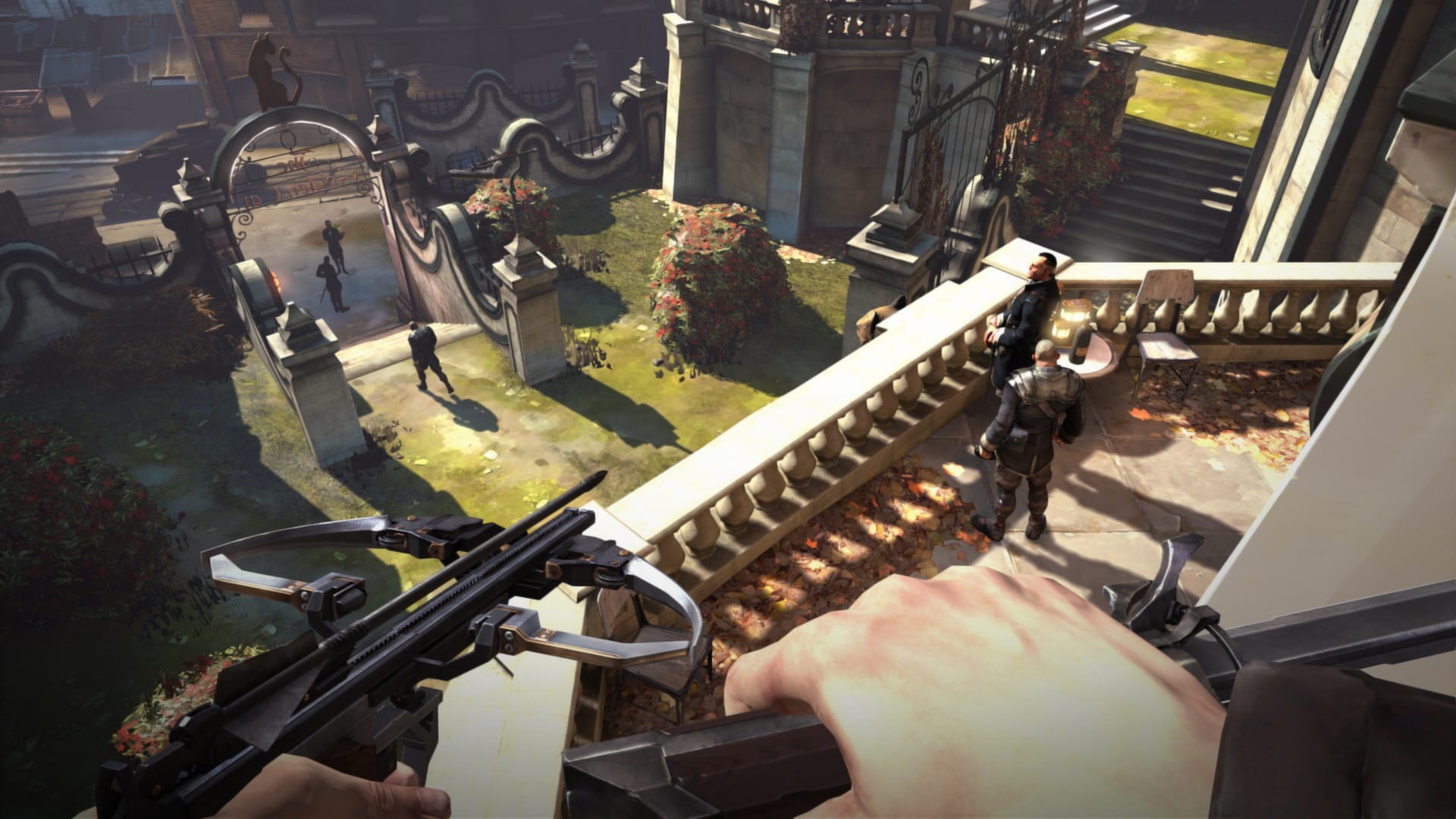
Corvo has the power to inflict great pain and suffering on the city of Dunwall. If the player so desires, Corvo can assassinate all of his targets — the corrupt Pendleton twins, the regicidal Lord Regent Burrows, the promiscuous High Overseer Campbell — and leave a trail of corpses along the way. He’d be justified. Mostly everyone he encounters in the game views him with fear or as an enemy, or both. Corvo can take bloody revenge on his tormentors, much to the demonic Outsider’s delight.
However, Corvo can make a different choice, and it’s the subject of that choice I want to discuss. Corvo can choose not to kill. Corvo can choose to make a difference for the better by not inflicting violence on others. It does not entirely make the most sense, but Corvo can choose to be a pacifist — he can choose not to kill. Instead, he can simply ruin their lives but leave their bodies intact. Corvo could, for example, abduct, disfigure, and sell the Pendleton twins into slavery in their own mines. You can dispatch Lord Regent Burrows by broadcasting evidence of his crimes to the entire city via the public broadcast system. Corvo can brand High Overseer Campbell as a heretic and cast him out of society, forcing him to scrounge in the most desolate corner of the city to survive. Corvo can show compassion.
A recurring theme I like to examine is compassion, which literally means to suffer with; however, the word is so much more than that. Compassion is showing mercy and kindness, often to people who have done little to deserve it. Take the cases I mentioned earlier.
High Overseer Campbell plots to poison Geoff Curnow. Callista Curnow, Geoff Curnow’s niece, begs Corvo to make sure her uncle lives when Corvo sets off to eliminate Campbell. Corvo is under no obligation to help her; he’s known her for a few hours at most. He knows nothing about Geoff Curnow either, other than that he’s a police officer of alleged moral integrity. He’d be justified in not helping her. In fact, trying to save Geoff Curnow’s life makes things more difficult for Corvo, and even if he intervenes, Geoff Curnow is likely to be ignorant of the fact that Corvo just helped him. But Corvo can do it anyway. Corvo could swap the glasses in the meeting between the High Overseer and Curnow, leading to Campbell being hoisted by his own petard. Or he could smash the glasses and shoot the High Overseer when he tries to dispatch Curnow through more straightforward means. Corvo receives a small trinket from Curnow’s niece as her thanks, and the two reunite at the game’s end, but that’s it. Corvo has no reason to help, but he can do it anyway.
Corvo can also intervene when the City Watch (police officers) is bullying a mother. Again, he has no reason to help; there’s no stately bearing about the woman. If anything, helping would be to his disadvantage, as he’d have to deal with a pair of City Watch officers. His only reward for helping is the key to a door that would make accessing his primary target easier, a key he could have easily taken from her corpse. But again, Corvo helps all the same. The two Bottle Street Gang thugs who imprisoned an elderly geezer in his own shop can be dispatched, despite being part of one of the most dangerous gangs in the city. Griff, once saved, offers Corvo no reward save the privilege of buying ammunition and blueprints from him. There is a risk and little reward, but this is another example of Corvo acting out of compassion.
Those examples, aside, Corvo can have a more general effect on the world by acting with compassion towards guards and gangsters. Rather than shooting, stabbing, or hurling them from high places, Corvo can choke them unconscious, shoot them with tranquilizers, or just avoid them entirely by sneaking past. By acting with restraint and kindness, Corvo reaches a state that the game refers to as Low Chaos. This state of Low Chaos influences the rest of the world — not only are there fewer guards posted in areas given Corvo’s pacifism, but there are fewer plague victims and plague-spreading rats to be found.
In addition, Corvo’s Low Chaos affects multiple characters. During the mission where he infiltrates the Abbey of the Everyman to dispatch High Overseer Campbell, Corvo comes across an infected Overseer (a priest or knight templar) in the Abbey. With High Chaos, if Corvo has acted with violence and vengeance, the Overseer denies his sickness, and his friends kill him for lying. But with Low Chaos, the sick man begs his friends to mercy kill him before the plague rots away his mind. At first, his friends refuse, but ultimately go along with his wishes, dispatching him while he recites a prayer to the Heavens.
When nearing the end of the game, Corvo’s ally, Callista Curnow, whose uncle Corvo had been tasked with saving, is captured by Corvo’s enemies. In High Chaos, she is killed along with Corvo’s allies. However, in Low Chaos, her kidnapper inexplicably elects to imprison her instead, muttering that he owes her uncle a favor. During the last mission, on High Chaos, Samuel the Boatman betrays Corvo, disgusted by his heinous crimes. In Low Chaos, Samuel declares it has been a true honor to serve with him and wishes him all the best of luck. Corvo’s compassion inspires others, some of whom do not even know Corvo directly; that’s a taste of the impact his choices have on others.
Corvo can choose to be a moral paragon, inspiring others to imitate his restraint and compassion. He has no reason to take on this role; he gains little but perhaps a good feeling in his chest and some small worldly rewards, but does right despite everything that has happened to him. Through the player’s actions, Corvo can become a moral paragon not only within the world of Dishonored but also in reality as well.
I might be criticized for praising a fictional character, but I can’t help but think to myself how I would have acted in Corvo’s shoes, and how I currently act and can act in reality.
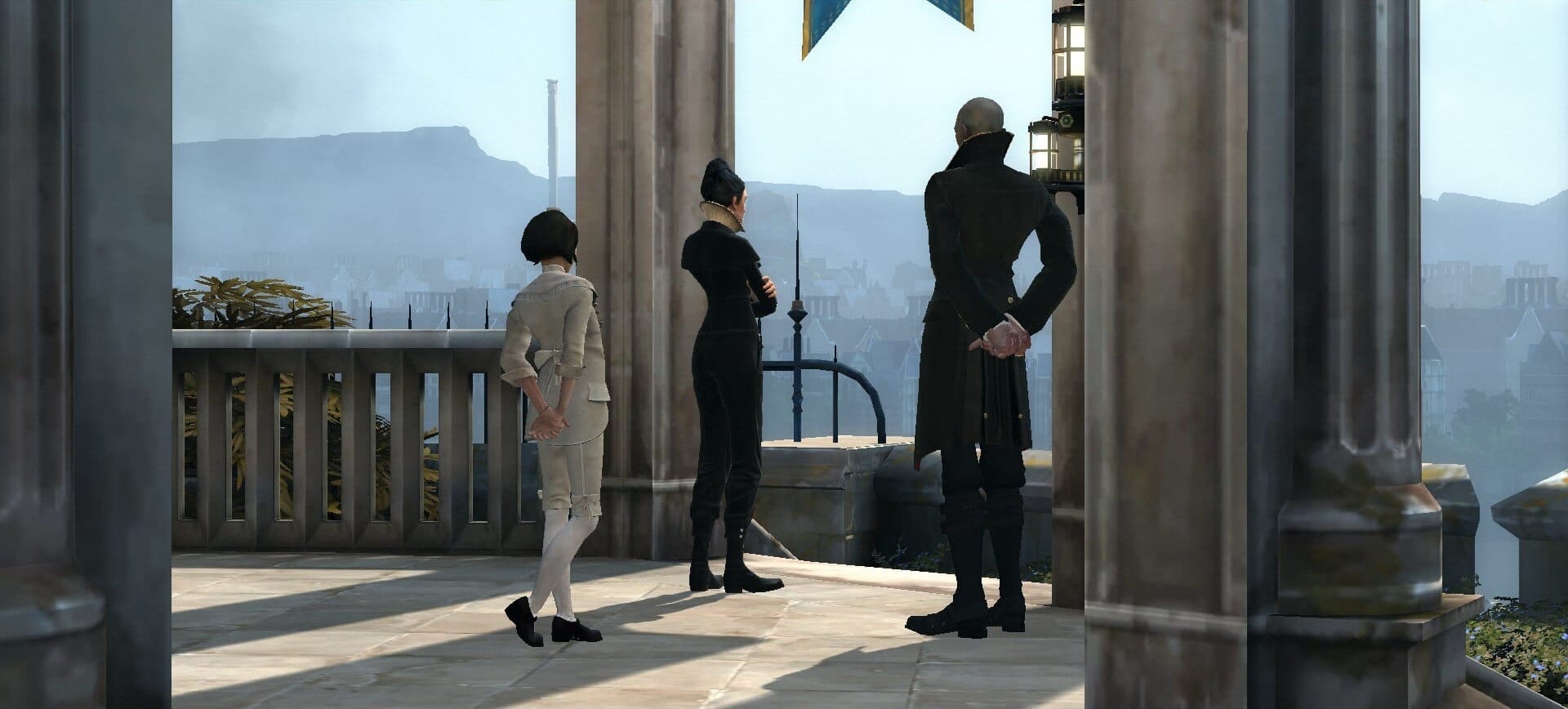
I can’t assassinate a corrupt head of state or a lecherous religious leader. I can’t kidnap an unethical scientist or sociopathic noblewoman. But I can be kind to my neighbor. I can stand up for the downtrodden. I can give charity to others and maybe restore someone’s faith in the human capacity for compassion. That is, well and truly, what Corvo Attano espouses.
A Lesson in Charity
Having talked about Corvo and compassion, I want to highlight an important contrast between Empress Jessamine and her successor, the pretender Lord Regent Hiram Burrows — specifically in their differing displays of charity.
Charity is voluntarily giving up something for the sake of someone else; however, it can also mean an acceptance of others, or, in a more archaic sense, a love of humanity. As opposed to compassion, which is based more on empathy and shared suffering, charity is more sympathetic, showing concern and love for someone even if one has not gone through the same sufferings as that person. Corvo chooses to or chooses not to show compassion based on his own personal sufferings. Yet the dichotomy of charity manifests itself in Dishonored not through Corvo’s choices, but through the contrast between Jessamine Kaldwell and Hiram Burrows’ actions.
While Empress Jessamine is the constitutional monarch of the Empire, Burrows is the former spymaster, the head of the secret espionage directorate of the Empire of the Isles. We know very little of the Empress from the base game, seeing as she dies in the prologue; we do know that although she could make controversial decisions, she was loved by many.
“I can’t wait to see his head roll. Not everyone did, but I really liked the Empress.”
There exists a significant contrast between the Empress and the Lord Regent. In the prologue, the Empress dismisses drastic measures to contain the plague, namely a blockade. Viewing the blockades set forth by neighboring nations as cowardly, she says: “They’re my citizens, and we will save them from the plague. All of them. [...] Cowards. They’re going to blockade us. They’re going to wait and see if the city transforms into a graveyard.”
It would be very easy to dismiss the Empress’s concerns and charity as naïve or her character as weak. As the past years have shown us, drastic measures are, sadly, often necessary to prevent the spread of the plague. While the Lord Regent’s actions regarding the plague might have genuinely aimed to halt the spread, this outlook is flawed. The Lord Regent comes across as a reasonable authority figure — at least, that’s how he presents himself. He professes to be a leader willing to make tough decisions for the greater good.
“This is the Lord Regent speaking. It is with regret that I announce my term as Lord Regent has been extended through the Month of Harvest, and potentially beyond.”
“Tomorrow you'll be executed. But it's for a good cause. This country needs strong leadership now. Someone to guide the weak. And that's where we come in.”
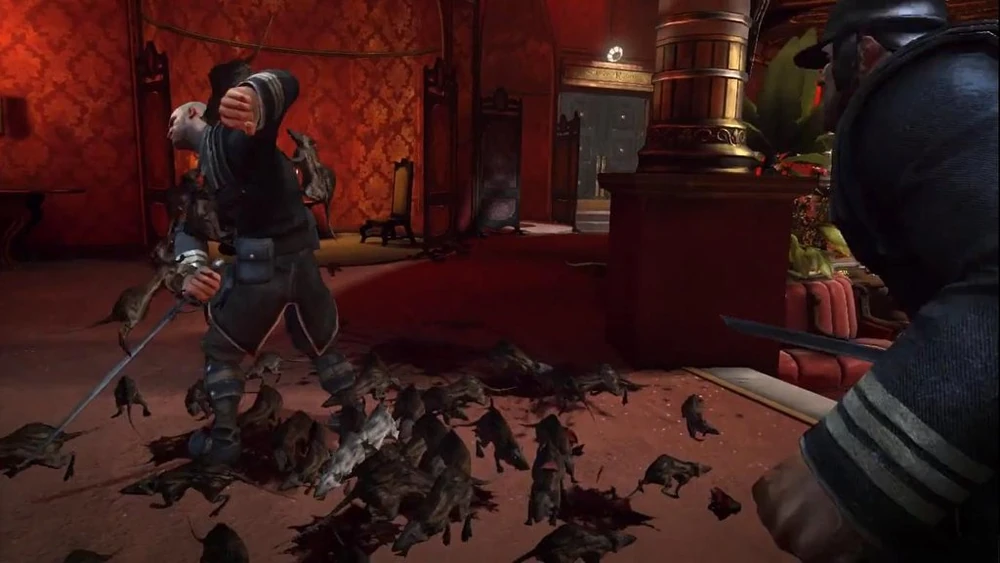
However, this perception of Burrows, much like his outlook on the plague, is flawed. The Lord Regent’s drastic measures are hopelessly ineffective as he is totally ignorant of human nature. Burrows thinks people will do as they are told in a crisis, and, finding this not to be the case, makes just about every crime punishable by death for the duration of the crisis.
“Attention, Dunwall Citizens. You are reminded that assaulting a member of the City Watch has been made a capital offense, and guardsmen are authorized to carry out this sentence on the spot.”
“This is a reminder that collective bargaining in any industry deemed vital to the state is a capital offense.”
“Attention, Dunwall Citizens: Be aware that looting of evacuated areas is a serious offense, and will be summarily punished by officers of the Watch.”
“Attention Dunwall Citizens. A mandatory whale oil ration is now in effect. Non-compliance is a punishable offense.”
“Attention Dunwall Citizens. Report all deceased family members to the local Dead Counter. Unreported deaths are a punishable offense.”
The declarations are endless.
The Lord Regent is the antithesis of the Empress. The antithesis of most characters in the game. His cruel measures, rather than controlling people, only cost him the cooperation and respect of the populace, the religious, and the parliament. The wealthy and the nobles are capable of showing charity; the Empress is one such example, and her legacy is one of general adoration. The Loyalists are another example, such as Callista and Geoff Curnow, who are more than capable of showing charity. But the Lord Regent cannot show such charity.
The apotheosis of his apathy comes with his confession that Corvo can broadcast to the people of Dunwall. The broadcast system that the Lord Regent used to spread his reign of terror is the same means used to defeat him. Hiram Burrows, before becoming Lord Regent, was the Royal Spymaster, who came up with a plan to eliminate the city of the poor:
"And it was a simple plan – bring the disease bearing rats from the Pandyssian Continent, and let them take care of the poor for us. The plan worked perfectly. At first. But the rats – it was as if they sought to undo me. They hid from the catchers, and bred at a sickening rate. Soon it didn’t matter, rich, poor, all were falling sick…”
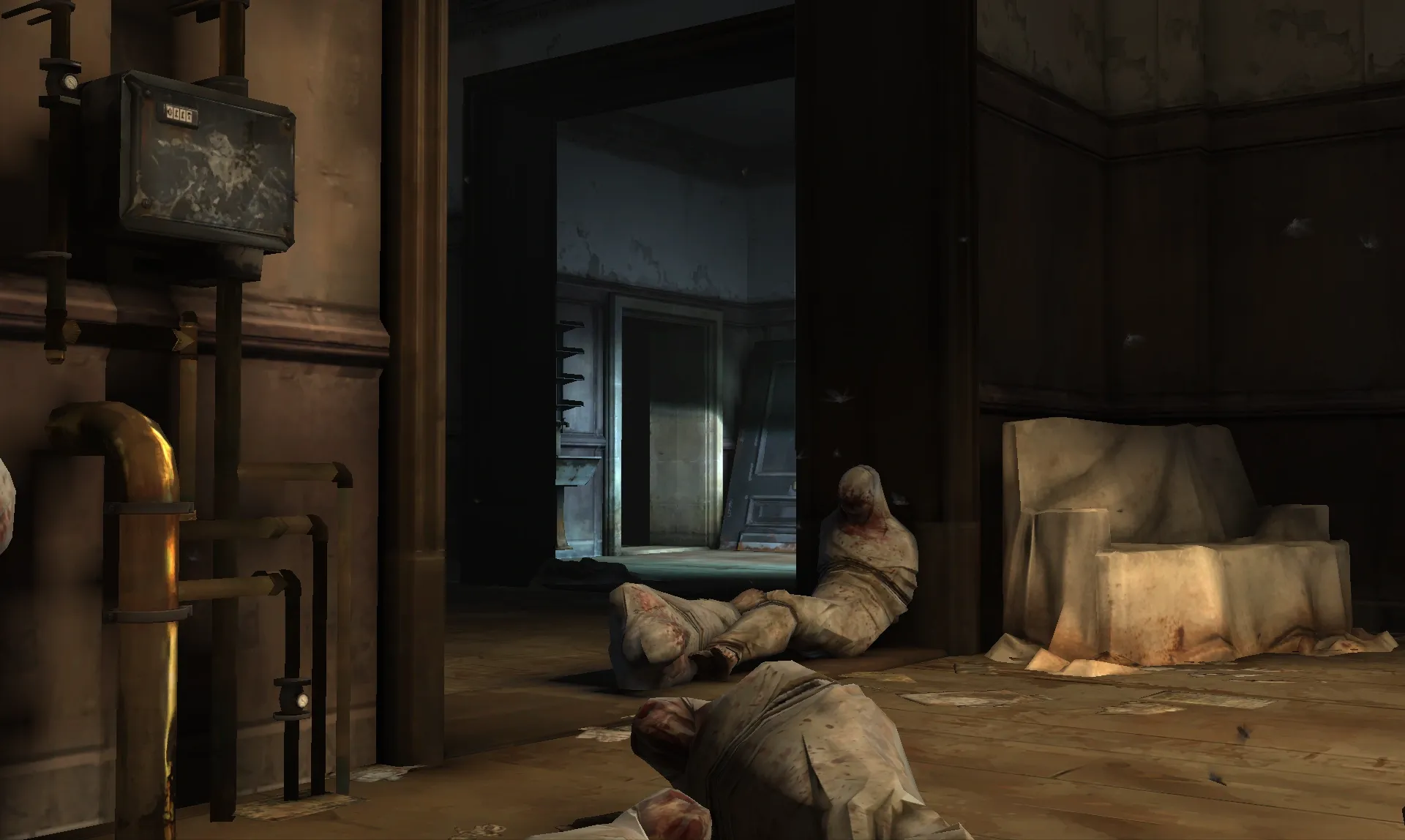
Hiram Burrows manufactured the plague, uncaring of the already abysmal plight of the poor, intending to permanently halt what he viewed as a leech on society. He shows the opposite of charity; he shows selfishness, putting what he made himself believe was the greater good ahead of everyone else. His apathy is even worse, as it becomes apparent that his understanding of human nature is fundamentally unsound.
“…Bringing about the death of an Empress is not an easy thing, but it gave me the chance to attack the plague with some real authority. Quarantines! Deportation of the sick! But there’s always some idiot woman searching for her wretched lost babe, or some sniveling workman searching for his missing wife. And then quarantine is broken! [...] But you can see how my plan should have worked? Would have worked! If everyone had just followed orders.”
Many dictators have concluded that they could transform the world into a veritable utopia if only the people beneath them would do as they were told. The greatest tragedy of Burrows’ moronic decision-making is that because he did not understand the most basic facets of humanity, his plan was destined to fail.
Men and women will not just march to their doom because they are told to by an authority figure. Burrows knows nothing of human nature, whether in the months leading up to the plague when he concluded that the poor must be exterminated, or when he wrote in his diary that Princess Emily should spend far less time playing (“The girl might rule the Empire some day; every moment spent at play is a moment wasted”). Burrows is the epitome of someone who does not have an ounce of charity in his body, and the only antidote for the likes of him is an immediate removal from office — dead or alive.
A Lesson in Redemption
Until now, I’ve focused mainly on Corvo Attano because he was the protagonist, and because compassion is clear in his works. However, Corvo has little to redeem himself for. He has done no heinous deeds that he must atone for, and he does not have to prove to the public that he is innocent. Once he places Emily on the throne and gets proof of the Lord Regent and his conspirators’ crimes, his name will be cleared. Nevertheless, redemption is an important theme, but is best represented through Dishonored's deuteragonist: Daud, the assassin who killed the Empress.
Daud briefly appears in the game’s intro, and then he shows up later towards the end of the game after Corvo is betrayed and left for dead. He is, however, featured heavily in the two downloadable expansions for Dishonored¸ The Knife of Dunwall and The Witches of Brigmore. The stories of the expansions take place concurrently with the main plotline. Daud is the player character in these expansions, and he has an agenda, a life, and allies of his own — just like Corvo.
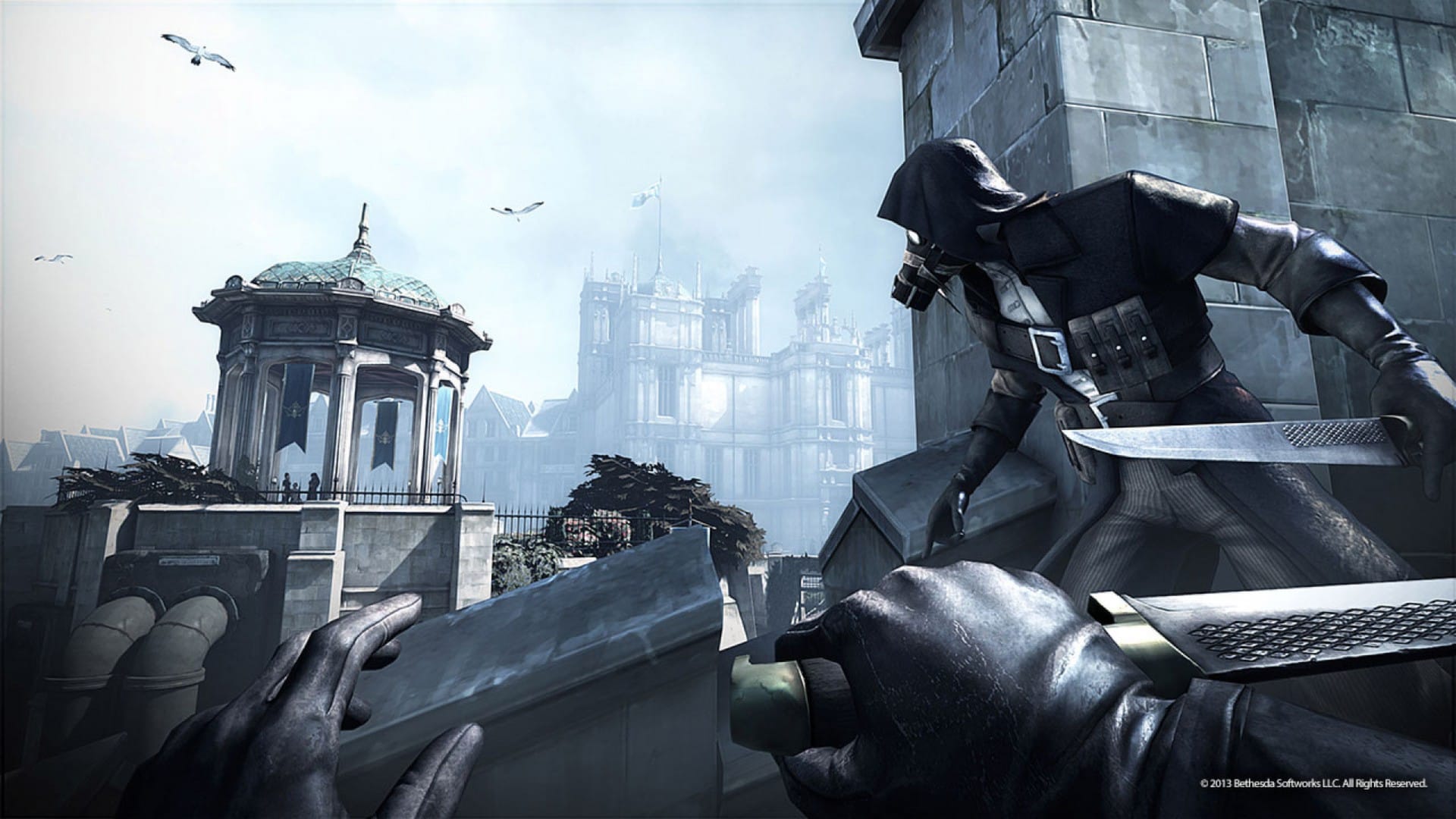
Unlike Corvo, Daud has something to atone for. In the past fifteen years, Daud has killed dozens, if not hundreds, of people for money, using the fantastical powers given to him by the Outsider to transform himself into a cut-above-the-average hitman for hire.
“You could float a whaling ship on the highborn blood I've spilled.”
Throughout all the killing, Daud has remained remorseless, unconcerned with the trail of corpses left in his path. Remorseless until the day comes when he kills the Empress. While Daud once could rationalize all the deaths he caused as people getting what they deserved, killing Empress Jessamine and kidnapping her daughter were acts he could not reconcile himself with. As the Outsider prophesied to Daud shortly after the assassination, “This time your actions will have consequences.”
Daud never had to experience the hardships the death of a businessman or mogul would cause, but this time, the Empress’s death leads to the ascension of a dangerous psychopath to the throne, who sends the city into a downward spiral of chaos.
“For six months, the city writhed and changed. For six months, I tried to forget what I’d done to the Empress and her little girl.”
That’s why it’s important to show the contrast between Empress Jessamine and Hiram Burrows. While the Empress shows charity and competence, Burrows’s mismanagement of matters leads to chaos in the city. This chaos only serves to aid in increasing the ever-swelling death count. If the Empress were still alive, none of this would have happened, or if it had, not on such a massive and disastrous scale. Daud is therefore directly responsible for the plague in Dunwall spinning out of control.
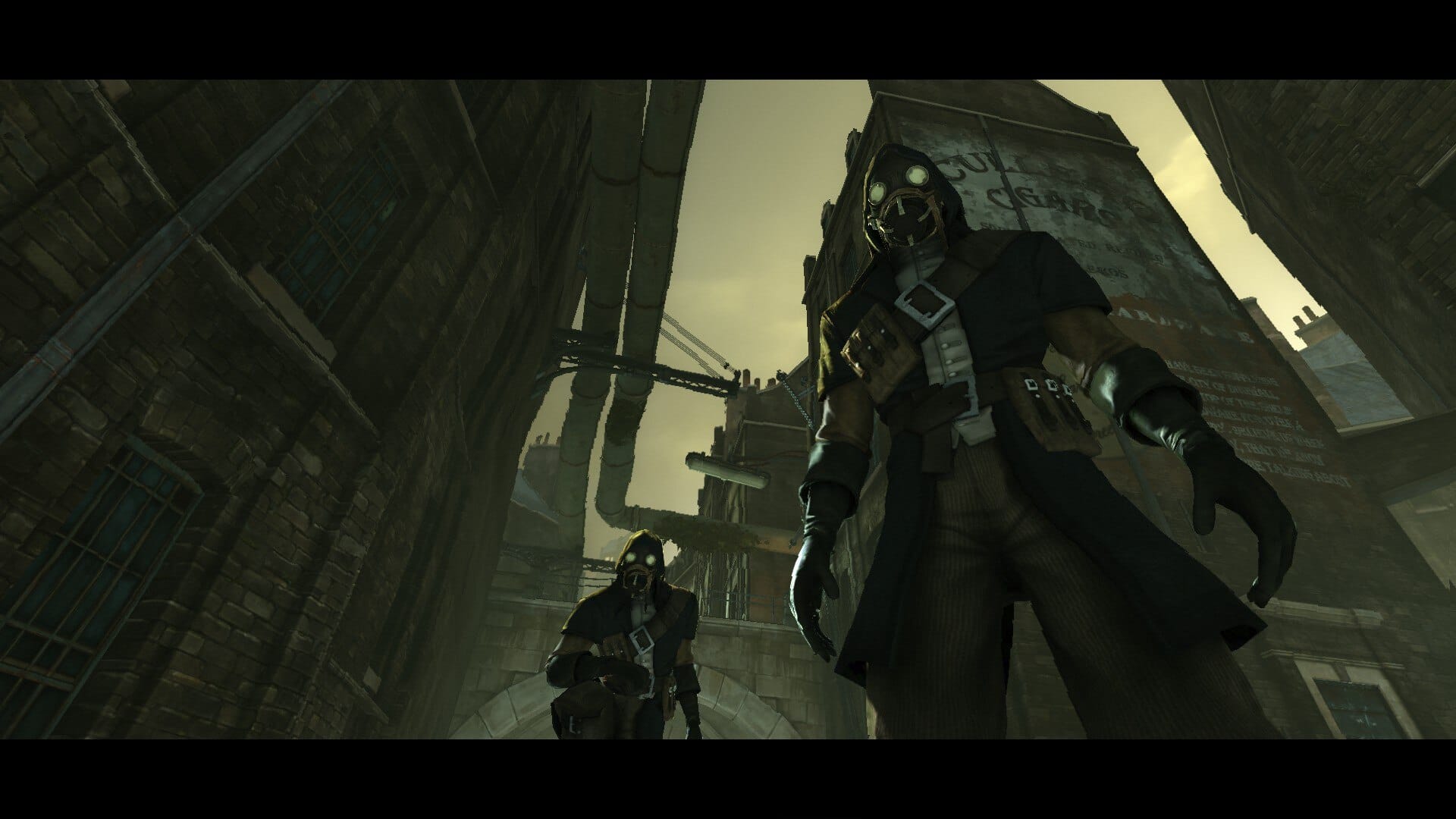
But, of all people, the trickster Outsider offers Daud redemption. The Outsider (in his typical unhelpful manner) gives Daud a name to investigate: Delilah. Daud’s quest to uncover the meaning of the name takes him all over the city, from the slums of the Rothwild whale oil slaughterhouse, to the opulent spires of the legal district, to the depths of the abandoned Flooded District.
Along the way, Daud encounters several targets whose deaths would be to his benefit. As with the base game, Daud has the option to kill these targets or pursue a more tedious way of incapacitating them. With the union-busting whale slaughterhouse owner Bundry Rothwild, Daud can kill him and blow up his slaughterhouse to get information from one of Rothwild’s enemies, killing dozens of innocent people. Alternatively, Daud can take Rothwild and torture him in his own torture chair designed to force workers to sign contracts, essentially stripping away all of their freedoms to get the information he is after. When finished, Daud can ship him off to one of the most distant parts of the Isles on one of his own ships.
Daud must do something similar later to get info from a woman who wants her uncle dead. The man Daud is after, Arnold Timsh, has a modus operandi of framing innocent people for being infected with the plague and then using this as a pretext to confiscate their properties. Daud could kill Timsh, or steal his legal protections and frame him for the plague outbreak in his home — a very satisfying role reversal.
Daud can continue to redeem himself by doing good deeds, such as helping negotiate a tenuous peace between two feuding criminal gangs — the Dead Eels and the Hatters; saving those who helped Corvo Attano escape prison from a death sentence; and revitalizing a formerly moribund district of the city by restoring water to a canal, one of the city’s vital lifelines. However, these good deeds do not equal redemption.
Daud shows a willingness to change, but this, by itself, is not how Daud redeems himself. Rather, Daud finds redemption by taking on Delilah, the leader of the eponymous Brigmore Witches. Growing up, Delilah was a companion of the now-deceased empress Jessamine Kaldwin; however, she became ostracized owing to her lowborn status. Her heart turned by jealousy, and gifted with powers by the Outsider, the same being who gave Corvo and Daud their powers, Delilah planned to use an elaborate magic ritual to hijack the body of Emily Kaldwin, Jessamine’s daughter, and rule the Empire as Emily.
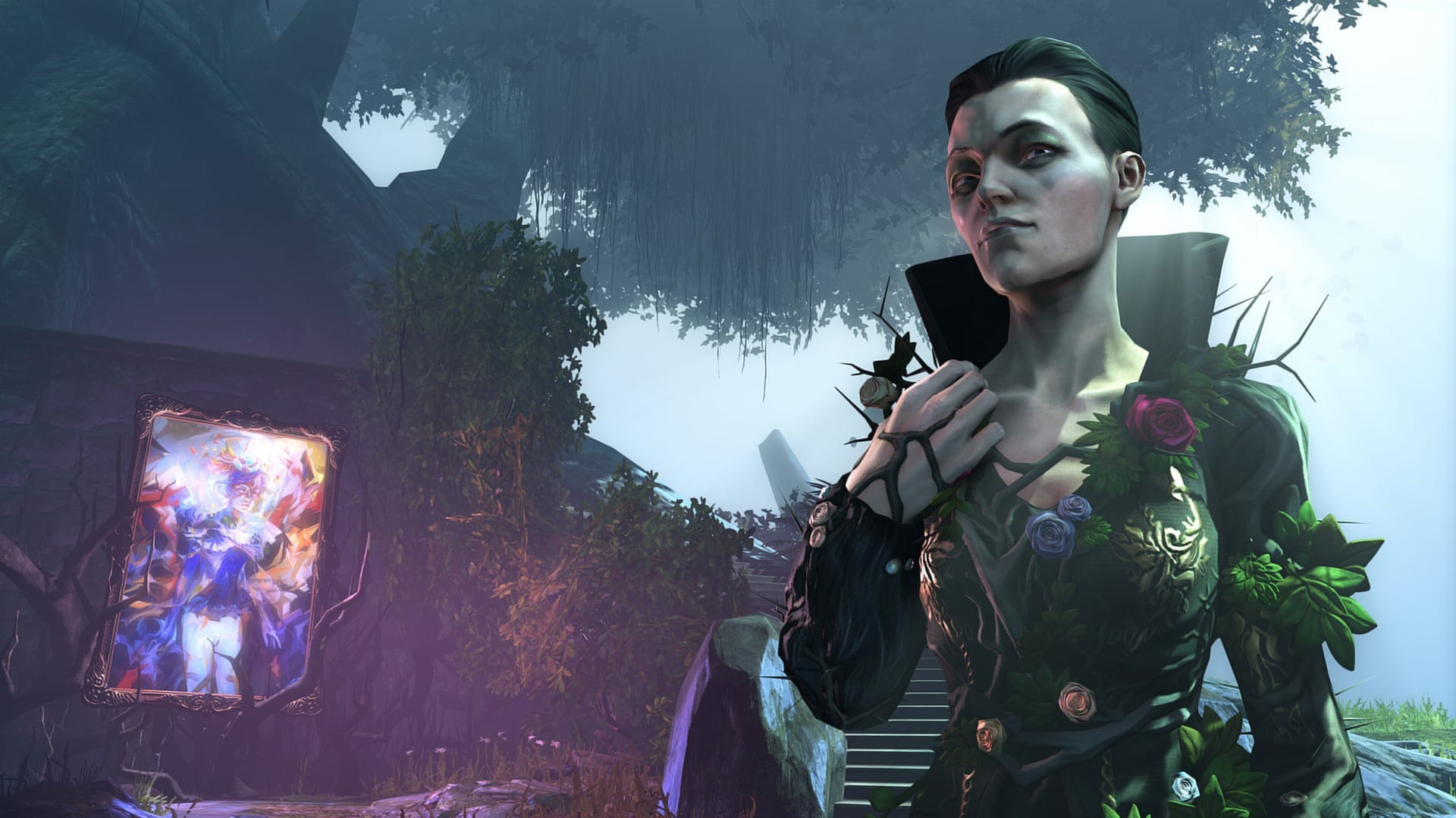
Delilah is Daud’s foil; they both get their powers from the Outsider, they both have a coven of loyal followers with similar fantastical powers, they both make their abodes in dilapidated former homes of the wealthy and powerful, and they both harmed or tried to harm members of the Kaldwin family. However, unlike Delilah, Daud realizes the hurt his actions can bring to others, and, in the final mission of The Brigmore Witches, infiltrates Delilah’s hideout in an abandoned mansion and thwarts her plans, either by killing her or by altering her ritual so that it traps her in another world, where she cannot harm Emily.
Daud does all this knowing the full extent of his actions will likely go unnoticed. Unlike Corvo, who, after saving the empire, has Emily and the Loyalists to tell his story and tell of his quest to save the empire, the people of the Empire are unaware of Daud’s actions. They do not know that Daud saved a little girl from a fate worse than death. Corvo is ignorant of Daud’s actions; Emily is ignorant of Daud’s actions — even Daud’s guild of assassins is ignorant of his quest to save Emily. As the Outsider says,
“You make an eloquent plea, for a man with innocent blood on his hands. It’s a shame Corvo doesn’t know the real story, isn’t it?... How you saved Emily Kaldwin, daughter of the Empress, first of her name, and no one will ever know. But how does it end for Daud the hired killer, the murderer, the savior of the Empire? It’s up to Corvo now.”
The end of Daud’s story lines up with Corvo’s confrontation with him in the Flooded District in the main game. If Daud has chosen to live a life of murder and destruction, causing High Chaos, Corvo slays him. But if Daud has lived a life of redemption - yes, of compassion - Corvo releases Daud.
Corvo spares Daud. Source: YouTube.
Saving a girl’s life does not atone for a life of bloodshed. Choosing not to kill wantonly is not a commendable effort. But after being spared by Corvo, Daud forswears the assassin’s life. He disbands his guild, pays his respects at the Empress’s tomb, and leaves for parts unknown to live a life of peace. It doesn’t make up for his previous life, but in saving the life of one Empress, Daud atones for taking the life of another Empress. In hanging up his blade and crossbow, Daud begins to change for the better. That’s really the lesson learned from Daud: people can change for the better if they are willing to sacrifice for it.
Dishonored is a bleak game, taking place in a bleak world. Plague, politics, religious persecution, and more resound throughout. It touches on irony, compassion, redemption, good, evil, charity, and so many other themes. However, the central message is one of the better angels of human nature. Some would have people believe humans are nasty, brutish creatures by nature. The Outsider espouses this. The Outsider sees people as predictable playthings. But Corvo and Daud have the power to show that this perception of humans is wrong. They have the power to surprise other people, and the power to surprise the Outsider. By showing a willingness not to discard human life, they perplex the Outsider.
To Corvo, he says:
“Now your choices interest me. You spared High Overseer Campbell, the leader of a great cult dedicated to loathing me. I'm older than the rocks this place is built on, and even I didn't see that coming.”
“And Daud - the man who killed the Empress. You had him in the palm of your hand, and you let him walk away? You fascinate me.”
And his assessment of Daud:
“You keep surprising me, Daud. Not long ago I watched you kill an Empress and steal her child for coin. For a man like that, you went through Coldridge Prison with an awfully soft touch.”
“In your long life I've rarely seen you act with such consummate grace. I give my mark sparingly, and I don't play favorites but I will watch this... with unusual attention.”
Corvo and Daud represent individuals who, despite facing hard times, made hard decisions and kept their humanity. They represent people who sacrifice and do good even when it is hard, despite being surrounded by people who do the easy and bad thing. And in doing so, they helped create a better world. That’s really what Dishonored is all about.